
Del.icio.us won over the more hard core early technology adopters in part because it looks and feels and acts like a database. It's fun to use if you appreciate the power of relational databases. However, the user interface by any traditional design standard is awkward at best.
Maybe the online world is teaching people not to be afraid of raw data and machine-like user interfaces. Del.icio.us in its current form could never have positioned itself as anything other than a platform product for resale a few years ago. Now it has about 200,000 users (I know I read this somewhere recently, but I forgot to tag it...anyone have the exact number?).
Will mainstream users be ready to adopt SQL query-like user interfaces next? They seem to understand relational databases intuitively now. When you show people sites like Chad's event-map mashup, they get it immediately. It's obvious that there are multiple databases connected via common data points. And, of course, it looks really slick.
Though specializing on one end of the spectrum or another will help differentiate in a crowded market, the real winners will be the products that are able to combine both forces effectively -- deep data utilities and clean user interfaces. There's no better example in that sense than Apple's iPod.
 Digg
Digg
 Comment
How the direct mail business can inform attention models
I didn't think much of it until I started actually reading the junk mail coming to my old home which we recently listed to sell. In the last 2 days we've had two different moving services and one personal storage company drop us a friendly postcard.
Now, this shouldn't seem strange. Junk mail is a part of having your name associated with an address. But maybe for the first time ever, I might actually call one of these companies. They hit me with the right information in the right place at the right time. Has the direct mail business gotten smarter?
I've written a few posts about flipping the online information discovery model upside down. I've been thinking that there ought to be smarter ways for information to find me rather than forcing me to find information. I'm the buyer in a glut of information sources, so it makes sense that I should control how information competes for my attention.
The problem with direct mail is that they know my address. They know how to get to me through the same channels I use for personal communications. I want companies with valuable services to give me offers on things that are relevant. I just don't want those offers coming via spam, dinner-time phone calls and tree-killing cardstock in the post.
I do, however, want to make my online behavior and the data I contribute available to information sources or information brokers in ways that help them learn about things that matter to me. This is what attention.xml is all about. It's about knowing that I just bought a new home and that I want cable. It's about knowing that I'm selling my old home and that I need to find a good deal on a mover in my area.
I'm not convinced that such a system would be spam-proof. But I think the nature of the RSS subscribe model may solve a lot of problems that make it possible for this concept to exist in some form or another.
What people are saying about the new 'Save' and 'Blog' buttons
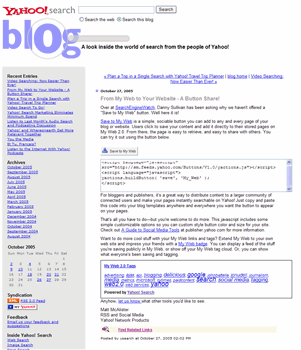
- Links to and tags for the Social Media Tools page:
- Y! SiteExplorer
- Pages saved with the "social media" tag in My Web
- del.icio.us
- Technorati
- Mentions:
- Marc Canter posted twice (1, 2)
- John Battelle
- WebProNews
- Pandia Search Engine News
- Richard MacManus
- php-scripts.com
- Marc Canter posted twice (1, 2)
- Comments on the YSearchBlog announcement
- Member signups and comments in the Yahoo! Social Media Tools Group
- Implementations:UPDATE:
- People want to see that the buttons serve their site visitors and whatever tool they use rather than just offer Yahoo!'s products
- The buttons should have more configuration options such as size...they are too fat by default
- The javascript should allow URLs to be passed directly to it so that a button can appear in multiple places on a single page
Really famous people should have blogs, too
1) The man appears to be much less the buffoon the media has painted him to be over the years. I wonder then why he hasn't jumped on the blogwagon to craft his own image for the public. The BlogOn conference in NYC covered a lot of ground in terms of PR strategies for products in the new world. I'm sure most of those concepts would also hold true for really really famous people...well, even not-so-famous people, I suppose.
2) The answer to #1 became obvious toward the end of the interview. "If you make everything over-efficient, you suck out, it seems to me, every last drop of what, up to now, has been known as culture. We are not the technology. It should be our - you know, our slave, the technology. But it's rapidly becoming our master in many areas." I think he envisions a Kubrick-like world where we willingly give up control of our environment to technologies and systems that ultimately fail us. That's a very gray line that different people draw at different points on a spectrum. I'm guessing that he draws the line somewhere before he's able to let his words get published directly from his keyboard to a public blog. For a man whose entire life has been encased in layer upon layer of deeply rooted systematic control, it's understandable that he would worry about what happens when those walls come down. But it might make problem #1 a lot easier to manage.
Who knew you might have interesting things to say? Where's your blog, Charlie?
San Francisco crime map mashup and bad timing
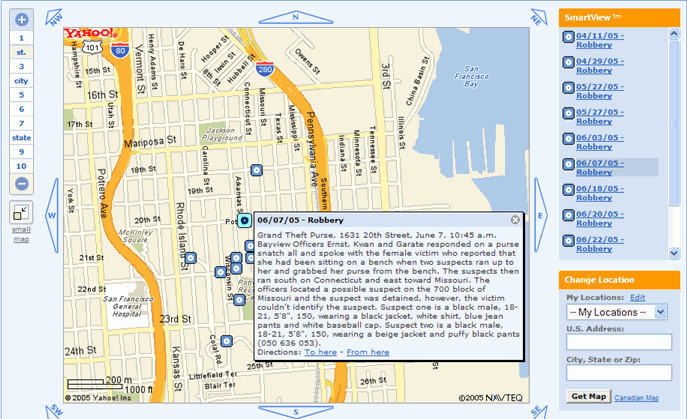
(via ProgrammableWeb.com)
Cross-cultural interface design challenges
The Asian code base for this product was built around certain assumptions about how a user feels about what he or she contributes to a pool of community data. In the translation they found some key differences in what motivates someone to participate online. The problem is not just about translating terminology in the user interface but also about interpreting interaction design models.
A US user expects different rewards for participation online than an Asian user does. A US user wants to be rewarded with reputation or some kind of ego stroke. An Asian user doesn't identify a reward with himself but rather the benefit to the community. He or she cares about how the group will benefit from his or her actions.
So, how do you translate the user interface from one that encourages a community to particpate on behalf of the community to one that encourages individual participation with personal rewards?
Wow, what a problem! And, sadly, what does that say about Western vs Eastern cultures?
Blogging for dollars
I was reminded of a conversation I had last summer with InfoWorld President Bob Ostrow who suggested that the only reason people blog is to get a job. In fact, I may have been interviewing at Yahoo! at the time, and it's plausible he knew something was up, inspiring that comment.
But it's not about landing a new gig. There are at least as many motivations for blogging as there are blogs out there. Showing what you think about can give prospective employers a nice way of understanding what value you bring (or don't bring) to the company. But blogging only because you want to be noticed is a sure way to get noticed for the wrong things by the wrong people.
David Weinberger on intellectual property
What about libraries? Are libraries pirates because they offer creative works to anyone who wants them? You don't hear Amazon or Simon & Schuster crying foul when someone checks out a book from the library rather than buying one. And it's getting even trickier with some of the mashups out there. Jon Udell invented a little tool that allows you to browse Amazon to find a book and then check your local library to see if the book is available right now.
In defense of Google Print, Eric Schmidt made the case for opening up access to books even further, "How many out-of-print and backlist [book] titles will find new and renewed sales life? How many future authors will make a living through their words solely because the Internet has made it so much easier for a scattered audience to find them?"
Fairness can be equitible. When someone creates something and someone else wants it, there are ways to make a fair trade. But that trade may not best occur through an elaborate system of property laws that "protect" the content. If the outcome of blogging tools means that more people are writing, then that's a good thing. If more people are writing and performing music because there are easy ways to post your works publicly, then that's a good thing. That trend won't reverse. It would be tragic if it did.
The question of how to make a living as an artist is a really good one. Just as journalists are learning that they have to improve their reporting skills because of bloggers, musicians will have to elevate their game and offer more value to rise above the crop. And just as news publishers are learning to offer additional value in what they publish in order to stem the tide of lost advertising opportunities from slippery distribution channels, musicians, novelists, photographers, and painters need to find better ways to add value to what they create.
Maybe people will pay more for access to artists, concerts, one-on-one conversations, commissioned works. Maybe brand marketers will pay more to sponsor events where people can get more personal access to artists. These are proven business models that require no property law. The big opportunity may be for distributors to turn their businesses from ones that create false scarcity and become businesses that personalize the art experience.
McDonald's on blogging
They've spent a lot of time, probably painful strings of meetings upon meetings and hirings and firings, sorting out how to approach the problem of speaking more directly with their community. Steve merely addressed how the company is learning to communicate with their own staff using blogs. I'm sure many would argue this is hardly blogging but rather using a new tool to publish press releases.
It's hard to congratulate them for what they've done (or for how little they've actually done), but just by watching how painful it was for Steve to talk publicly about this we all got a glimpse into a cultural battle that must be very frightening for everyone at the company. McDonald's has a lot to lose, not just scores of high paying corporate jobs but an historical position in the history of capitalism. They are treading the "open" waters very very cautiously.
I can't help but feel like these are exactly the types of organizations that will fall even harder when the next generation of consumers discover brands online first. At some point in the not too distant future, enough corporate PR will have opened up to the idea of transparency that the companies that craft messages will be assumed to be hiding things. At minimum, they should let their staff blog publicly under some kind of communications policy with a penalty of termination for breaking that policy.
Seth Godin's Blogon keynote on Squidoo
Seth then pitched his new Squidoo product, what appears to be an easily customizable SEO jump page. Users will create a "lens" or a very basic templated home page filled with links and context which will carry AdSense. The AdSense revenue then gets pooled among all the users and redistributed based on traffic performance. I'm sure Seth has put in a lot of effort to optimize these pages for search engines.
Seems like a weird model to me. I don't know why I would create a home page and then share revenue from that page with someone else. If it's about getting help creating a better home page, then I'm not going to want that restricted to someone else's template design.
I'm also a little irritated that the keynote was a sales pitch.
While Boomers were busy watching their retirement accounts...
One of the great disappointments of the Baby Boomers is that their Gen X children haven't taken the torch of rebellion to change the world as they once did. I was reminded of this as I listened to Chad Dickerson's latest weekly guest speaker here on Friday, Mark Hosler of Negativland, leader of a San Francisco area band/performance art group. (UPDATE: Chad details the event here, including more background on Negativland.)
Negativland battles convention with complex challenges to the structures that enforce those conventions. One example, they packaged a musical piece using an electronically altered cover of U2's "I Still Can't Find What I'm Looking For" mixed with an underground outtake of Kasey Casem cussing out a sound engineer. The work was the subject of a major lawsuit and then a book on the story which became the greater art work than the original piece itself. They challenged copyright law and the way the media laws cripple people's ability to speak freely and critically and to reuse art to create art.
In talking about the weight of the legal system Mark made an interesting comment about how media uses its power, "I'm a middle class, white, straight male from the Bay Area, and I was attacked in a very frightening way. I have a new understanding of oppression."
The Negativland team grew up Baby Boomer, but the messages they drive resound with the Gen X mentality profoundly. Authority in 1969 was the US President and the conservative politics that supported racism and war. Authority in the new century is the media business and the way it controls information flow to drive political agendas and horde wealth.
The challenges Baby Boomers made to the power structures of the day gave rise to the media business, an unofficial 4th branch of our political system. The media's new position in society was firmly established when it overthrew Nixon, a President who ignored the voice of the people and believed the President was above the law. His resignation was the successful outcome of several years of cultural reorganization. The methods for change of the day were folk songs and concerts, investigative reporting and broadcast TV, student protests and long hair. The very power they fought for and ultimately attained then formed its own tools for repressing threats to its stability. The clincher was when one of their own took over the top spot, former B-movie actor Ronald Reagan.
Gen X has been developing technology that enables a new system to counter the strength of Baby Boomer media law and revenue streams that keep it healthy. Today's tools of change are open source software and personal computers, blogs and the Internet, hiphop sampling and digital photography. Baby Boomers are fighting P2P culture with lawsuit bullets and paperwork water hoses.
Negativland's art reflects the trends Gen X has naturally adopted into its cultural paradigm. It occurred to me while Mark was speaking that the torch of rebellion was passed successfully via ethernet and the message board rather than the megaphone and the sit-in. Gen X was less inspired by John Lennon, Timothy Leary, Ken Kesey and Martin Luther King. Instead, they've adopted breakthrough efforts of people like Bob Metcalfe, Tim Berners-Lee, Larry Lessig and Russell Simmons, unwitting leaders of a revolution, as calling cards for a new world order. These pioneers enabled new leaders to drive today's cultural shifts such as Linus Torvalds, Shawn Fanning, Craig Newmark and De la Soul.
I can hear Baby Boomers dismissing the idea that there's a revolution happening at all. "Kids steal music because its easy and its fun. They found a loophole in the legal system that just needs a patch. We know what a revolution looks like, and this ain't no revolution."
I wonder how many Boomers really went to Woodstock to hear some good music, do some drugs and hang out with their friends because it was fun, and how many went because they were rebelling against authority. It doesn't matter, does it? It was a movement whether you were just having fun or participating with a purpose.
If information is power, then the power structures as we know them are being turned upside down as you read this. Traditional TV and music businesses, publishing businesses, PR and marketing businesses are all propped up by fading revenue models, and yet more information is flowing more freely across wider geographies than ever before, without the overly produced packaging and closed distribution channels that the Boomers carefully constructed to solidify their power position. Kasey Casem's recorded outrage and George Bush's recent on-camera "fuck you" make the Baby Boomer packaged media sheen feel more like a new type of Gilded Age, one with a thin layer of information control, a coating much thinner than Boomer's are comfortable admitting, if they're even aware it exists at all.
Baby Boomers mistakenly interpreted understatement for apathy while Gen Xer’s created a disruptive force right under their noses. Gen Xers quietly fought the power from their PCs in their bedrooms while Boomers were busy congratulating each other on TV for throwing a great party in the 60s and 70s. Of course, despite all this upheaval in the works, Gen X is no closer to ending discrimination, inequality, poverty and war than the Baby Boomers were. So none of this matters in the end, anyhow.
We'll know the circle is complete when Sergey Brin replaces Arnold Schwarzenegger in Sacramento on his way to leading the New Republicans to the White House.
The travel information problem
I was chatting about this with a project manager who just joined us here named Micael. He excitedly proclaimed he was having the same problem, but get this...when I asked him how he solved it, he said, "We went to a local travel agent."
Let me rephrase this astounding scenario...rather than go online to search for and find the best travel options, something the Web has been very successful at offering over the last several years, Micael found his offline travel information services more useful to him than the online services. In 2005, that seems preposterous to someone who spends as much time living online as I do.
There is so much information out there, so much valuable information, that the old models are starting to show weaknesses. Micael didn't want to spend all day finding the right information online. He wanted information to compete for his business. It shouldn't compete for his screen real estate through the old advertising methods. It should come to him in ways that he invites. His behavior should indicate what he needs, and he should be able to permit certain sources (whether directly or through degrees of separation in his social network) to send him information that he wants, when he wants it.
More specifically, Jessica should be able to watch a price ticker on her desktop that shows the going rate for flights from SFO to Heathrow. It should offer alternatives for adjusting what data she wants to see in the feed. It should pull data from sources that she finds credible. It should give her the best source for purchasing the ticket. And it should go away after she purchases her ticket.
The technology and data is all there. It's a matter of assembling the pieces.
A 4GB Nano vs a 30GB with video = $50 difference...?
This is the first time I can say I've wished a competitor would come in and swipe market share away from Apple. You can't play underdog anymore, Steve. It's time for a new computing startup to throw hammers at big screens.
Chad's doctor locator mashup
- Add a way for me to define my location by zip
- Get someone to help you pour in data from other providers
That's all it needs (and maybe a silly name like "drahoo.com" or "feelgoodfinder.com").
Yahoo! product launches
The new podcast site (and Yahoo! Music Engine plugin) is a really strong implementation for bringing podcasts to the rest of the world. We found in a research study done recently that very few people are actually consuming podcasts yet. So, it makes a lot of sense to build a set of tools that will help the general public discover, listen to and subscribe to the stuff that matters to them. Before this launch, it was really just too complicated to figure out how to get a podcast or even just identify one that might be interesting to you. You don't have to have an iPod to enjoy a podcast.
Similarly, RSS has a big adoption curve ahead of it still. The same research shows that about 27% of the US Internet population are consuming RSS feeds without being aware that RSS is the transport mechanism. Again, My Yahoo! is enabling that wider adoption of RSS by simplifying how people adopt it. It's conceivable that without the introduction of RSS into My Yahoo! that RSS consumption in general might have stayed below 5%.
Then today the search team launched Blog Search. But rather than offer a copycat solution, the team here thought about the right use case for an index of blog data. It makes much more sense integrating that index in relevant context than as purely a standalone search engine for blog content. Why would Average Joe want to search blogs? Average Joe has a lot to gain by discovering relevant blog posts, but he's not likely going to want to search against a big index of blog posts without context.
Stewart's view on fame and music
I really like this view whether its totally accurate or not. Centralized distribution may have given the world more stuff to listen to and more exposure to different kinds of art forms that could never have happened otherwise. The value of that influence on humanity is incalculable. But what I love about the Internet is this premise that everyone can participate in any way that they are able...and that their participation can be contributed to any family you define, anywhere in the world. The distribution model is no longer centralized and, once again, everyone can play in the band.
Is Warhol's '15 minutes of fame' still valid, or does the younger generation even care about fame? Perhaps Warhol's own response to the adoption of that quote is more accurate these days, "In fifteen minutes everybody will be famous."
The difference between Yahoo! and Google
We both demoed some forward-thinking work in the area of photos. Prabhkar Raghavan of Yahoo! showed a dynamic timeline of photo and tag bursts. Images and their respective tags scrolled across the screen as days incremented indicating bursts of activity from the community as they upload bits of their lives over time, providing an historical view of primary source information in a very interesting way. Google's Alan Eustice showed how they are now scanning faces in images to identify characteristics such as male or female. They then demonstrated how a face could become a search criteria which then pulls up results of other photos where this face also appears...amazing if not a little scary.
One company is building tools that reflect how people are expressing themselves. The other is building tools that will help find needles in haystacks. One is facilitating community development. The other is facilitating data retrieval.
Google Reader
Collaborative educational text books
Jeff Jarvis pointed out in Q&A that this is already starting to happen at WikiBooks which I had seen before but didn't really get until now. Check out this US History book which spends proportionately more time on pre-Columbus America than the text books I recall from my primary school days.
CNET blogger list
A giant web of product reviews
I see a very similar model for product reviews. Product reviews from site users could be generated at the web site of an independent publisher who covers a given product category (perhaps a local newspaper, perhaps a niche publication or trade journal). That user review data could be shared with other publishers by posting it all publicly. Other sites or tools would then leverage that data and use it to get their users to contribute to the wider pool. A federation of similar media properties would then be able to foster product research in a very robust way for their combined audiences.
Jon explains how the problem of different event data coming from different sources could be solved:
Similarly, users reviewing products at different web sites may have different names for the same products or different ideas of what constitutes a product. Publishers should be motivated to solve this problem. The benefits are very powerful -- Users are talking about products on your site. Advertisers are crawling over each other to talk to your audience. You're making loads and loads of dosh.
The obvious question of competition quickly follows. If NichePublisher X is better at driving user reviews into the pool than NichePublisher Y and NichePublisher Y is using all that content on their web site to drive additional page views, then NichePublisher Y is getting more value for less effort than NichePublisher X. And what about managing quality control?
It's an interesting problem. Maybe there's a link carried with the review to the site that facilitated each product review, thereby rewarding sites that are good at driving more data into the pool. Maybe certain licensing rights need to be applied to the content to curb malicious behavior.
Regardless, a system like this would clearly create some new winners and new losers, but I'm certain that after the shakeout, the new losers will be the ones that failed to drive reviews, proving that they were unable to serve the needs of their own site users. The new winners will be the ones who are first to market, first to identify how to serve their users, first to help marketers reach potential customers in ways that customers want to be reached.
User Review API
I've always thought it would be cool to build a massive Product Reviews Wiki, but the smartest way to do it would be if the content was developed in a distributed way rather than through a big centralized wiki. NichePublisher X would build a user reviews section of their site. NichePublisher Y would also have a user reviews section. If the user review data format was the same and there was a vehicle for channeling reviews between both sites, then they could leverage their respective users/contributors to make a better product reviews database for everyone involved. They could each present data in the most sensible way for their own users and even build their own ad revenue streams on their own pages. And both publishers would have a better offering for their users than what they could offer doing this separately.
This User Review API is definitely a step in the right direction in terms of enabling a global reviews platform of some sort. Here's the Yahoo! User Review output format:
<Title></Title>
<Reviewer></Reviewer>
<CreateTime></CreateTime>
<HelpfulRecommendations></HelpfulRecommendations>
<TotalRecommendations></TotalRecommendations>
<OverallRating></OverallRating>
<Pro></Pro>
<Con></Con>
<Posting></Posting>
</Review>
Tantek is proposing the review microformat standard should work something like this:
-
item
-
optional:type of item (business, Web page/site, product, event, person, place, file, text)
-
name/title of item being reviewed (string | hCard if business or person)
-
optional:URL (all additional information should be somewhere else, not in the review itself)
-
optional:image (URL)
-
-
-
reviewer (hCard|name|email|URL)
-
review publication/authoring date (ISO8601 datetime)
-
rating 1 to 5 (default max = 5, default min = 1)
-
optional:tags (keyword,rating)*
-
optional:comments (string)
Tags would definitely be an easy thing to add to the Yahoo! format. I would love to see some way to add User Review data back into the Yahoo! database, as well. There are obviously some authentication and quality control issues with that.
Anyhow, this is very cool. Well done, guys.
Upcoming and Yahoo!
test post using Writely
Hello World.
Web 2.0...maybe it just shouldn't be called that
Scott Gatz launches a professional blog
There is RSS to email
Hmm, not quite ready or primetime, but it's the right kind of solution (in concept) for a key problem in RSS adoption for the wider population.
A balanced view of tomorrow's Internet
"I insist we barter with the moon to sell the patients cohesive lyrical maps in exchange for a vision of the future."
Information should be able to search for me
Technorati, Feedster and Pubsub have all tried variations on
this theme with their RSS search tools, but the premise of their systems is
still based on indexing and search queries.
Technorati’s use of tags is useful, but, in fact, I shouldn’t even need
Technorati’s style of intermediation because those tags are already posted at
the point of content creation.
The intermediation that would make this work would be a system where RSS feeds from information sources, microformat data and explicit relationship data would be channeled directly from the information source to relevant consumers. It would be kind of like invitation-only spam.
Where is RSS to email?
I don't have a good answer for her.
I know there are a couple of RSS to Email tools out there, but I haven't found an online service that does this the right way, yet. Anyone know of a good solution?
You can obviously get RSS in GMail, but that view is pretty poor and my wife doesn't use GMail. NewsGator is fine for Outlook users but it is only a partial solution. Shouldn't there be a standard way to get RSS entries emailed to everyone to any email account?
Sometimes we forget to retrofit new ideas for the rest of the world. This seems like a real fast way to catch everyone up.