We're having some interesting internal debates here at Yahoo! about RSS
adoption. There's at least some agreement that mainstreaming RSS
subscriptions is about simplifying the signup user interface.
The research shows that "XML" doesn't have tangible value to people,
even amongst those who know what it means. If the orange XML
button were on NASDAQ, you could make a quick buck shorting it, I'm
sure.
We also know that verbs make much better calls to action than
nouns. So, what is the right verb for RSS feeds? Is it
"Subscribe"? How about "Add"? Or "Track"?
Tom Raftery thinks 'Subscribe' with a little tooltip next to it is the right way to present the experience.
Pete Freitag
came up with a nice UI in his SoloSub experiment, but it's definitely
missing a clear call-to-action for non-initiated users.
Of course,
Dave Winer, Jeremy Zawodny,
Dare Obasanjo,
Tim Bray
and several others, have had debates about what the behavior of that
button should be. Regardless of the browser behavior, we still
have a verb problem.
Yahoo! currently uses "Add Content" on My Yahoo!. And that seems
to have paid off pretty well, but it was designed for a dashboard
interface. In any other enviornment, "Subscribe" is
probably a better action word.
However any research will tell you that people find the word
"Subscribe" to be a loaded concept...it might have pay
implications...it might mean that I have to do something to get
something...it might mean I need to cancel something...it feels
permanent.
Perhaps more importantly, the word "Subscribe" may be a conflicting
term when you also have paid services that people subscribe to or email
newsletters promoted on the same page.
So, then you start thinking "Add Feeds" might make more sense, in
general. But where you are "Adding" these things becomes crucial
to that experience. And "Add" is being used in many different
contexts for other content types. It may work as the right action
in a very specific context, but it can't be applied the moment you
abstract the UI out of the local environment.
If I'm on a news site somewhere, and I see a button to "Add Feeds" I
have no idea where they are going and if I'll ever see them again after
I "Add" them. Does "Adding" a feed do the same thing as "Adding
an Event" to my calendar? Is it like "Adding" a friend in my
social network? Am I "Adding" two things together to make one
thing? There's no concept that I can have an ongoing relationship
with the content of the feed with the word "Add". And the word
will get even less meaningful over time as there are more things people
can add to more environments.
I would like to push for "Subscribe" and "Subscriptions", as it's a
more scaleable nomenclature and more accurate for the experience.
But I have trouble arguing that mainstream users are ready to
"Subscribe" to things as readily as they will "Add" things.
If we're ever going to solve the chiclet overload problem, we need to
come up with something that the 95% of the Internet audience who
doesn't yet grasp RSS can relate to without having to be trained.
Of course, there’s a lot to do in terms of improving the ways people consume RSS, too. But that’s a different debate.
Wednesday, November 16
November 16, 2005 06:36PM (EST)
0.2 Thumbs Up for The Office
Nov 16, 2005 by
Matt McAlisterproduct The Office ★★★★★Though I'm disappointed this show doesn't measure up to the original from Ricky Gervais, I find it to be easily one of the best programs on TV. It's a guaranteed laugh for me.
-----
I just wanted to test what would happen if I put a review in my feed that was tagged with the correct hReview microformat.
hReview Creator tool:
http://microformats.org/code/hreview/creator
November 16, 2005 12:33PM (EST)
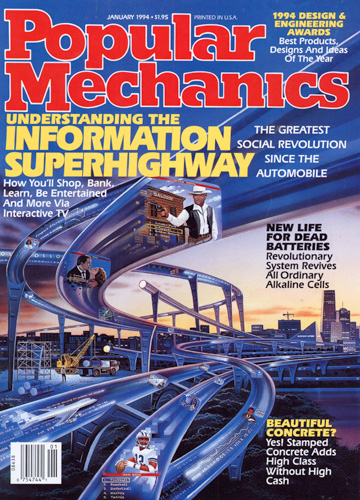
In 1994, I gave a presentation on Internet technologies to a group of Amdahl customers who were unsure of what this whole cyberspace thing was all about. I was working on a small R&D team there who were developing a WYSIWYG HTML editor and a customizable Cern server, among other things, none of which made it to market.
I was reminded of this yesterday while giving a presentation to a group of publishers at
Stanford's Publishing on the Web course run by Holly Brady and Janet Wright. Except this time I had a little more perspective than my view only a year out of university back at Amdahl.
They were there to learn smart strategies for operating their businesses. I was there to talk about RSS, Tagging, Social Networks and the pending threats and opportunities for publishers in the new world. (
PowerPoint 6.3MB)
I struggled a bit coming up with a thesis for my talk. I wanted to go through the implications of these new things on the content business, but it wasn't until I looked up "
Mashup" in Wikipedia that the message became clear to me.
Telling the Web 2.0 story is full of buzziness that only a VC can love. But when I positioned the talk around 'Mashups' I think I stumbled on a concept that people can lock on to.
I started with a definition of Mashup by talking about music, sampling and Hip Hop. Everyone understands that.
I then went through the trends I see affecting publishers in terms of their home page traffic (RSS readers and new browsers taking away attention), navigation (semantics and tagging becoming the new concepts for user interfaces) and then communities that are forming in different ways (social networks driving usage away from publishers).
I followed that by explaining how these pieces can contribute to a 'Mashup' using a few examples like the
Yahoo! Event mashup,
BBC's various traffic mashups and
Trulia.
Finally, I went through a few concepts for business models and then stepped through the various arguments against making your content more Mashup-friendly, posing some challenges to each.
The response seemed mixed, but based on some of the questions I got (
"Explain again how I make money with someone else using my content?" and "How can I track what's happening with my content out there?") and even some of the challenges (
"You're saying that I should encourage people to take my most valuable content and reuse it? No. I don't see it." and "Isn't a mashup copyright infringement?") the message of what a Mashup is got through.
From what I could tell, everyone in the room understood Web 2.0 despite the fact that I didn't once mention the term. Remember the idea of the "
Information Superhighway"? That was a very effective way of grasping the Internet in 1994. It seems the "Mashup" might be the smartest way to give today's Internet trends life for the non-technical.
Wednesday, November 9
November 9, 2005 12:17PM (EST)
I stayed with my little brother Mitch in Los Angeles last week while on a trip to the Yahoo! offices there. He invited me to join him on his podcast
Notes Underground, a weekly program talking about and playing alternative music. We had a brief discussion about the new economies of art distribution on the show, but, unfortunately, we weren't recording the next morning over breakfast while talking about music discovery.
He had some interesting ideas on how people discover new music. He's clearly an advanced music searcher, perhaps obsessed even, with several different methods for staying in tune with the market. Being an employee at MySpace gives him a lot of visibility into the underground scene. As a content creator, he has self-imposed deadlines for finding a few new tracks each week to play for his audience. Listeners to his show email him ideas for things to play. He goes to live shows. His friends are obsessed with music. He has a handful of labels that provide
jumping off points to new artists. He subscribes to some email newsletters. And he gets a CD delivered to him each month, a compilation of new music called the
Cornerstone Player.
I asked Mitch to estimate how much of his time is spent finding new music, including listening to things for the purpose of learning as opposed to simply enjoying music.
"I mean, that's a joke. It's maybe like several hours a day. I have momentary detours into something all the time, so I'm basically always doing it."
There's a certain gratification in finding an unheard of band. He said discovery can even be a competitive thing. A band is suddenly not as interesting when someone else finds it first or when someone less sophisticated in their music tastes mentions it.
Discovering new music is part of life for him. But it seems to me that there must be ways to help people who have a genuine interest in music to get closer to the discovery trail that Mitch is blazing without all the heavy lifting. I have a lower tolerance for a bad signal to noise ratio when it comes to music than he does.
Fortunately, I can listen to Mitch's podcast and get a glimpse into his world, but I don't like all the same music he likes. He can't be my only filter into the world of music. I want to stitch together a network of the obsessed in the genres along several different content axes that interest me and let them pull me along in their journeys.
I wonder then how this translates into other genres of content such as photos and world news and local events and shopping deals and Hollywood gossip. The obsessed are putting context around their worlds that the rest of us should have access to in sensible ways. They are uncovering new depths and adding value in their perpetual quests.
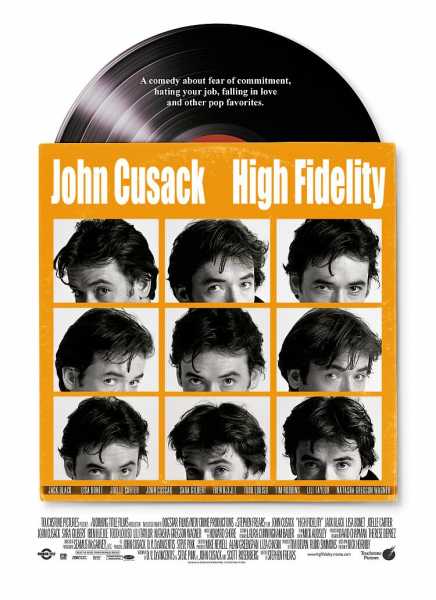
Nick Hornby might have characterized Rob Gordon in his book
High Fidelity a little more like Mitch had he written it in 2005, constantly online jumping from source to source to source on a neverending search. If you're like me, you may have heard of the Beta Band before that film, but it was just another source in a genre until the view through his obsessed world brought life to that track
Dry the Rain.
Show me the Top 5 music freaks in my Top 5 favorite genres. Then give me the Top 5 most-listened to tracks amongst their followers. Throw in X random tracks per 100. Flag the ones my friends like for context. Readjust monthly.
Now that would be a kick ass music station to listen to.
Tuesday, November 8
November 8, 2005 08:57PM (EST)
For all the progress being made toward reducing the sense of distance between geographically dispersed populations, there's an equal and opposite distance being created amongst people standing next to eachother. We can make two people who couldn't be physically further from each other feel like they are face-to-face. And yet two people sharing the same air space can coexist without ever speaking to eachother.
As I post this I'm wondering if the engineer who sits maybe 2 feet away from me will know that I'm blogging about her. We exchange pleasantries most days, but since we're not working on the same projects, we might as well be in different countries.
Email, IM, blogging, RSS and all the Internet-based forms of communication encourage a lightweight human interaction model that is replacing real world human interaction.
We can interact with more people, but we interact less with each person. Is this bad?
November 8, 2005 12:17PM (EST)
I can hear "I told you so" echo through the corridors of the print publication businesses this morning, coming from the dotcom groups tucked away in the far corners of their buildings. The print circulation numbers released by the
ABC which audits sales figures indicated
a 2.6% drop in circulation amongst US daily newspapers the last 6 months, a 16% drop for The San Francisco Chronicle.
Though many newspapers are claiming that they are removing wasted circulation from their file, that's actually code for cutting printing costs because they aren't making enough money to justify the number of issues being printed. You can also expect the industry to make claims about 'readership' as opposed to circulation which is a measure of the number of people who read a publication perhaps from pass-along from friends rather than a measure of one reader per printed copy. Again, this is a way to float larger audience numbers to advertisers to justify the cost of printed pages.
I won't proclaim the end of print as a medium. I enjoy skimming through The Chronicle every morning on the train very much. But if you can't see that the online space is where it's at by now, then you probably deserve to watch your print circulation business slip into oblivion. I've heard the excuse that the money isn't there yet. Well, you're on the edge of losing the revenue stream that could be used to figure out how to make enough money online to support the staff and infrastructure that keeps your business alive.
Dear Mr. Print Publsher - The next time an editor says she wants to pay a blogger to post on the site, I suggest you reply, "Yes, please. Shall we pay bloggers $2 per word? Let's put that blog on the home page. Would you like more engineers to work with? What is the minimum number of people we need to keep the print product alive? I want to move all the talent over to the online side of the business. Who wants the corner office where the Art Director used to sit?"
By the way, kudos to
Tom Abate and The Chronicle for printing this story on the front page of the Business section...in print. Bold.
Monday, November 7
November 7, 2005 12:54PM (EST)
I had a meeting with
Matthew Rothenberg Friday that evolved into a discussion about user interaction models, tagging tools and APIs. He made an interesting comment about the point where a technology product is defined either as a pure utility or an interface to a utility.
Del.icio.us won over the more hard core early technology adopters in part because it looks and feels and acts like a database. It's fun to use if you appreciate the power of relational databases. However, the user interface by any traditional design standard is awkward at best.
Maybe the online world is teaching people not to be afraid of raw data and machine-like user interfaces. Del.icio.us in its current form could never have positioned itself as anything other than a platform product for resale a few years ago. Now it has about 200,000 users (I know I read this somewhere recently, but I forgot to tag it...anyone have the exact number?).
Will mainstream users be ready to adopt SQL query-like user interfaces next? They seem to understand relational databases intuitively now. When you show people sites like
Chad's event-map mashup, they get it immediately. It's obvious that there are multiple databases connected via common data points. And, of course, it looks really slick.
Though specializing on one end of the spectrum or another will help differentiate in a crowded market, the real winners will be the products that are able to combine both forces effectively -- deep data utilities and clean user interfaces. There's no better example in that sense than Apple's iPod.
Tuesday, November 1
November 1, 2005 12:47PM (EST)
I opened the mailbox at our new home last weekend just checking to see what it looks like, I guess, certainly not expecting to find any mail. To my surprise there were two pieces of mail addressed to me, both junk mail. The first was from an insurance company, the second offering cable services. We closed escrow on the property Thursday and had junk mail coming by Saturday.
I didn't think much of it until I started actually reading the junk mail coming to my old home which we recently listed to sell. In the last 2 days we've had two different moving services and one personal storage company drop us a friendly postcard.
Now, this shouldn't seem strange. Junk mail is a part of having your name associated with an address. But maybe for the first time ever, I might actually call one of these companies. They hit me with the right information in the right place at the right time. Has the direct mail business gotten smarter?
I've written a few posts about flipping the online information discovery model
upside down. I've been thinking that there ought to be smarter ways for information to find me rather than
forcing me to find information.
I'm the buyer in a glut of information sources, so it makes sense that I should control how information competes for my attention.
The problem with direct mail is that they know my address. They know how to get to me through the same channels I use for personal communications. I want companies with valuable services to give me offers on things that are relevant. I just don't want those offers coming via spam, dinner-time phone calls and tree-killing cardstock in the post.
I do, however, want to make my online behavior and the data I contribute available to information sources or information brokers in ways that help them learn about things that matter to me. This is what
attention.xml is all about. It's about knowing that I just bought a new home and that I want cable. It's about knowing that I'm selling my old home and that I need to find a good deal on a mover in my area.
I'm not convinced that such a system would be spam-proof. But I think the nature of the RSS subscribe model may solve a lot of problems that make it possible for this concept to exist in some form or another.
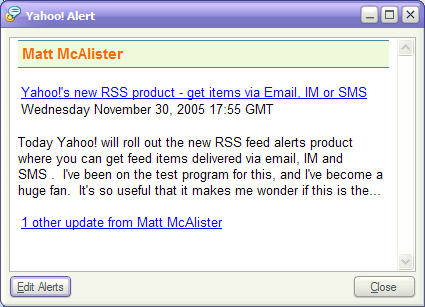 Today Yahoo! will roll out the new RSS feed alerts product where you can get feed items delivered via email, IM and SMS.
I've been on the test program for this, and I've become a huge
fan. It's so useful that it makes me wonder if this is the game
changer that makes RSS a viable mainstream consumption vehicle.
Today Yahoo! will roll out the new RSS feed alerts product where you can get feed items delivered via email, IM and SMS.
I've been on the test program for this, and I've become a huge
fan. It's so useful that it makes me wonder if this is the game
changer that makes RSS a viable mainstream consumption vehicle.  Digg
Digg Comment
 On your first day at Yahoo! they give you a backpack for your
laptop. It's a really nice backpack. Everything I need fits
nicely in it, and the pockets are in the right places, and it's sturdy,
and it's not ugly.
On your first day at Yahoo! they give you a backpack for your
laptop. It's a really nice backpack. Everything I need fits
nicely in it, and the pockets are in the right places, and it's sturdy,
and it's not ugly.