
Enjoy.
 Digg
Digg
 Comment
Friday, December 16
Switching back to del.icio.us from My Web
There are some really interesting aspects of the Yahoo! My Web tool, but none of them are compelling enough to keep me using the service as my primary bookmarking environment now that del.icio.us is part of the team here. I do hope, however, that del.icio.us can incorporate things like:
I almost thought I had done this transition prematurely when I started seeing the server problems this week, but I'm really pleased to be back in the del.icio.us pool.
Why? Well, there are several reasons, but they're sometimes subtle or hard to articulate:
I can't tell you how nice it is to have a meeting with the Yahoo! Search team now and discuss the world of possibilities rather than fret the competitive landscape. It's going to take a pretty impressive tool to get me to switch from del.icio.us now.
- private bookmarks. I was planning a trip not too long ago, and it was nice to save pages just for my own benefit. I think this has been addressed with del.icio.us using the "for:" tag, but the My Web privacy features are nicely done.
- integration with my community. I like looking at what my friends are saving in the My Web UI. This is easy enough to do using del.icio.us feeds in a reader, but the My Web UI has some nice views to my community's saved pages with just a few clicks.
- my results in search. This is the best feature of all. I find myself clicking on Yahoo!'s personalized search results more and more these days and less and less on organic results. I really like being able to search within the pages my community is saving as part of my default search engine UI.
I almost thought I had done this transition prematurely when I started seeing the server problems this week, but I'm really pleased to be back in the del.icio.us pool.
Why? Well, there are several reasons, but they're sometimes subtle or hard to articulate:
- One click tagging from the Firefox plugin
- Mixing my pages and tags in with a wider pool of very active taggers
- Related pages
- Open and easy-to-see namespaces
- Greasemonkey scripts galore
- RSS access to everything across all dimensions
I can't tell you how nice it is to have a meeting with the Yahoo! Search team now and discuss the world of possibilities rather than fret the competitive landscape. It's going to take a pretty impressive tool to get me to switch from del.icio.us now.
Where's the revenue model?
There are two kinds of online publishers in this world: those who depend on their advertisers for survival and those who depend on their readers.
I was speaking with a publisher of a big media company at the Syndicate Conference in San Francisco and sharing my excitement over the Open Content session with the Washingtonpost. His first question was, "Where's the revenue model?" I was surprised by the question...not because I didn't have an answer but because that was his first question. He didn't see that this was a good idea and threw out the time-tested dismissive challenge to new ideas, "That's fine, kid, but we've got mouths to feed here."
The concept that a publisher should do whatever possible to give his readers what they want is idealistic to him. The revenue model is what rationalizes his decisions, not the wants and needs of his readers.
Of course, you have no business if you don't have revenue. And there were a lot of companies that were rewarded for not jumping into the late '90's dotcom madness when they stepped out of their bombshelters in 2003 with all their parts still functioning...including their old revenue streams. It's understandable that someone leading a large business would think that an idea whose revenue model is unproven should be considered cautiously. Nobody wants to be the fall guy when this next bubble bursts.
But the economics don't add up for the old school revenue-ists. There are more and more people creating content and publishing it on the Internet every day. Groups of people are forming around issues and topics spontaneously. More and more tools are learning how to aggregate content and facilitate dialog amongst people. The supply of information and sources for it is far too great to satiate the demand. And even if the supply of really really good and highly relevant information is low in your little market, you command less and less ownership of your audience's attention.
Advertisers get this. They know they have to distribute their marketing dollars widely. They're aware that it makes more sense to spend more money for custom programs at niche sites that yield better leads, but they also know that they can always spend their money elsewhere to hit their targets.
So, the revenue-ists are stuck with web sites that have a revenue cap. You can't raise your rates, because your advertisers will go elsewhere and still achieve their goals. Your traffic is inching up a little each month, but you're spending more and more to acquire it. And that means your margins are falling.
Ugh. How do we get out of this death spiral? Call in the idealists!
The revenue models are all around you, and you'll kick yourself for not starting sooner when it begins working for you. What do the following models all have in common?
In nearly every meeting I've had at Yahoo!, the driving force behind every decision is the question, "What do users want?" People often disagree on the answer, but Yahoo! knows that you lose when users aren't satisfied. Somebody else will satisfy them, and they will leave.
It's not idealistic. It's just smart.
I was speaking with a publisher of a big media company at the Syndicate Conference in San Francisco and sharing my excitement over the Open Content session with the Washingtonpost. His first question was, "Where's the revenue model?" I was surprised by the question...not because I didn't have an answer but because that was his first question. He didn't see that this was a good idea and threw out the time-tested dismissive challenge to new ideas, "That's fine, kid, but we've got mouths to feed here."
The concept that a publisher should do whatever possible to give his readers what they want is idealistic to him. The revenue model is what rationalizes his decisions, not the wants and needs of his readers.
Of course, you have no business if you don't have revenue. And there were a lot of companies that were rewarded for not jumping into the late '90's dotcom madness when they stepped out of their bombshelters in 2003 with all their parts still functioning...including their old revenue streams. It's understandable that someone leading a large business would think that an idea whose revenue model is unproven should be considered cautiously. Nobody wants to be the fall guy when this next bubble bursts.
But the economics don't add up for the old school revenue-ists. There are more and more people creating content and publishing it on the Internet every day. Groups of people are forming around issues and topics spontaneously. More and more tools are learning how to aggregate content and facilitate dialog amongst people. The supply of information and sources for it is far too great to satiate the demand. And even if the supply of really really good and highly relevant information is low in your little market, you command less and less ownership of your audience's attention.
Advertisers get this. They know they have to distribute their marketing dollars widely. They're aware that it makes more sense to spend more money for custom programs at niche sites that yield better leads, but they also know that they can always spend their money elsewhere to hit their targets.
So, the revenue-ists are stuck with web sites that have a revenue cap. You can't raise your rates, because your advertisers will go elsewhere and still achieve their goals. Your traffic is inching up a little each month, but you're spending more and more to acquire it. And that means your margins are falling.
Ugh. How do we get out of this death spiral? Call in the idealists!
The revenue models are all around you, and you'll kick yourself for not starting sooner when it begins working for you. What do the following models all have in common?
- McDonald's Franchises
- Wintel (Windows and Intel)
- Google AdSense
In nearly every meeting I've had at Yahoo!, the driving force behind every decision is the question, "What do users want?" People often disagree on the answer, but Yahoo! knows that you lose when users aren't satisfied. Somebody else will satisfy them, and they will leave.
It's not idealistic. It's just smart.
Thursday, December 15
Washingtonpost.com jumps into open content in a big way
The open content models session at the Syndicate Conference
in San Francisco gave us a sneek peak into the future of online
publishing. Dave Panos of Pluck led a panel with Jim Brady of
Washingtonpost.com, Andrew Eisner formerly of PCWorld and Amy McDonough
of CNet.
Jim's team has done some of the most forward-thinking work in big media publishing out there both in terms of what they're delivering and how they're approaching the problems of openness. They have emulated BBC's Backstage effort, but BBC has the luxury of not worrying about revenue. Washingtonpost.com is the first major media outlet to employ the open content model more broadly.
Among the highlights:
Jim's team has done some of the most forward-thinking work in big media publishing out there both in terms of what they're delivering and how they're approaching the problems of openness. They have emulated BBC's Backstage effort, but BBC has the luxury of not worrying about revenue. Washingtonpost.com is the first major media outlet to employ the open content model more broadly.
Among the highlights:
They launched a web site called post/remix.
Here they have a blogger posting what they're doing and linking to
their resources. This will likelty serve as a gallery pointing to
mashup examples they find. You can get lots of different feeds
here, and I imaging they'll expose APIs here when they have them.
Washingtonpost.com provides voting records of your local Congressman via RSS. This is a direct hit to Congressional Quarterly's robust paid service and the CQ House ActionTracker. You could, for example, see which politicians are voting to renew the Patriot Act. (update: the link to this vote is down as of this post. update2: I had the wrong link. corrected now. thanks, Adrian.)
They're offering content licenses using something similar to the Creative Commons Noncommercial Share Alike license, though they should consider including attribution. Jim details the usage conditions:
Washingtonpost.com provides voting records of your local Congressman via RSS. This is a direct hit to Congressional Quarterly's robust paid service and the CQ House ActionTracker. You could, for example, see which politicians are voting to renew the Patriot Act. (update: the link to this vote is down as of this post. update2: I had the wrong link. corrected now. thanks, Adrian.)
They're offering content licenses using something similar to the Creative Commons Noncommercial Share Alike license, though they should consider including attribution. Jim details the usage conditions:
- Your efforts must be for personal, and not for commercial, use. You may not sell applications that use or incorporate washingtonpost.com content.
- You recognize that Washingtonpost.Newsweek Interactive retains all intellectual property rights in all washingtonpost.com content and you that acquire no such rights by participating in Post Remix.
- Washingtonpost.com may incorporate your ideas into future projects it develops.
- Customer acquisition. Distributing links to your stuff is going to yield new customers who might not otherwise know you exist.
- Retention. If you are the dominant source for a particular type of content, then people will come to you when they need that content or similar content.
- Branding. Your brand gets distributed with your links. And the mashups may leverage your brand to validate the tools they create using your content. Again, your brand becomes associated with the utility of the content.
- Partner Loyalty. Or perhaps it's more
like partner lock-in. Once a partner figures out how to do
something successful with your content, the switching cost to another
similar content provider will likely be too high.
- Cost Savings. Washingtonpost.com doesn't hide the fact that they intend to use some of the ideas the evolve from the mashup partners. They get free product development this way.
- Distributed Ad Revenue. Washingtonpost.com does not allow anyone to make money from using their content, but they could. If there was a partner doing something smart that they liked, they could run advertising on that site together and share the revenue. This is how you break out of the online revenue cap problem that many online publishers are facing.
Wednesday, December 14
Scott Gatz Keynote: All the ways Yahoo! is using RSS
Scott Gatz gave the lunch keynote today at Syndicate
in San Francisco. He went through Yahoo!'s range of products that
are leveraging RSS in one way or another, positioning the company's
activites as serving users whatever content they want, where and when
they want it, however they want.
He demo'd the new Yahoo! Mail app, the RSS Alerts service, the integration of MediaRSS on My Yahoo!, the new podcast subscription manager, YPN ads in RSS feeds, etc. Seeing the whole set of offerings strung together like that makes quite an impression.
When I interviewed with Yahoo! back in July, I was told over and over again that the company had gone through the pain of embracing openness and that the products would tell the story. I believed these people were being truthful, but it was hard to imagine how this was actually going to play out. Seeing the powerpoint suddenly makes that feel very real.
Niall Kennedy asked a question about publisher services and how Yahoo! plans to share with content creators what data we're able to see happening around all these products. There are several ways the company is exposing that data, but we could clearly do more here. Enabling content creators to leverage Yahoo! as a distribution channel is one thing, but supporting their needs to make a business out of doing that is something totally different. It's a good question, and I would love to see Yahoo! really focus on this.
Kevin Burton asked about public APIs. Scott pointed him to developer.yahoo.net where the current APIs are posted and some community efforts to help facilitate more activity. He said, Yahoo! is still testing some concepts, and the company knows that this is incredibly important. And Scott said we can expect to see a lot more in that area.
He demo'd the new Yahoo! Mail app, the RSS Alerts service, the integration of MediaRSS on My Yahoo!, the new podcast subscription manager, YPN ads in RSS feeds, etc. Seeing the whole set of offerings strung together like that makes quite an impression.
When I interviewed with Yahoo! back in July, I was told over and over again that the company had gone through the pain of embracing openness and that the products would tell the story. I believed these people were being truthful, but it was hard to imagine how this was actually going to play out. Seeing the powerpoint suddenly makes that feel very real.
Niall Kennedy asked a question about publisher services and how Yahoo! plans to share with content creators what data we're able to see happening around all these products. There are several ways the company is exposing that data, but we could clearly do more here. Enabling content creators to leverage Yahoo! as a distribution channel is one thing, but supporting their needs to make a business out of doing that is something totally different. It's a good question, and I would love to see Yahoo! really focus on this.
Kevin Burton asked about public APIs. Scott pointed him to developer.yahoo.net where the current APIs are posted and some community efforts to help facilitate more activity. He said, Yahoo! is still testing some concepts, and the company knows that this is incredibly important. And Scott said we can expect to see a lot more in that area.
Monday, December 12
How to drive your company faster
Now is the time of year for lists. We're starting to see
predictions for 2006, 'Best of' lists from 2005 and Top 10 this and
that. So, here's my first list of the month.
One issue that I think a lot of people in the Internet business struggle with is speed. How do you build a system that supports increasing pressure to drive fast? The answer is the subject of many books by many researchers and analysts, but these are a few obvious ones that are sometimes easy to forget.
Top 5 Things Needed by Fast Company Leaders:
One issue that I think a lot of people in the Internet business struggle with is speed. How do you build a system that supports increasing pressure to drive fast? The answer is the subject of many books by many researchers and analysts, but these are a few obvious ones that are sometimes easy to forget.
Top 5 Things Needed by Fast Company Leaders:
- BHAG - Define a single, clear, and really big goal for your staff that keeps them focused on something really hard but also something possible to achieve. This is otherwise known as the Big Hairy Audacious Goal.
- Fear - Make your staff fear the outside world, not the inside world. It shouldn't be the threat of internal political punishment that inspires your staff to be competitive. The market is your battlefield
- Evolution
- Analyze performance in parallel with releases and iterate
quickly. A product that hasn't changed in 6 months is in a
dangerous position. Iterate constantly.
- Distance - Train people to make big decisions by giving them power over the little ones, even if you know they're wrong.
- Momentum - Identify momentum and fuel it. Steer it, but never stop it. If you don't have it, do something small to kick-start it.
Friday, December 9
Yahoo! acquires del.icio.us
I needed some good news this week, and here it is. Welcome Joshua!
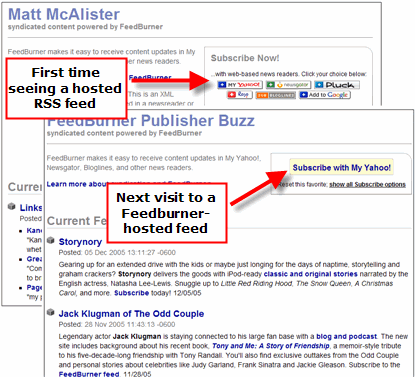 I see today that Feedburner is offering a new way to enable users to quickly and easily subscribe to RSS feeds.
When you click on a link to a feed hosted by Feedburner, the page now
shows several options for which feed reading environment you
want. The interesting new element is that they are saving this
preference for users, which means that next time I click on another
feed hosted by FeedBurner I will automatically see a link to subscribe
via my chosen reader. This action is also enabled for podcasts.
I see today that Feedburner is offering a new way to enable users to quickly and easily subscribe to RSS feeds.
When you click on a link to a feed hosted by Feedburner, the page now
shows several options for which feed reading environment you
want. The interesting new element is that they are saving this
preference for users, which means that next time I click on another
feed hosted by FeedBurner I will automatically see a link to subscribe
via my chosen reader. This action is also enabled for podcasts.
Feedburner continues to impress me with their innovations. The chiclet overload problem is not over yet, but the solution is working its way out with these kinds of UI improvements. There is obviously a race to provide publishers with the best solutions for distributing their RSS feeds. Focusing on making RSS invisible to users is the right direction, no doubt.
Speed to market is a winning strategy, too. In today's online game, staying competitive or jump-starting a market is about iterating ideas rather than producing robust, deeply engineered and fully tested solutions. Greg Linden questioned whether mashups were about giving big companies a way to outsource R&D for free.
While that may be partially true, have no doubt that the ambitions of many developers and small companies out there who are innovating quickly is to come up with a product or business model that becomes a big hit.
Feedburner isn't worried about being first to market and having their ideas stolen. They're trying to win.
 John Battelle drove his book reading tour
through the Yahoo! campus today and spoke to a standing room only
crowd. I was intrigued that the questions from the crowd didn't
concern Google but rather his perspectives on issues of privacy,
marketing and the philosophical importance of search.
John Battelle drove his book reading tour
through the Yahoo! campus today and spoke to a standing room only
crowd. I was intrigued that the questions from the crowd didn't
concern Google but rather his perspectives on issues of privacy,
marketing and the philosophical importance of search.
He gave some interesting answers including one thought in particular about the search user interface that I also enjoyed from his book. He talks about search as the logical next step in computer interface design from the operating system GUI. "The OS GUI is about poking things. You poke at the objects on the screen. Search is a way of navigating computer data using language, the way we communicate with each other."
When you put it in that perspective you start to think about what might come next. I'm guessing that people will want to assemple knowledge and data and other digital things into their own personal environments. I can't exactly see it in my mind, but if we went from poking things on our computer to talking at our computers, then I'm betting people will feel comfortable taking apart data and putting it back together to build things either on their own or with groups of people pretty soon. We're building our online homes out there, progressing from lean-to's to huts to structured houses which will certainly be followed by mansions, condos and Trump Towers, no doubt.
Wednesday, December 7
Feedburner's new method for managing the RSS subscribe button problem
I see today that Feedburner is offering a new way to enable users to quickly and easily subscribe to RSS feeds.
When you click on a link to a feed hosted by Feedburner, the page now
shows several options for which feed reading environment you
want. The interesting new element is that they are saving this
preference for users, which means that next time I click on another
feed hosted by FeedBurner I will automatically see a link to subscribe
via my chosen reader. This action is also enabled for podcasts.Feedburner continues to impress me with their innovations. The chiclet overload problem is not over yet, but the solution is working its way out with these kinds of UI improvements. There is obviously a race to provide publishers with the best solutions for distributing their RSS feeds. Focusing on making RSS invisible to users is the right direction, no doubt.
Speed to market is a winning strategy, too. In today's online game, staying competitive or jump-starting a market is about iterating ideas rather than producing robust, deeply engineered and fully tested solutions. Greg Linden questioned whether mashups were about giving big companies a way to outsource R&D for free.
"They offer the APIs so people can build clever toys, the best of which
the company will grab -- thank you very much -- and develop further on
their own."
While that may be partially true, have no doubt that the ambitions of many developers and small companies out there who are innovating quickly is to come up with a product or business model that becomes a big hit.
Feedburner isn't worried about being first to market and having their ideas stolen. They're trying to win.
Friday, December 2
John Battelle speaks at Yahoo!
John Battelle drove his book reading tour
through the Yahoo! campus today and spoke to a standing room only
crowd. I was intrigued that the questions from the crowd didn't
concern Google but rather his perspectives on issues of privacy,
marketing and the philosophical importance of search. He gave some interesting answers including one thought in particular about the search user interface that I also enjoyed from his book. He talks about search as the logical next step in computer interface design from the operating system GUI. "The OS GUI is about poking things. You poke at the objects on the screen. Search is a way of navigating computer data using language, the way we communicate with each other."
When you put it in that perspective you start to think about what might come next. I'm guessing that people will want to assemple knowledge and data and other digital things into their own personal environments. I can't exactly see it in my mind, but if we went from poking things on our computer to talking at our computers, then I'm betting people will feel comfortable taking apart data and putting it back together to build things either on their own or with groups of people pretty soon. We're building our online homes out there, progressing from lean-to's to huts to structured houses which will certainly be followed by mansions, condos and Trump Towers, no doubt.
Thursday, December 1
Web 2.0 matters across industries and markets...not just on the Internet
The premise of The Industry Standard when it launched in 1998 was that
the Internet would enable profound changes across all aspects of
business across all market sectors.
Yesterday Jon Udell wrote a blog post about 2 industries that have yet to dive into the new Web 2.0 world. These are just a small sample of all the businesses that don't know a revolution is upon them, and, once again, technology is about to enable profound change to everything everywhere.
Jon talks about a vision for the airline industry which could transform by a peer-based booking process. It could allow people to hop from local airport to local airport in a sort of air taxi system. Similarly, he noted that the energy sector could apply some of the on-demand efficiencies we've come to depend on for many other systems in the technology space.
Just as in it was in 1998, the media and communications industries were early to figure out how to capitalize on the new technology, and the excitement probably sounded like echo chamber noise until companies like Schwabb and Wal-Mart jumped into the game threatening the pure plays.
Could it be true that we're about to watch another explosion of businesses that figure out how to leverage the new technology platform? How will Virgin Airlines and Nike utilize peer-to-peer concepts, user-generated content and participation models, syndicated and distributed revenue streams, and data mashups?
Or will some new pure plays come in and challenge the now old school business models to become the new Amazons, easyJets and Yahoo!'s?
If history can teach us about the future, both cases will be true.
Yesterday Jon Udell wrote a blog post about 2 industries that have yet to dive into the new Web 2.0 world. These are just a small sample of all the businesses that don't know a revolution is upon them, and, once again, technology is about to enable profound change to everything everywhere.
Jon talks about a vision for the airline industry which could transform by a peer-based booking process. It could allow people to hop from local airport to local airport in a sort of air taxi system. Similarly, he noted that the energy sector could apply some of the on-demand efficiencies we've come to depend on for many other systems in the technology space.
"The June 2005 issue of Esther Dyson's Release 1.0 mentions two companies working to make these visions real: GridPoint and DayJet. "
Just as in it was in 1998, the media and communications industries were early to figure out how to capitalize on the new technology, and the excitement probably sounded like echo chamber noise until companies like Schwabb and Wal-Mart jumped into the game threatening the pure plays.
Could it be true that we're about to watch another explosion of businesses that figure out how to leverage the new technology platform? How will Virgin Airlines and Nike utilize peer-to-peer concepts, user-generated content and participation models, syndicated and distributed revenue streams, and data mashups?
Or will some new pure plays come in and challenge the now old school business models to become the new Amazons, easyJets and Yahoo!'s?
If history can teach us about the future, both cases will be true.