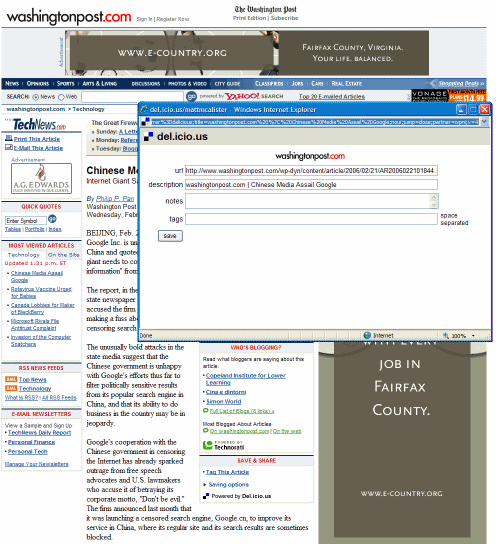
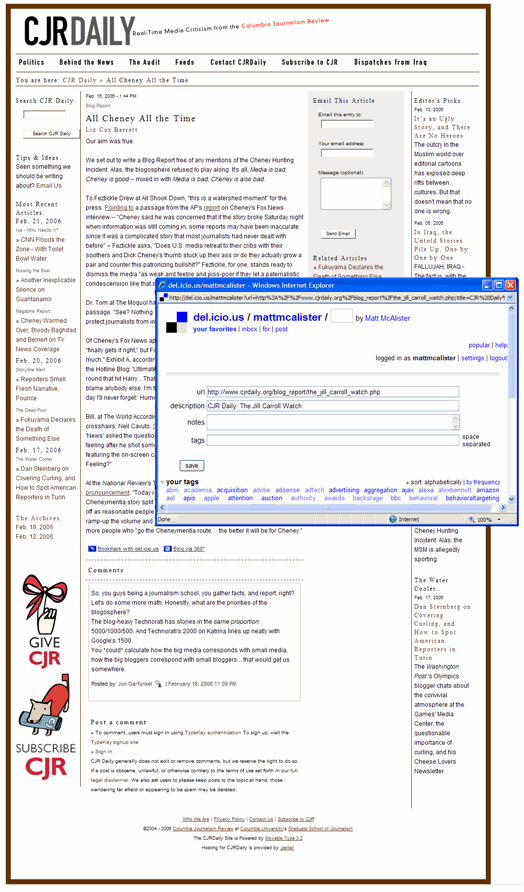
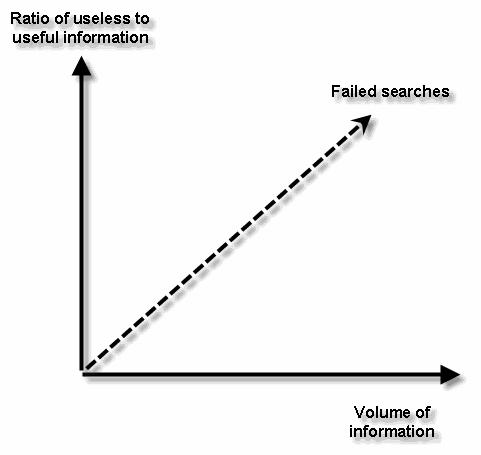
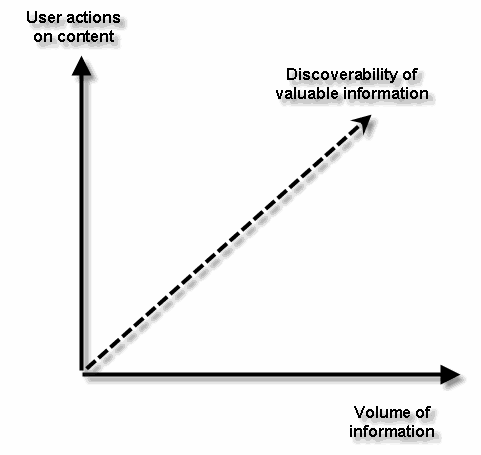
These are obvious to those of us watching the evolution of RSS every day, but I think there are some other important issues that must be addressed somehow:
Friday, February 3
February 3, 2006 01:02PM (EST)
I really like
Thomas Vander Wal's "Come to me Web" post where he contrasts that with the "I go get Web". He talks about web design being about usability, not information reading.
"Many of us as designers and developers have embraced "user-centered" or "user experience" design as part of our practice. These mantras place the focus on the people using our tools and information as we have moved to making what we produce "usable". The "use" in "usable" goes beyond the person just reading the information and to meeting peoples desires and needs for reusing information."
We're seeing the online user experience evolve into a more complicated space that's less about request/receive behavior to one that streams and flows based on triggers and loose couplings. I also like the idea of
information searching for me which I was exploring in a few posts last fall:
"We are telling the
creators of information that we want filters, we want flow control, and we want
those controls in our own hands. It’s
the era of syndication and subscriptions.
I’ll tell you what information I want, and then you come find me with
the right data in the right place at the right time."
Umair Haque's Media Economics presentation (
ppt) from April 2005 makes some fascinating statements about the mix of forces in the media ecology and where it is going in a Media 2.0 world. A bunch of people have been referencing it recently which you can
track at Technorati if you don't want to read it yourself.
It starts with an analysis of Media 1.0 economics and how supply meets demand. And then he shows where this model breaks down and finally how to take advantage of the new market.
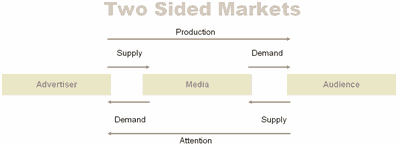
There's a lot in here, much of which I can't get my head around yet, but one piece I like is the supposition that production costs don't efficiently capture attention at certain levels...at big media levels. In other words, expensive high quality content does not pay off. It's more efficient to spend money on ways to capture attention directly than it is to use high production value content as the bait.
"Blockbuster strategies emerge due to the natural economics of mass media: production is costlier than attention, so the dominant strategy is to invest in attention (marketing cost wars), and economize on production (quality erosion). The result is a smaller and smaller number of concentrated players, who are forced to invest more and more heavily in marketing as attention becomes scarcer."
This isn't true on smaller scales where media microchunks are both produced and disseminated cheaply. He explains that the fixed economies of mass media get hijacked by consumers who are able and willing to consume lots of content through convenient channels at low cost. The consequence is that production values stay low and quality gets fragmented and harder to find.
"Value shift: in a Media 2.0 world, producers realize production economies of scale and scope in production, and marketing diseconomies of scale and scope. Attention becomes more expensive than production, because technology vaporizes production (distribution, and retail) costs, exploding media supply (relative to a mass media world, where media supply is fixed), which creates intense rivalry for attention."
Mass media really feels the heat when micro media takes away the ability to franchise content. Soundtrack sales, video rental, syndication and other tie-ins enabled high production cost economics to scale. Micro media erodes those revenue streams and kills production-driven models.
But there's still hope.
He defines the effect of Media 2.0 on Media 1.0 as "hyperdeflation". Effective margins can't be found in average content (a boring article, a crappy film, a stupid song). But by leveraging the strengths of the new systems, margins can come back.
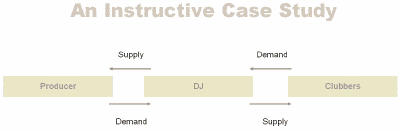
He goes on about Snowball Economics and defining how the 3 key types of players (Smart Aggregators, Microplatforms and Reconstructors) are going to serve the market most efficiently. But I loved this abstract description of the interplay between Media 2.0 and its consumers...
- DJ plays a selection of tracks
- Audience reveals preferences, expectations, and satisfaction with their feet: private info is made public
- Consumption externality: your dancing reduces my search and transaction costs
- Tracks which maximize aggregate utility are efficiently revealed, and value creation is maximized...
- ...across multiple niches/different genres of club music
- Music listeners are a connected network ... DJs realized it, the music industry didn’t...
- ...Now, dance music is the fastest growing segment of the music industry and the segment which most regularly produces snowballs
This presentation is a must read for people in Media 1.0, but it also puts some really powerful perspective on what those in Media 2.0 are doing whether they know it or not.
Thursday, February 2
February 2, 2006 01:00PM (EST)
Though the issue at hand is very serious and the implications of this
have far reaching consequences, I find the timing of the Old Media attacks on Google to be very convenient for another battle taking place.
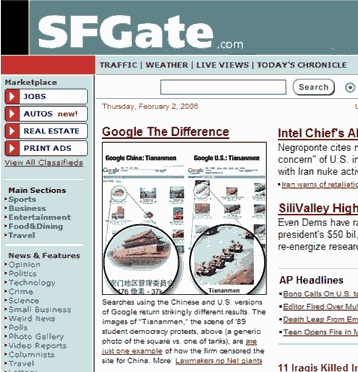
We're watching the media go to battle with it's future self. Editors who use their deep analytical processing capabilities and expensive liberal arts educations are lashing out at the man-made machines built by their antisocial computer science adversaries.
They couldn't win the battle on cost. They couldn't win the battle on efficiency. They've even been losing the battle on relevance. But now they found a place where the editorial voice cannot be replaced...ethics. But to be sure it wasn't the machines who made the decision to cooperate with Chinese policy. It was the stockholders and two young billionaires who might be getting in over their heads.
Michael Malone articulates the big picture challenge for expanding Silicon Valley companies nicely:
"Small, fast-moving companies typically don't have to worry about the
larger cultural and geopolitical impact of their decisions, and when
they do, they can actually incorporate ethical analysis into the
process. Large corporations rarely do this, partly because the new
product or business decision-making is pushed down through the
organization and is rarely touched by senior management, and partly
because the goal stops being that of changing the world and becomes
that of hitting revenue targets."
The threat to media is not the machines. The threat to media is money. The current economic models of Old Media are not going to survive.
Now that
Google is starting to look a little more like one of them, it's a lot easier to know where to aim the gun. But I would spend more time looking at how to recapture the trust, imagination, creativity, curiosity and thirst for human connection that people want. The money will come back. And then editors can wrestle with their own bosses over how to handle increasing demands from stockholders to show growth while huge opportunities in places that don't respect the same cultural priorities beckon them with cash rewards.
Wednesday, February 1
February 1, 2006 03:25PM (EST)
There was a really funny exchange between
Ricky Gervais and his idiot sidekick
Karl Pilkington on his podcast the other day. They started talking about Chinese proverbs and quickly devolved the conversation into Noah's poor decision to let similar animals onto the Ark.
This is paraphrasing, but you get the idea...
Ricky: "One of my favorites is, 'A camel is a horse designed by committee.'"
Stephen: "Carl's already wondering who's on that committee."
Karl: "I was just thinking why would you request the hump bit, cause that's just gonna get in the way, innit?"
Ricky: "Ok, Karl. I'll give you an animal, and you tell me where it has gone wrong. The Octopus."
Karl: "It should have some bones. I never understood why it would like to get in a jar anyway."
Ricky: "A Giraffe."
Karl: "Noah should have seen some of the animals coming in and said, 'Hold on. Just saw one like you.' and then throw it out."
Not sure if I captured the humor there, but, regardless, I like the premise of the initial statement.
Design-by-committee is bound to produce suboptimal results. I think the Internet business is very good at rolling out visionary products invented by passionate people. But how do you institutionalize that drive as the company evolves? How do you formulate a process for initiating vision and committing to its delivery?
I can point to a few Yahoo! products that suffer from camel-ness, but out of respect to my colleagues, I'll pick on other people instead. Here are some of the industry's worst design-by-committee products (mind you that doesn't preclude success):
- Google Video Search and Google Reader
- The new IE browser and Live.com
- Amazon's left-hand site navigation
- iTunes Music Store
- Every home page on the Internet

This issue is everywhere. It's the classic Marketing 101 mistake at big car manufacturing companies where they take the concept of giving customers what they want a little too far. On more than one occasion Detroit has designed cars entirely by feedback from people who were asked what features they wanted in the ideal car. Of course, the result is always a variation on the minivan.

 Digg
Digg Comment