« Previous 15 days  |  Next 15 days »

  Washingtonpost.com and CJRDaily first major publishers to add del.icio.us button

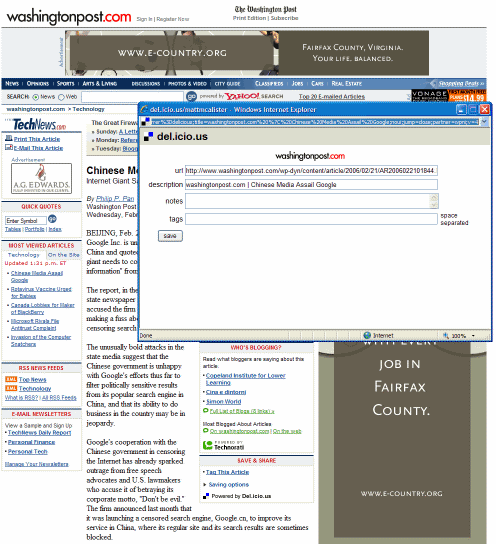
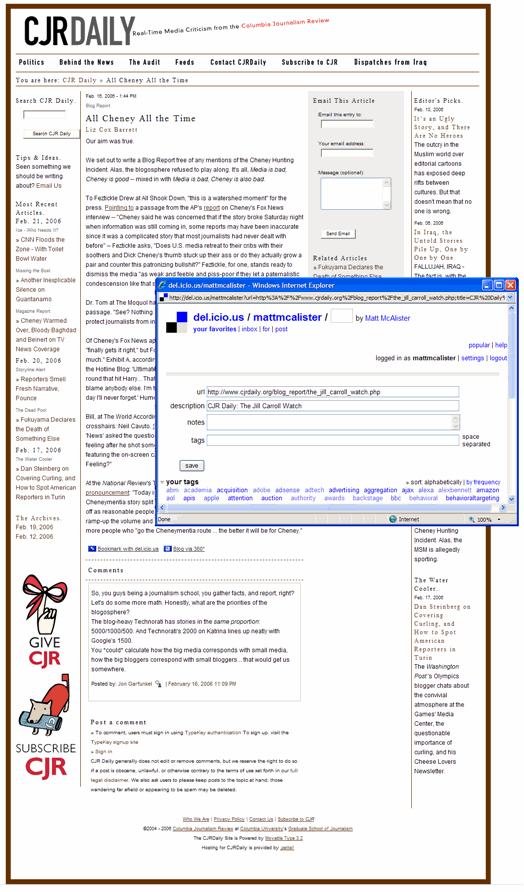
Washingtonpost.com and CJRDaily both added "Bookmark with del.icio.us" buttons on their article templates today.  At the bottom of every article is a link that spawns a popup for users to save this article with del.icio.us and to add tags to help them find this article later.  These are the first major media properties that I'm aware of to adopt the bookmark button.  (Are there others?)

I think it's critical for publishers to think about ways to enable their users to utilize content in more ways.  This bookmark button is one of the lightweight user actions that will expose content in new ways to mashups, RSS feeds, recommendations sytems, and all the other new discovery tools that people are using more and more in addition to search engines.  Even if only a small percentage of a site's users act on content in social ways, there will be positive effects that emerge from those actions.

Anybody can add the del.icio.us button to their site.  There are instructions for doing that here, and the bizdev contact at Yahoo! who can help is John Klem (jklem@yahoo-inc.com)


   Digg   Bookmark Send Blog    Trackback (4)    Comment (1)

  Podcasting solves the click-wait problem

Dave Winer spoke at the Yahoo! campus last week with Chad Dickerson's guest speaker series to offer his advice.  He dropped one nugget, in particular, that I thought was interesting.  Dave talked about video on the Internet and the user interface problems with streaming and downloading.

"Podcasting works because it solved the click-wait problem."

A lot of people have struggled with video's heavy data issues and the low adoption rates for years.  Now, it seems, there's just an assumption that video needs to be online and that people are going to get it there.

What happened?  Did broadband adoption hit critical mass?  Did TiVo inspire a time-shifting media revolution?  Did the price of personal electronics (PCs, digital cameras, etc.) subvert the strangelhold on content production?

Or was it, as Dave thinks, the combination of RSS subscriptions with enclosures that created the perfect storm and turned the Internet into a viable multimedia distribution platform?
   Digg   Bookmark Send Blog    Comment

  Allowing users to add value to advertising

Steve Outing reminds me that people should also be able to add value to advertising through their participation:

"Count me as an advocate of media sites allowing public comments to be added to content -- and I mean all content, including ads...An example of what's possible comes from the Muncie Free Press, a citizen-journalism website covering Muncie, Indiana..."

I can only imagine how much more useful advertising would get if something like "hot deals in my local area that people like me rated with 5 stars", for example, was filtered through a good recommendation engine.
   Digg   Bookmark Send Blog    Comment (1)

  The actions of a few impact discovery for many

The key flaw in the arguments about user actions driving better search discovery is that not everybody is willing to contribute an action.  A click on a link is enough to create some interesting discovery effects, but much better than that is qualitative effects of ratings, tags, comments, blog posts, etc.  As Steve Goldstein and Clare Hart noted, "People are busy."

I've been waiting for someone to put some kind of number out there that helps clarify why a segment of a community can influence the perspective of the whole in important and relevant ways through their participation.  Finally, a model emerges from Yahoo!'s Bradley Horowitz with his second post on his new blog.


He explains how this ecosystem defines the community and creates the opportunities that drive better discovery:

"There are a couple of interesting points worth noting.  The first is that we don’t need to convert 100% of the audience into “active” participants to have a thriving product that benefits tens of millions of users.  In fact, there are many reasons why you wouldn’t want to do this.  The hurdles that users cross as they transition from lurkers to synthesizers to creators are also filters that can eliminate noise from signal."

This is what drives the ability to bubble up tail content in meaningful ways.  It's all about user actions.

   Digg   Bookmark Send Blog    Trackback (2)    Comment

  Portals see lead conversions between 4% and 6%

I can hear publishers celebrating today as research shows that their lead generation programs look healthy still compared to the big kids:

"For the month of January, AOL Search generated the best conversion rate at business-to consumer e-commerce sites (6.17 percent), followed by MSN (6.03 percent), Yahoo (4.07 percent) and Google (3.83 percent)..."

Those numbers don't match up to the conversions and cost-per-lead numbers of more focused sites.  Now, if niche publishers could just figure out how to drive better volumes.  I would certainly start considering new distribution methods and revenue models if I were still playing that game. 

I'd also keep close watch of TechTarget who reported revenues of $70 million for 2005, which is up from $48 million in 2004...their whole business model is driven by the lead gen model. (Alan Meckler is jealous, I'm sure.)
   Digg   Bookmark Send Blog    Comment (1)

  What will be the next PageRank?

John Battelle defined PageRank in his book as the key factor that differentiated Google's technology and forever altered the search landscape.  PageRank gave currency to the hyperlink and mapped the online world using that pivot point and all its inherent values.

A lot of people seem to be asking themselves, "What will happen next?"

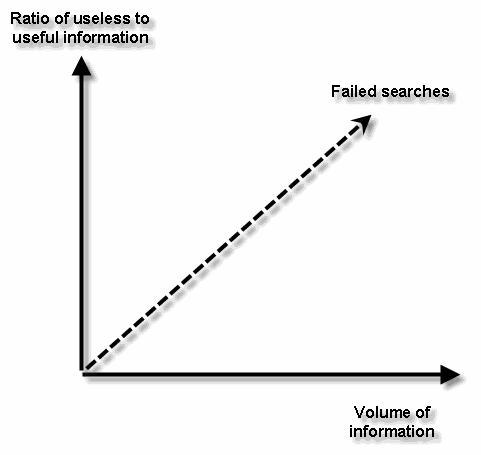
The PageRank concept was very clever and very simple.  It made finding things a hell of a lot more efficient than browsing a hierarchy, the PageRank predecessor.  But the haystack is just too big to find ever smaller needles, and the ratio of useless to useful information out there is getting really ugly:


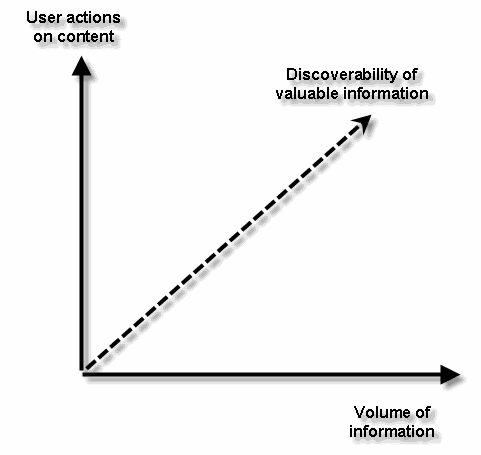
The hyperlink was a vote in the search-driven Internet.  Now I'm dependent on a new currency - human action.  The click is much more potent than the existence of a link.  Even more potent than clicks are tags, ratings, comments and emailed URLs.  A hyperlink is still a vote, but seeing some form of human action gives me much more confidence that a source has value.

So, the trick now is for content creators to figure out how to get users to act on their stuff.  How do you get people to add that extra bit of value to your content that validates and then qualifies the value for other people?  And then how do you expose the user-contributed value so that the right things get picked up from the right tools at the right time to reach the right people?


I won't predict I have the solution to this problem, nor do I have the answer to what's the next PageRank.  I think encouraging people to tag, send, rate, blog about and comment on your stuff and then exposing the results of those actions is crucial in this next phase of the Internet's evolution.  I also think understanding how the new crop of recommendation systems works may make or break a publisher who sits anywhere under the head of the long tail.

It makes sense when you look back historically on the Internet's evolution that there will be a new method for finding valuable information on the Internet soon if it doesn't already exist.  Again, I wouldn't predict what that is, but you can be sure that you will need your users' help to cross that chasm when it's more obvious what it looks like.
   Digg   Bookmark Send Blog    Trackback (4)    Comment (1)

  Viewing the world through other people's subscription lists

The discussions around sharing lists have felt a bit empty to me, generally, mostly because I don't understand it.  Even something more tangible like sharing playlists doesn't quite get to what I want as a consumer despite the idea's unmistakeable coolness factor.

What starts to get interesting to me, though, is seeing the effects of people's subscriptions rather than the subscriptions themselves.  I've been fascinated with memeorandum ever since I heard that the tech channel was seeded with Scoble's blog roll (is it true?).  So, it's logical to consider an interesting lens might be yourboss.memeorandum.com and yourmusicobssessedfriend.memorandum.com.  

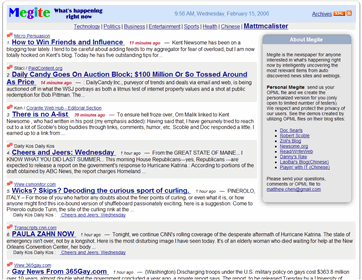
Then I started seeing referrals from megite.com in my logs a week or so ago.  And this week Alex Barnett posted about megite showing that he now has, essentially, alexbarnett.memeorandum.  Doc Searls' blog is a bit of a pain to read, but I like his views and what he's all about.  Luckily, I can now see the Doc Searls lens on the world rather than read all his posts.

Megite is the Being John Malkevich RSS Reader.  Here's the view through my head (Apparently, I'm a gay AJAX programmer.  My wife will be surprised to hear this, as will my boss).

UPDATE: Nick Cubrilovic challenges both the accuracy and utility of a service like Megite:

"The more memetrackers that commit themselves to the personalized path the less people we have working on the real problem of prioritizing content and finding the smaller stories that everybody would be interested in knowing about. Getting the first part right would be far more interesting not just for me but for most people out there who are interested in the long tail of news."
   Digg   Bookmark Send Blog    Trackback (1)    Comment

  Clearly focused products unseat generalist products

The 37 Signals guys have a really interesting perspective on product development.  They commit to small chunks and singular functionality.  They aim to make the one thing that a product does the very best at that one thing.

This same philosophy is what made Pat McGovern of IDG the 321st richest man in the world.  When he founded Computerworld magazine in the late 1960's, he realized that the specific will always drive out the general in the media business.  He proceeded to build a portfolio of computer magazine properties around the globe on this basis.

What these guys all share is a clear vision of how their products help the consumer.  McGovern understood intuitively what his readers wanted and kept cutting new properties from the same mold based on a live, working, successful product.  37 Signals is following a similar strategy with online productivity tools.

The strategy wins, though, not just because of the focus.  It wins because these guys understand their users.

This model works for lots of things, including platforms that have a slightly different dynamic than consumer-facing products.  Platform products not only need to know what the software tool needs that it serves, it also needs to understand what end-users want.  

Take the neverending CMS project behind every media site.  The CMS platform's primary customer is not the editor.  The CMS must serve the site visitor first.  How many major media sites are now using MovableType, Drupal or WordPress as functional CMS's on one level or another?  How many have actually considered replacing their expensive CMS with one of these cheaper, easier-to-use tools?

The reason Vignette didn't end up dominating today's CMS market was not only because of technology issues but also because they lost touch with the real customer of the product...the site visitor.  MovableType, Drupal and WordPress all make it very easy to make web sites that people like.  Users like the site.  Site owners are happy.  The platform is doing it's job.

Platforms need to be clearly focused.  But, more importantly, if a platform product doesn't understand the end-user, they will suffer the same fate of the consumer-facing products that don't know their users...they will get replaced by better, more clearly defined and focused products.
   Digg   Bookmark Send Blog    Comment (2)

  Making your web site weigh less

Like most people, I've made the mistake of overdesigning a web site a few times.  It's easy to do.  You can get excited about the possibilities and forget that most people who come to your site really don't care what you're up to.  They're just trying to find something.

How do you make it dead simple to give people what they want as fast as they want?  And then how do you help them do more at that crucial moment when they are highly engaged with your content?

I think the first question is harder than the second, but there are some new answers to the problem.  Jon Udell might be on to something with his Metadata Explorer UI.  When I saw how simple it was to dive into topics and then surface back out with just simple intuitive clicks, I started wondering why you wouldn't just make your home page more like that.  We've all learned that publisher's search engines always suck.  Exploring through data this way makes much more sense.

Then once you've helped someone find what they want, how can you incentivize them to add value to your content, to share it with others, to find more things like it, to come back again?  The little action buttons like the ones on my blog here are helpful to people.  (...more info on Yahoo!'s buttons here: http://publisher.yahoo.com/socialmediatools.)  Giving people related stuff to click on is smart, but there's an art to that.  There's an interesting method for using del.icio.us to create related links at InfoWorld.  And Feedburner has added a new FeedFlare API that allows publishers to add lightweight interfaces within items of their RSS feeds.

People have learned how to use more complicated user interfaces on the Internet, but I find it fascinating that people still gravitate toward the simplest interactions.  I like the idea behind CNet's cluster cloud with each article, but I never click on it...it's too heavy.

Publishers are always thinking about their next redesign.  Maybe instead of adding functionality, your next redesign will have less functionality.
   Digg   Bookmark Send Blog    Comment

  Why is RSS taking so long to reach big time mainstream adoption?

A lot of blame can be placed on the tools providers.  The business models have some headroom before RSS is required in the publishing mix.  And the format itself has some inherent awkwardness. 

These are obvious to those of us watching the evolution of RSS every day, but I think there are some other important issues that must be addressed somehow:
  • Maybe the user has too much control.  What kind of people want to take responsibility for managing high volumes of incoming data?  I like seeing new mail in my inbox because someone wants to contact me.  I don't like seeing unread items, though, because that feels like work.
  • More better filters, please.  Where's the PageRank equivilent for ranking items of interest from the RSS cloud?
  • The data isn't pretty.  RSS can be about so much more than headlines.
  • Its social power isn't obvious yet.  Email, IM, SMS and blogging all have specific and tangible social implications.  How will I explain to my mother that RSS can help her connect with people in new ways?
Or maybe it's all a bunch of hoo-ha, and RSS will just fade into oblivion.
   Digg   Bookmark Send Blog    Trackback (4)    Comment (1)

  The "Come to Me Web" school of design

I really like Thomas Vander Wal's "Come to me Web" post where he contrasts that with the "I go get Web".  He talks about web design being about usability, not information reading.

"Many of us as designers and developers have embraced "user-centered" or "user experience" design as part of our practice. These mantras place the focus on the people using our tools and information as we have moved to making what we produce "usable". The "use" in "usable" goes beyond the person just reading the information and to meeting peoples desires and needs for reusing information."

We're seeing the online user experience evolve into a more complicated space that's less about request/receive behavior to one that streams and flows based on triggers and loose couplings.  I also like the idea of information searching for me which I was exploring in a few posts last fall:

"We are telling the creators of information that we want filters, we want flow control, and we want those controls in our own hands.  It’s the era of syndication and subscriptions.  I’ll tell you what information I want, and then you come find me with the right data in the right place at the right time."
   Digg   Bookmark Send Blog    Comment

  Media Economics: The hyperdeflation of Media 1.0 and opportunities in Media 2.0

Umair Haque's Media Economics presentation (ppt) from April 2005 makes some fascinating statements about the mix of forces in the media ecology and where it is going in a Media 2.0 world.  A bunch of people have been referencing it recently which you can track at Technorati if you don't want to read it yourself.

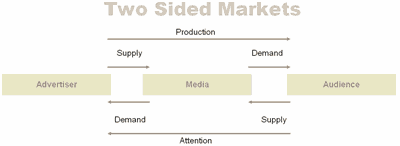
It starts with an analysis of Media 1.0 economics and how supply meets demand.  And then he shows where this model breaks down and finally how to take advantage of the new market.


There's a lot in here, much of which I can't get my head around yet, but one piece I like is the supposition that production costs don't efficiently capture attention at certain levels...at big media levels.  In other words, expensive high quality content does not pay off.  It's more efficient to spend money on ways to capture attention directly than it is to use high production value content as the bait.

"Blockbuster strategies emerge due to the natural economics of mass media: production is costlier than attention, so the dominant strategy is to invest in attention (marketing cost wars), and economize on production (quality erosion). The result is a smaller and smaller number of concentrated players, who are forced to invest more and more heavily in marketing as attention becomes scarcer."

This isn't true on smaller scales where media microchunks are both produced and disseminated cheaply.  He explains that the fixed economies of mass media get hijacked by consumers who are able and willing to consume lots of content through convenient channels at low cost.  The consequence is that production values stay low and quality gets fragmented and harder to find.

"Value shift: in a Media 2.0 world, producers realize production economies of scale and scope in production, and marketing diseconomies of scale and scope. Attention becomes more expensive than production, because technology vaporizes production (distribution, and retail) costs, exploding media supply (relative to a mass media world, where media supply is fixed), which creates intense rivalry for attention."

Mass media really feels the heat when micro media takes away the ability to franchise content.  Soundtrack sales, video rental, syndication and other tie-ins enabled high production cost economics to scale.  Micro media erodes those revenue streams and kills production-driven models.

But there's still hope.

He defines the effect of Media 2.0 on Media 1.0 as "hyperdeflation".  Effective margins can't be found in average content (a boring article, a crappy film, a stupid song). But by leveraging the strengths of the new systems, margins can come back.

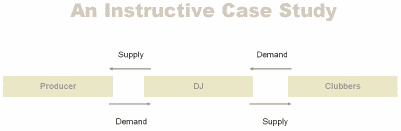
He goes on about Snowball Economics and defining how the 3 key types of players (Smart Aggregators, Microplatforms and Reconstructors) are going to serve the market most efficiently.  But I loved this abstract description of the interplay between Media 2.0 and its consumers...

  1. DJ plays a selection of tracks
  2. Audience reveals preferences, expectations, and satisfaction with their feet: private info is made public
  3. Consumption externality: your dancing reduces my search and transaction costs
  4. Tracks which maximize aggregate utility are efficiently revealed, and value creation is maximized...
  5. ...across multiple niches/different genres of club music
  6. Music listeners are a connected network ... DJs realized it, the music industry didn’t...
  7. ...Now, dance music is the fastest growing segment of the music industry and the segment which most regularly produces snowballs


This presentation is a must read for people in Media 1.0, but it also puts some really powerful perspective on what those in Media 2.0 are doing whether they know it or not.
   Digg   Bookmark Send Blog    Comment

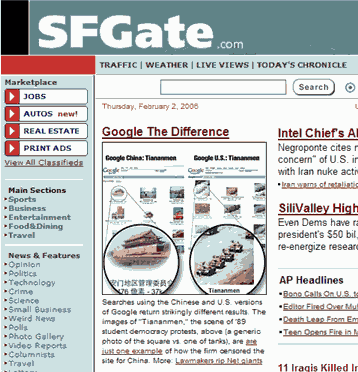
  Using China censorship to attack Google

Though the issue at hand is very serious and the implications of this have far reaching consequences, I find the timing of the Old Media attacks on Google to be very convenient for another battle taking place.

We're watching the media go to battle with it's future self.  Editors who use their deep analytical processing capabilities and expensive liberal arts educations are lashing out at the man-made machines built by their antisocial computer science adversaries.

They couldn't win the battle on cost.  They couldn't win the battle on efficiency.  They've even been losing the battle on relevance.  But now they found a place where the editorial voice cannot be replaced...ethics.  But to be sure it wasn't the machines who made the decision to cooperate with Chinese policy.  It was the stockholders and two young billionaires who might be getting in over their heads.

Michael Malone articulates the big picture challenge for expanding Silicon Valley companies nicely:

"Small, fast-moving companies typically don't have to worry about the larger cultural and geopolitical impact of their decisions, and when they do, they can actually incorporate ethical analysis into the process. Large corporations rarely do this, partly because the new product or business decision-making is pushed down through the organization and is rarely touched by senior management, and partly because the goal stops being that of changing the world and becomes that of hitting revenue targets."

The threat to media is not the machines.  The threat to media is money.  The current economic models of Old Media are not going to survive.

Now that Google is starting to look a little more like one of them, it's a lot easier to know where to aim the gun.  But I would spend more time looking at how to recapture the trust, imagination, creativity, curiosity and thirst for human connection that people want.  The money will come back.  And then editors can wrestle with their own bosses over how to handle increasing demands from stockholders to show growth while huge opportunities in places that don't respect the same cultural priorities beckon them with cash rewards.
   Digg   Bookmark Send Blog    Comment

  A camel is a horse designed by committee

There was a really funny exchange between Ricky Gervais and his idiot sidekick Karl Pilkington on his podcast the other day.  They started talking about Chinese proverbs and quickly devolved the conversation into Noah's poor decision to let similar animals onto the Ark.

This is paraphrasing, but you get the idea...

Ricky: "One of my favorites is, 'A camel is a horse designed by committee.'"

Stephen: "Carl's already wondering who's on that committee."

Karl: "I was just thinking why would you request the hump bit, cause that's just gonna get in the way, innit?"

Ricky: "Ok, Karl.  I'll give you an animal, and you tell me where it has gone wrong. The Octopus."

Karl:  "It should have some bones.  I never understood why it would like to get in a jar anyway."

Ricky: "A Giraffe."

Karl: "Noah should have seen some of the animals coming in and said, 'Hold on.  Just saw one like you.' and then throw it out."

Not sure if I captured the humor there, but, regardless, I like the premise of the initial statement.  Design-by-committee is bound to produce suboptimal results.  I think the Internet business is very good at rolling out visionary products invented by passionate people.  But how do you institutionalize that drive as the company evolves?  How do you formulate a process for initiating vision and committing to its delivery?

I can point to a few Yahoo! products that suffer from camel-ness, but out of respect to my colleagues, I'll pick on other people instead.  Here are some of the industry's worst design-by-committee products (mind you that doesn't preclude success):
  • Google Video Search and Google Reader
  • The new IE browser and Live.com
  • Amazon's left-hand site navigation
  • iTunes Music Store
  • Every home page on the Internet
This issue is everywhere.  It's the classic Marketing 101 mistake at big car manufacturing companies where they take the concept of giving customers what they want a little too far.  On more than one occasion Detroit has designed cars entirely by feedback from people who were asked what features they wanted in the ideal car.  Of course, the result is always a variation on the minivan.
   Digg   Bookmark Send Blog    Comment

  Tags as social constraints

I found an interesting post about the social implications of tagging by Nathan Lovejoy at swarmingmedia.com in response to my post, "Lightweight social interactions in a loosely coupled offline world."  He questions whether a future data pool of tags on people could create social shackles of sorts.

"The ability to freely tag individuals (I'm imagining a sort of del.icio.us for people) takes Foucault's concept of disciplinary individuality through institutional labelling and observance to a new extreme. An extreme that makes the swarm-the collective action of society-an all-encompassing disciplinary institution. Individuals would become their tags, become as they have been tagged, as they tag themselves."

The beauty of tagging, in my mind, is very different.  Tagging brings about more diverse meanings to things not fewer categorical meanings.  I characterize my relationships with people and the things that I know about them in many congruous ways, not by hierarchical, deterministic structures.  

My friend Hunter, for example, is a great guy to have in my Netflix Friends list for his unusual film taste, but he does me no good in discussions about RSS.  He is also a close friend from years back.  A Foucaultian structure to that relationship would mean that "friend" would come before "film recommender" based on some hierarchical meaning to my relationship with him.

I prefer the deconstruction approach to explain the multitude of relationships and tags I can apply to Hunter for what they really mean to me.  Each relationship has unique and undeniable truth in my interpretation of their value.  The tag itself is a symbolic and perhaps even temporary representation of value.  Tags are both subjective and independent.  One doesn't come before the other.

They are also additive data.  I would never tag Hunter as "-RSS", yet he very well could be insightful about RSS to other people who might, in turn, tag him with "RSS".

There may be cases where building meaning from collections of tags will give institutions dependent on structuralism some kind of new insight that could be used for power or for classifying people into buckets or something.  But those are just fears that should never be used to stop progress.  

Tags are a key ingredient to a larger world view rather than existential markers that institutions could use to box me in.
   Digg   Bookmark Send Blog    Trackback (1)    Comment

  InfoWorld.com nominated for Jesse H Neal Award

A big congratulations to my former InfoWorld colleagues for their recent Jesse H. Neal Award nomination from American Business Media.  This award is like the Pulitzer for business journalism, which sounds kind of funny, but I think this is a pretty serious award given by very serious people.  

A small team of us won a Neal Award back in 1996 for a pretty cool feature we did on streaming audio technologies at Macworld.  We got Les Claypool to license a track that we encoded using both Macromedia's Shockwave and RealAudio's formats.  Then we created an interactive test lab, a page with all the samples using all the codecs and playback rates.  You could play each sample and then vote for your preference from that page.  We also wrote a how-to on setting up streaming audio and built a table of streaming audio vendor comparisons.  You can still see what's left of that feature in the Internet Archive

I don't remember how many people worked on that piece, but the one thing I do remember thinking at the time was that this was an expensive project that would have a short life span on the Macworld.com home page.

InfoWorld's product tests aren't cheap, either.  The research involved in doing performance analysis on big ethernet switches or anti-spam tools or business intelligence packages is not for the lighthearted.  Add in a requirement to post to an InfoWorld blog regularly, and your typical InfoWorld editor is now earning his salary through blood sweat and tears.

Anyhow, I'd like to think I had at least a small part in helping InfoWorld get into the nomination circle.  Of course, everyone knows the man behind the curtain there is Jon Udell.  Just this week he blew me away with yet another breakthrough with his Metadata Explorer...always on the hunt for ways to make existing technologies more powerful.

Hope you win the top prize, guys!
   Digg   Bookmark Send Blog    Comment

  Four Things

I've been tagged.  So, here goes:

Four jobs I've had in my life:
   1. Window washer and baby sitter for really super incredibly wealthy financier
   2. Hasher for a sorority house at UCLA
   3. Security guard at Hollywood music studio (I spent an hour talking to Keith Richards on the phone one night.  I think he was drunk.)
   4. Games reviewer at Macworld

Four movies I can watch over and over:
   1. Caddyshack
   2. Shawshank Redemption
   3. I HEART Huckabees
   4. Old School

Four TV shows I love to watch:
   1. The Office
   2. American Idol
   3. Frontline
   4. Elimidate (I hate it, but sometimes I can't help myself)

Four places I've been on vacation:
   1. Andorra
   2. Cabo Wabo
   3. Santorini
   4. Chicago

Four of my favorite dishes:
   1. F-line Burger at HiDive
   2. Pizza
   3. Burrito
   4. English Breakfast

Four websites I visit daily:
   1. Bloglines
   2. Memeorandum
   3. Searchblog
   4. del.icio.us

Four places I would rather be right now:
   1. Italy
   2. Tahoe
   3. My deck at home
   4. Thailand

Four bloggers I am tagging (as in "you're it"...?):
   1. Chad Dickerson
   2. Hunter Hubby
   3. Lloyd Shepherd
   4. Don Loeb (maybe this will inspire your first post, Don)
   Digg   Bookmark Send Blog    Comment

  Lightweight social interactions in a loosley coupled offline world

The first generation of Internet users learned (and created) the online social models through the nature of the protocol itself.  A back and forth relationship.  Make a request, get a response.  

But the model has evolved into a sort of graffiti approach to the online social model.  People flag things, tag things, rate things, annotate and comment, link to things, blog about things, etc.  The art of flirting through lightweight notifications gets the teens spinning with gossip.  There's less of an on/off experience and more of a data soup happening out there.

Unfortunately, I still have to define my friends and co-workers into 2 distinct and separate identities in my IM tool.  I'd much rather use tags to identify my relationships with people.  I'd prefer to see whatmycolleaguesread.memeorandum.com.  I want playlists from my brother and his 1st degree friends who also obssess on music.  

Does this have meaning in an offline world, too?  Could we alter our commitments to traditional structures so they are less about the man-made constructs that once made sense to new constructs that serve a more interconnected world?  

For example, My mother and stepfather have been loyal Republicans since they were children, and they voted for George Bush (twice) because of that loyalty more than any other factor.  Despite their desire to remain faithful to the system, they are now torn with frustration.  (Strangely, the straw that broke them was when Bush nominated his personal friend to the Supreme Court.)

It makes me wonder if we'll start to view our political system in a much less binary way because of this cultural phenomenon happening online.  I can't possibly agree with every issue my representative votes for.  I would be glad to add value to a political discussion through ratings and tags and pings and blog posts and emoticons.  

But just like I don't want my IM app to tell me that a former colleague who I used to drink with can only be a friend or a co-worker, I don't want such an either/or relationship with my government.  In aggregate, lightweight social data from people could have relevant meaning to decisions made by the people in power if it was possible to contribute that way.

And the idea extends way beyond government.

For example, I want to track the UCLA athletes I remember from school through their trades and professional achievements...I care more about seeing Baron Davis do well than I do about the Warriors who can be difficult to cheer for.  After 5 years together, a wedding and a child, my wife is still facing visa issues that make living in and travelling to and from the United States an annoying experience.  Somebody needs to realize that we are inextricably connected.  We call our baby's physician when she gets sick, but we usually end up on the phone with someone else from the group who may or may not be as helpful.  Shouldn't our friends and family be able to connect us with knowledgeable and reputable doctors who are accessible at the moment we need them?

I suspect that the offline social constructs don't work as well as they did when geopolitical boundaries could be reinforced through the cost of communication and travel.  But there's a new sociology of lightweight interactions out there.  It might be time to reevaluate how that is going to improve the world as we know it on a larger scale.

Does 'loosely coupled' have a similar meaning offline?
   Digg   Bookmark Send Blog    Trackback (3)    Comment

  Welcome Susan Mernit

I didn't have a chance to blog the news about Susan Mernit joining Yahoo! when it came out, but I was reminded of this today both when she posted about her first day and while sitting through a presentation here on the impressive community efforts going on.  Looking forward to seeing her contribute to a lot of solid thinking happening at Yahoo! right now.
   Digg   Bookmark Send Blog    Comment

  Lessons for Old Media from Jared Diamond and the evolution of civilizations

Last night the local PBS affiliate KQED ran the first segment in a really cool series called 'Guns, Germs and Steel' based on the research of Jared Diamond published in 1997.  He tries to reduce the evolution of civilizations to a few key resources and the way people adapted because of the presence of those environmental factors.  (I haven't read the book or seen the 2nd and 3rd episodes yet.)

He challenges the concept of free will on one level, as he maps common outcomes around the globe at similar times in history where cultures were not likely to cross pollinate.  He says that the introduction of farming followed by food storage followed by animal domestication created the foundation upon which sustenance could support a standalone community.  The system was robust enough to allow a segment of the society to explore beyond the day-to-day grind and invent new tools, weapons and art forms.

Of course, the local environment repeatedly fails to support this system across time, yet the inventions of man continue to open up new ways to counterbalance nature's inherent instability.  

You can see similar forces occurring within society and even within human nature itself.  We even replicate this pattern in our creations including the Internet and the businesses that try to survive there.

Take the recent discourse on Old Media vs New Media.  Old Media relies on known beasts of burden (the editor, expensive distribution, advertising revenue, etc.), but it has spread too thin the resource that keeps Old Media alive - attention.  And while Old Media was making enough money to support the crazy web site project on the side, they often failed to leave the dry desert for more fertile ground found by the New Media explorers.

Diamond goes on to explain how the farming system forced people to spread from the Middle East to Asia, Europe and North Africa in search of more sustainable land.  Cultures like New Guinea which were unable to capitalize on key new developments remained small and unchanged if they survived at all.

It would be a mistake to proclaim the end of tv, radio or print.  Media as we understand it today is a sustainable concept with some very important social implications.  The system works and it matters.  But it is equally wrong to hold on to the old models with the knowledge that the resources are evolving, drying up in some cases, and that new tools, weapons and art are now available to grow and expand media into more fruitful territory.
   Digg   Bookmark Send Blog    Trackback (1)    Comment

  Humans make recommendation engines work

The Google News recommendation engine exposes one of the interesting problems facing the new media models.  Though machines can make really good editors, the better solutions for providing relevant things to people are those that combine the power of social actions with machine learning.

Justin Fox of Fortune (who happens to be a good family friend, actually) asks if the role of the traditional editor is getting hijacked on the Internet, then what is going to replace the need for social reference points?

"There is nothing natural or inherently superior about the monolithic media institutions of the mid-to-late 20th century.  But there is still a need for the community-building, consensus-shaping role that the best of the media gatekeepers can play. The question is, who's going to play it? And how are they going to make it work economically?"

Google's PageRank algorhythm was a landmark differentiator in the web-based world of machine-driven editorial decision-making because it placed value on one very important social action, the hyperlink.  The existence of a hyperlink to a web site implied human value because it was assumed that the link was created by a human who valued that destination page.  Therefore, that page should be ranked higher than other pages valued less by humans.  That factor more than any other made the Google search results better than everything else out there at the time.

It's not obvious to me that Google learned from that breakthrough in their new recommendation editor in Google News.  It appears to be based entirely on machine learning.  Just like all the content in Google News, the results are pretty good in a sort of categorical way and in terms of immediacy, but the machine context isn't enough to create any kind of emotive response to the recommendations they give me.

(Update: Google News posted some info on what's happening: "Google News has no human editors selecting stories or deciding which ones deserve top placement. Our headlines are selected by computer algorithms, based on factors including how often and on what sites a story appears online...Google News can automatically recommend relevant stories just for you by using smart algorithms that analyze your selections.")

The New York Times published a Recommendations 101 piece this week where they described why recommendations matter, and they noted a key flaw in the concept:

"Earlier this month, Walmart.com issued a public apology and took down its entire cross-selling recommendation system when customers who looked at a boxed set of movies that included 'Martin Luther King: I Have a Dream' and 'Unforgivable Blackness: The Rise and Fall of Jack Johnson' were told they might also appreciate a 'Planet of the Apes' DVD collection, as well as 'Ace Ventura: Pet Detective' and other irrelevant titles."

If recommendation engines are to replace traditional editors, they need to have a more direct connection to the human-powered web.  This is one of the reasons I like del.icio.us so much.  The output and display of content there is very purely machine-driven, but all of the input is human-driven.  It's a fantastic combination of the two forces working together.

Noah Brier agrees that the role of the editor in a media company is changing quickly:

"In many ways, recommendation systems spell the end of the editor as we know it. Of course there will always be a place for human editors somewhere, but increasingly technology is going to find ways to deliver information without their help."

Our social actions create the editorial filter through which we will discover things that matter to us.  Recommendations are very trendy and for a good reason, but the juice that makes it a powerful force is not the machines behind it...it's the people.

   Digg   Bookmark Send Blog    Comment