
I have the Nokia 6630 which takes nice images at 1.3 megapixels. And I've equipped it with the recently launched ZoneTags from Yahoo! Research. ZoneTags automatically flags a location on every photo I take. More importantly, it automatically uploads my photos directly to my Flickr account immediately after I take a picture with my phone.
This will not only open up a world of photobloggers and a massive stream of new RSS feeds, but it will enable some fantastic mapping possibilities. Satellite imagery will always be fascinating, but how cool is it that we're now applying historical visualizations of events in time and space from human perspectives?
 This reminds me that I need to re-watch the movie 'Smoke'. Harvey Keitel takes the same photo in the same location of the same smoke shop every day to show us the depth of the things right in front of us:
"People say you have to travel to see the world. Sometimes I think that if you just stay in one place and keep your eyes open, you're going to see just about all that you can handle."
The simple application of this technology combo, though, is the ability to give my friends and family a stream of visual content from my life that is otherwise just too hard to manage still. Downloading stuff off my camera isn't really that much of a hassle, but it definitely becomes a chore. My wife has stopped doing it herself and just lets the camera sit full of images for weeks at a time or until I download them.
Flickr hardcores have known for a long time that this moment was coming. They may even get annoyed when the wider world figures this out and crowds the pool.
However, there are still two things that need to happen, in my mind, before we hit the goal line for this combination of services:
1) Video. I need Flickr to host videos I capture with my phone. I don't really need more storage on my phone if this works (though it would be nice), as Flickr will serve that purpose.
2) Private RSS feeds. I want to put the Flickr feed of my private family photos on my mother-in-law's start page. She should always see the latest photo of her granddaughter when she opens a browser. That is more important to her than today's news, the weather or her stocks. And I don't want those images to be public.
2) Private RSS feeds. I want to put the Flickr feed of my private family photos on my mother-in-law's start page. She should always see the latest photo of her granddaughter when she opens a browser. That is more important to her than today's news, the weather or her stocks. And I don't want those images to be public.
There's no doubt that this toolset will be user-friendly enough for technophobes, and it may bring a wave of older generation types into the photosphere, at least those who aren't afraid of cameraphones.
I'm a little frightened by what teenagers will do with it, but that's why we don't call them adults and feel comfortable shaking our heads when they do something stupid. Bring it on, kids. A new medium is here. Show us what it can do.
 Digg
Digg Comment (1)
Sunday, March 26
Top 10 reasons why Hack Day rocks
I joined Chad Dickerson's Yahoo! Hack Day Friday to try and work out some things that have been sitting on the backburner for a while now. I'm an instant convert. Hack Day is a trully brilliant idea.
I'm not experienced enough to know the historical twists and turns of management philosophy, but this feels to me like a breakthrough, perhaps an unintended consequence of the need to retain talented people.
How do you explain the benefit of Hack Day in one sentence? Hack Day bubbles up significant yet tangible product strategy advances from across the organization while simultaneously feeding all that workforce optimization and touchy feely crap without paying a team of expensive Stephen Covey robots to tell you what you already know. It's also super cheap.
These are some of my personal observations about the day and what it offers both the participants and the company itself:
TOP 10 REASONS WHY HACK DAY ROCKS
I can't give away what my team built nor any of the other 100 or so brilliant ideas that came to fruition, but let's just say that there are some pretty wild game-changing moves in the works even if only a handful of these hacks make it to market.
I'm not experienced enough to know the historical twists and turns of management philosophy, but this feels to me like a breakthrough, perhaps an unintended consequence of the need to retain talented people.
How do you explain the benefit of Hack Day in one sentence? Hack Day bubbles up significant yet tangible product strategy advances from across the organization while simultaneously feeding all that workforce optimization and touchy feely crap without paying a team of expensive Stephen Covey robots to tell you what you already know. It's also super cheap.
These are some of my personal observations about the day and what it offers both the participants and the company itself:
TOP 10 REASONS WHY HACK DAY ROCKS
- Bonding. For those of us who formed teams to complete hacks, we became dependent on each other. We had to learn in a very short period of time how to get along in an intense environment and make something together. In our case, we blocked out a conference room and did the typical dotcom fast-build along with the dotcom diet of pizza, coke, krispy kremes and chips. We already knew eachother's workstyles, but elevating your game together to complete a mission forces some interesting dynamics to unfold. You get to know eachother in a way that's more useful than any offsite I've ever attended (or led).
- Trust. We gave ourselves a somewhat simple but potentially tricky problem where no single member of the team understood exactly how it would or should unfold. We had to talk fast, listen carefully and adjust to each other as we progressed. We had to expect that each member of the team would carry as much weight as they could and trust that whatever they did was as good as it could be.
- Fun. It wasn't just getting jacked up on sugar and caffeine that made things fun. It felt like a day off. I turned down one meeting using the "I'm busy hacking" excuse, and the guy actually sounded apologetic for asking. There was lots of trash talking and laughter. At the end of the day, we were all disappointed that it was over...and excited for the next one.
- Competition. Competing with external forces to win in the market can get pretty scary. Competing with internal forces for some political agenda can get pretty nasty. Competing for the sake of a competition, though, can be really healthy not to mention productive. And the way Chad has designed the event, there are no losers except those who don't participate.
- Brainstorming. The brainstorms that typically happen around here involve finding solutions to known problems. Hack Day is a chance to break through the constraints of the known world and find far away problems that might actually be pretty easy to solve if you take the chains of daily routine off your back.
- Inspiration. The idea of inventing something new can cause some inspirational run-off to the things that currently exist. I've had some big ideas of where to go with some of the products I'm working on, but the world of possibility is many times larger now that I had a chance to step out of the current queue of to-do items.
- Energy. When I was at The Industry Standard I couldn't afford to take my eye off the ball for even a moment in the day. It wore me out. But we were energized all the time by a leader who expected us to push the envelope and lead the market. We had to be smarter than the companies we were writing about every day. Yahoo! has a more steady and strong, more polished and professional approach to management. But it's also smart enough to know that it needs injections of energy like we had at The Standard. Hack Day is now my steroid of choice. It felt like 1999 all over again.
- Dirty hands. Non-engineers are officially invited to contribute to Hack Day, but they aren't really welcome. Managers and product people have a way of ruining things with roadmaps and schedules and analysis and meetings. I'm as guilty as the next one. Hack Day is a chance to break through all that and to just build. If you are a manager or a PM, you better have some skill to bring or you're just in the way. You have to get your hands dirty and actually do something.
- Creativity. We not only had to be creative with our approach to solving a problem in a small amount of time with a small team, we had to be creative on the fly as problems came up. We ran into a few snags right at the end of the day including a sudden injection of overambition on my part that took us on a wasteful detour. When you're operating in high gear, you have to shift from action to problem-solving and back to action at the drop of a hat. It requires multiple layers of creativity to deliver something you're willing to share in a competition.
- Deliverables. I'm now looking at this hack and some of the others and thinking about how to turn them into real products. The value of the day is going to continue for weeks and months to come. Even a good offsite has a very short impact lifespan.
I can't give away what my team built nor any of the other 100 or so brilliant ideas that came to fruition, but let's just say that there are some pretty wild game-changing moves in the works even if only a handful of these hacks make it to market.

Thursday, March 23
The Internet is making 'Being John Malkovich' a reality
There's some kind of shift evolving out of the voyeuristic nature of social bookmarking, screencasting, shared playlists, RSS and OPML that I find really interesting. If we think of blogging as the view into our thoughts via the outside world, then this other trend is a view to the outside world via human lenses. Kevin Kelly refers to some of these tools as Consensus Web Filters.
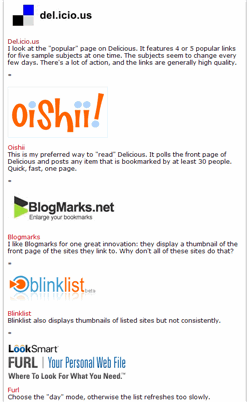 A multilayered example of this model in action is Alex Barnet's screencast about "The Attention Engine", particularly his comments about Megite. I'm seeing his view of himself showing us how to see through his collection of feeds out onto the world. It's a timeshift and a placeshift. People are creating lenses of the world for themselves that they are sharing with other people who want to see the world through them.
I also recently discovered a del.icio.us feed that looks to be a collection managed by someone (or several someones) at Google (or possibly someone studying Google very closely). When I first saw it I thought the feed might give me insight into what people are thinking about internally there and hopefully a little competitive intelligence.
It turns out that rather than provide a view inside the company, this feed provides a view to the world outside the Googleplex through a Google lens. There are bookmarks to articles that are critical, glowing and tangential to the Google cause. What I didn't expect is that an occasional bookmark makes me more empathetic to Google's viewpoint.
The feed has started to influence my thinking despite my attempts to interpret patterns and infer competitive insights.
A few weeks ago I took the PersonalDNA test which told me that my greatest weakness is my lack of empathy. The report told me, "Taking some time to explore others' perspectives could make spending time with people even more compelling than it already is."
I was surprised by that, as I consider myself an understanding and generally kind person. But being nice to people is no substitute for actually having empathy. It makes me wonder if I'm disingenuous, but that's not the point here...
Part of the reason reality TV works so well is because it gives us all a chance to taste experiences vicariously. We are voyeurs into other people's worlds until the winner is chosen and the season ends.
This same concept happens online.
I particularly like Don Loeb's link blog as he is so in tune with what's happening when and with whom in the same spaces I'm studying. It's not a blog with output from his thought process but rather a daily view of the Internet business through his eyes.
I also like seeing what music people are listening to on their Last.fm badges. It has become less of a window into the person and more of a window out onto new music for me to discover.
The view through someone else's view is very compelling. I'm not sure I understand how the concept evolves into more mass market products yet, but I'm more and more certain that del.icio.us feeds, screencasts and last.fm badges are indicators of a fundamental change in the way people discover things on the Internet.
I guess I'm asking someone to come up with "Malkevision" "Malkovision".
A multilayered example of this model in action is Alex Barnet's screencast about "The Attention Engine", particularly his comments about Megite. I'm seeing his view of himself showing us how to see through his collection of feeds out onto the world. It's a timeshift and a placeshift. People are creating lenses of the world for themselves that they are sharing with other people who want to see the world through them. I also recently discovered a del.icio.us feed that looks to be a collection managed by someone (or several someones) at Google (or possibly someone studying Google very closely). When I first saw it I thought the feed might give me insight into what people are thinking about internally there and hopefully a little competitive intelligence.
It turns out that rather than provide a view inside the company, this feed provides a view to the world outside the Googleplex through a Google lens. There are bookmarks to articles that are critical, glowing and tangential to the Google cause. What I didn't expect is that an occasional bookmark makes me more empathetic to Google's viewpoint.
The feed has started to influence my thinking despite my attempts to interpret patterns and infer competitive insights.
A few weeks ago I took the PersonalDNA test which told me that my greatest weakness is my lack of empathy. The report told me, "Taking some time to explore others' perspectives could make spending time with people even more compelling than it already is."
I was surprised by that, as I consider myself an understanding and generally kind person. But being nice to people is no substitute for actually having empathy. It makes me wonder if I'm disingenuous, but that's not the point here...
Part of the reason reality TV works so well is because it gives us all a chance to taste experiences vicariously. We are voyeurs into other people's worlds until the winner is chosen and the season ends.
This same concept happens online.
I particularly like Don Loeb's link blog as he is so in tune with what's happening when and with whom in the same spaces I'm studying. It's not a blog with output from his thought process but rather a daily view of the Internet business through his eyes.
I also like seeing what music people are listening to on their Last.fm badges. It has become less of a window into the person and more of a window out onto new music for me to discover.
The view through someone else's view is very compelling. I'm not sure I understand how the concept evolves into more mass market products yet, but I'm more and more certain that del.icio.us feeds, screencasts and last.fm badges are indicators of a fundamental change in the way people discover things on the Internet.
I guess I'm asking someone to come up with "Malkevision" "Malkovision".
Wednesday, March 22
Shifting perspectives through other people's eyes
Joey Piziali is a San Francisco artist who runs the Ping Pong Gallery in Potrero Hill. I often swing by his place on the way home from the train station to see what weird stuff he has on display and to peak into a different world for a moment.
Last week I stopped by after wrestling with some of the ideas from Jon Udell's talk at Yahoo! hoping an alternate viewpoint could put my thoughts into perspective. I asked Joey what he thought about the concept of lenses using examples like Squidoo and Megite. Without having to explain feeds or OPML or anything about the underlying Web concepts, he chimed in with a reference to "Art and Physics", a book by Leonard Shlain.
 The book is apparently about the breakthroughs that happen in art and physics prior to man's ability to verbalize a concept. Picasso and Einstein, for example, were simultaneously investigating shifts in time and space. Cubism offered a new language for people to understand alternate physical perspectives and time shifts in one visual composition. Relativity opened up an alternate view on our understanding of physical location in time through a mathematical perspective. They both defined in different ways a new dimension to our physical world without using words.
Art and physics gave us completely different vantage points for understanding something we thought we had already defined, and suddenly the realm of possibility expanded dramatically.
Similarly, many of the recent online experiences that are impacting our view of the collective mind have involved timeshifting concepts. From feed readers to podcasting to TiVo, we are learning to understand the world along different moments in time, constantly swinging forward and backward without missing a beat.
We've also learned how to understand shifts in space. The hyperlink was the ultimate transport device in the beginning. Now we're learning that our minds have different kinds of mapping capabilities for understanding the physical world.
For example, Jon Udell talks about how he located a brief moment buried in a podcast segment that otherwise would have been a pain to locate again if he hadn't used a physical map to identify the place he saw when he heard the moment. Similarly, I've been playing a particular playlist over and over on the train so that now I know where we are along the journey based on what point we're at in which track. Without looking at my watch or the view out the window, I just know it.
So, how did Joey make the connection to "Art and Physics" from my explanation of Megite? He understood how people can be lenses to other worlds for the rest of us.
As Umair Haque noted in his presentation on new media models (ppt), the club DJ is an interesting model for understanding what media could be online. People learn which DJs create the best listening experience. They learn that certain DJs can drive emotions and energy that they like. Different DJs introduce new and interesting music they wouldn't find elsewhere.
The best club DJs, though, are not broadcasting a premeditated string of tracks. The best DJs build a relationship with the clubbers in realtime. They have alternate paths for getting to musical climaxes through different track selections which are driven by how the clubbers are reacting. The clubbers vote with their feet. They go nuts when the music is good. They congregate at the bar if they are waiting for the string to improve. The DJ waits for the right moment to kick the party into high gear and also knows when to ease off.
Everybody can be a DJ on the Internet. Everybody can apply their expertise with the things that they know and create a lens of the world for others to enjoy. And other people can react to the view in ways that can help inform the lens itself.
Joey is my primary lens to the art world. My brother Mitch is my primary lens to new music. Michael Arrington is my priamry lens to new dotcom startups. Jon Udell is my primary lens to the Semantic Web.
What I want to see are tools that can help me both pivot on those lenses easily and interact with them to help inform the lensmaker.
Last week I stopped by after wrestling with some of the ideas from Jon Udell's talk at Yahoo! hoping an alternate viewpoint could put my thoughts into perspective. I asked Joey what he thought about the concept of lenses using examples like Squidoo and Megite. Without having to explain feeds or OPML or anything about the underlying Web concepts, he chimed in with a reference to "Art and Physics", a book by Leonard Shlain.
The book is apparently about the breakthroughs that happen in art and physics prior to man's ability to verbalize a concept. Picasso and Einstein, for example, were simultaneously investigating shifts in time and space. Cubism offered a new language for people to understand alternate physical perspectives and time shifts in one visual composition. Relativity opened up an alternate view on our understanding of physical location in time through a mathematical perspective. They both defined in different ways a new dimension to our physical world without using words.Art and physics gave us completely different vantage points for understanding something we thought we had already defined, and suddenly the realm of possibility expanded dramatically.
Similarly, many of the recent online experiences that are impacting our view of the collective mind have involved timeshifting concepts. From feed readers to podcasting to TiVo, we are learning to understand the world along different moments in time, constantly swinging forward and backward without missing a beat.
We've also learned how to understand shifts in space. The hyperlink was the ultimate transport device in the beginning. Now we're learning that our minds have different kinds of mapping capabilities for understanding the physical world.
For example, Jon Udell talks about how he located a brief moment buried in a podcast segment that otherwise would have been a pain to locate again if he hadn't used a physical map to identify the place he saw when he heard the moment. Similarly, I've been playing a particular playlist over and over on the train so that now I know where we are along the journey based on what point we're at in which track. Without looking at my watch or the view out the window, I just know it.
So, how did Joey make the connection to "Art and Physics" from my explanation of Megite? He understood how people can be lenses to other worlds for the rest of us.
As Umair Haque noted in his presentation on new media models (ppt), the club DJ is an interesting model for understanding what media could be online. People learn which DJs create the best listening experience. They learn that certain DJs can drive emotions and energy that they like. Different DJs introduce new and interesting music they wouldn't find elsewhere.
The best club DJs, though, are not broadcasting a premeditated string of tracks. The best DJs build a relationship with the clubbers in realtime. They have alternate paths for getting to musical climaxes through different track selections which are driven by how the clubbers are reacting. The clubbers vote with their feet. They go nuts when the music is good. They congregate at the bar if they are waiting for the string to improve. The DJ waits for the right moment to kick the party into high gear and also knows when to ease off.
Everybody can be a DJ on the Internet. Everybody can apply their expertise with the things that they know and create a lens of the world for others to enjoy. And other people can react to the view in ways that can help inform the lens itself.
Joey is my primary lens to the art world. My brother Mitch is my primary lens to new music. Michael Arrington is my priamry lens to new dotcom startups. Jon Udell is my primary lens to the Semantic Web.
What I want to see are tools that can help me both pivot on those lenses easily and interact with them to help inform the lensmaker.
Tuesday, March 21
Jon Udell, storytelling, and learning through imitation
Jon Udell visited Yahoo! last week to share some of his thoughts on language, visualization, and storytelling, among other things that all connected together in the end despite a seemingly random journey through his recent thoughts.
One bit I really liked was his discussion on learning. He talked about how human beings have an innate learning mechanism through imitation. I've been thinking a lot about this recently as my 15-month old daughter is now reflecting back to us the words and signs we use to communicate. Jon emphasized imitation as a way to communicate new user experiences on the Internet.
He talked a bit about del.icio.us in this context. The social bookmarking concepts evolving from heavy del.icio.us users have incredible power and utility. Jon said, "del.icio.us has changed my personal productivity more than anything else in the last 5 years."
He went on to explain that the problem with wider adoption of del.icio.us is really about showing people how it works. He said, "People don't know what they don't know." Until you see someone else doing something that you didn't know about, you don't have any frame of reference for learning.
For concepts like subscribing to feeds or bookmarking with del.icio.us, you need really tight but very compelling stories that capture people's imaginations. One of the more interesting storytelling vehicles to appear in the last 2 years is a Udell invention of sorts called screencasting. His 'Heavy Metal Umlaut' screencast is the classic, the visual story that clarified to a lot of people, myself included, why Wikipedia is really something special.
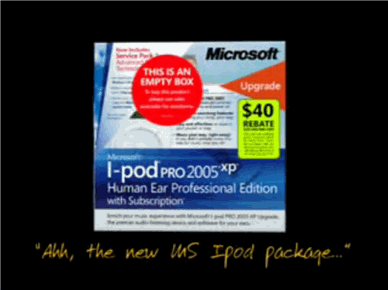 The reason screencasting works, Jon argues, is because it gives you the opportunity to imitate. You can be a voyeur of someone else's computer screen for a few minutes and watch what they're experiencing before applying it to your own experience. His del.icio.us screencast was what converted me into a heavy user of the product and inspired me to convince staff at InfoWorld to join us in some experiments with the tool on the web site last year and to try some ideas in my own sandbox.
Similarly, he brought up the example of the Microsoft iPod packaging video on YouTube and the ACLU Pizza video which both visualized incredibly rich concepts through very tight and highly entertaining stories. A screencast is worth a hundred MBA case studies.
Lots of thought-provoking stuff, as always. I particularly liked the fact that all of his seemingly tangential thoughts were in fact loosley connected. Just like the world he's evangelizing every day through his writing, his presentation swirled in one direction and another all the while routing in a random but purposeful direction back to the start.
One bit I really liked was his discussion on learning. He talked about how human beings have an innate learning mechanism through imitation. I've been thinking a lot about this recently as my 15-month old daughter is now reflecting back to us the words and signs we use to communicate. Jon emphasized imitation as a way to communicate new user experiences on the Internet.
He talked a bit about del.icio.us in this context. The social bookmarking concepts evolving from heavy del.icio.us users have incredible power and utility. Jon said, "del.icio.us has changed my personal productivity more than anything else in the last 5 years."
He went on to explain that the problem with wider adoption of del.icio.us is really about showing people how it works. He said, "People don't know what they don't know." Until you see someone else doing something that you didn't know about, you don't have any frame of reference for learning.
For concepts like subscribing to feeds or bookmarking with del.icio.us, you need really tight but very compelling stories that capture people's imaginations. One of the more interesting storytelling vehicles to appear in the last 2 years is a Udell invention of sorts called screencasting. His 'Heavy Metal Umlaut' screencast is the classic, the visual story that clarified to a lot of people, myself included, why Wikipedia is really something special.
The reason screencasting works, Jon argues, is because it gives you the opportunity to imitate. You can be a voyeur of someone else's computer screen for a few minutes and watch what they're experiencing before applying it to your own experience. His del.icio.us screencast was what converted me into a heavy user of the product and inspired me to convince staff at InfoWorld to join us in some experiments with the tool on the web site last year and to try some ideas in my own sandbox.Similarly, he brought up the example of the Microsoft iPod packaging video on YouTube and the ACLU Pizza video which both visualized incredibly rich concepts through very tight and highly entertaining stories. A screencast is worth a hundred MBA case studies.
Lots of thought-provoking stuff, as always. I particularly liked the fact that all of his seemingly tangential thoughts were in fact loosley connected. Just like the world he's evangelizing every day through his writing, his presentation swirled in one direction and another all the while routing in a random but purposeful direction back to the start.
Friday, March 17
Mashups need to become real products
The mashup is made up of 3 primary ingredients:
1) content streams (RSS)
2) muscle and connective tissue (APIs)
3) pretty skin (AJAX)
But there's one element that seems to be missing from the mashup body out there: intelligence. Jason Douglas made this clear for me when he said that at some point these mashups are going to have to get smart about who they're serving. Just because you can mix something up doesn't mean it should be or that anyone will care.
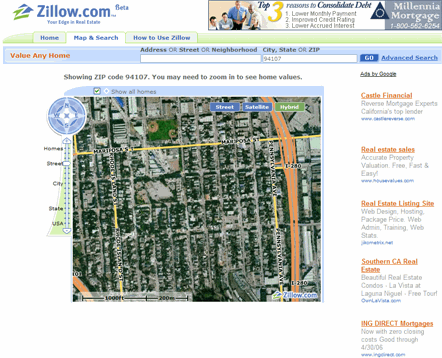 Zillow, the ultimate real estate mashup, is an interesting case study. There are several dials in the user interface that make it very easy for me to research what I want. The depth is incredible.
But Zillow should be smart enough to identify what kind of researcher I am by my behavior. Am I browsing for fun? Am I drilling into a neighborhood looking at specifc sized/priced properties? Am I watching the value of my own home compared to the market?
There are lots of different ways to optimize for different types of users. If you get that right then the money will follow.
For example, advertisers want to offer different things to different users at each stage of the purchase process. The purchase process for anything typically looks like this:
Awareness -> Research -> Comparison -> Transaction -> Loyalty
Zillow should have ways to optimize for and capitalize on these different audience segements. If I'm browsing for fun, then perhaps I also want to know what the local council has to say about living in the area. If I'm drilling in, perhaps I also need to know who the good agents are or even how to buy without one. If I'm watching my own home, maybe I need someone to recommend an architect or a good local contractor for that remodel I've been planning.
The audience segments for the service could also be drawn using a subscription model. For example, if I'm a real estate agent with a particular skill at helping buyers, then I'm going to fear for my job now that Zillow takes away my advantage. I'd gladly pay Zillow a hefty fee to keep it out of the hands of all the people who are using it for free today or to at least give me special reporting tools that I can use to advise the buyers who aren't clued in yet.
It's the character, intelligence, and the behavioral wrapper that the tool needs to put around the mashup that will help it stand out in the crowd. Without it, the typical mashup legacy may only be inspiration for a smarter company who will make the idea actually work for people.
1) content streams (RSS)
2) muscle and connective tissue (APIs)
3) pretty skin (AJAX)
But there's one element that seems to be missing from the mashup body out there: intelligence. Jason Douglas made this clear for me when he said that at some point these mashups are going to have to get smart about who they're serving. Just because you can mix something up doesn't mean it should be or that anyone will care.
Zillow, the ultimate real estate mashup, is an interesting case study. There are several dials in the user interface that make it very easy for me to research what I want. The depth is incredible. But Zillow should be smart enough to identify what kind of researcher I am by my behavior. Am I browsing for fun? Am I drilling into a neighborhood looking at specifc sized/priced properties? Am I watching the value of my own home compared to the market?
There are lots of different ways to optimize for different types of users. If you get that right then the money will follow.
For example, advertisers want to offer different things to different users at each stage of the purchase process. The purchase process for anything typically looks like this:
Awareness -> Research -> Comparison -> Transaction -> Loyalty
Zillow should have ways to optimize for and capitalize on these different audience segements. If I'm browsing for fun, then perhaps I also want to know what the local council has to say about living in the area. If I'm drilling in, perhaps I also need to know who the good agents are or even how to buy without one. If I'm watching my own home, maybe I need someone to recommend an architect or a good local contractor for that remodel I've been planning.
The audience segments for the service could also be drawn using a subscription model. For example, if I'm a real estate agent with a particular skill at helping buyers, then I'm going to fear for my job now that Zillow takes away my advantage. I'd gladly pay Zillow a hefty fee to keep it out of the hands of all the people who are using it for free today or to at least give me special reporting tools that I can use to advise the buyers who aren't clued in yet.
It's the character, intelligence, and the behavioral wrapper that the tool needs to put around the mashup that will help it stand out in the crowd. Without it, the typical mashup legacy may only be inspiration for a smarter company who will make the idea actually work for people.
Wednesday, March 15
People are predictable, like it or not
The dude who runs the coffee bar in the afternoons here knows everybody's favorite espresso drink. I asked him how he remembers the drinks. He said,
I asked him if he could predict what drinks different people like. He replied,
I wonder if this is a cultural issue for Americans, in particular. Americans want to be unique individuals who are in control of their destiny. Yet the success of the American marketing machine is based primarily on the ability to box people into categories and sell them fixes to their fears.
It turns out that, in fact, we are very predictable. If the coffee bar dude knows what I want to drink before I do, then I'm sure there are lots of things being predicted for me throughout the day that I don't even know about.
"I just remember people. I see the same people at the same time of day. They sometimes come in groups, and I can just crank out their drinks."
I asked him if he could predict what drinks different people like. He replied,
"Yeah, it's easy. But some people don't like that. They don't want to be predictable. So, I wait for them to tell me. But I already know most of the time."
I wonder if this is a cultural issue for Americans, in particular. Americans want to be unique individuals who are in control of their destiny. Yet the success of the American marketing machine is based primarily on the ability to box people into categories and sell them fixes to their fears.
It turns out that, in fact, we are very predictable. If the coffee bar dude knows what I want to drink before I do, then I'm sure there are lots of things being predicted for me throughout the day that I don't even know about.
Tuesday, March 14
Don Loeb leaves Yahoo! for Feedburner
We lost a good soldier (and friend) to an increasingly impressive startup:
He'll bring some really sharp and aggressive strategic thinking to the outfit along with the ultimate address book. This move is part of Feedburner's global expansion plans:
Sorry to see you go, Don. Good luck.
"friday was my last day at yahoo…while I’m sad to leave, I’m incredibly excited about where I’m headed…i’m joining FeedBurner as vp business development, strategic partnerships"
He'll bring some really sharp and aggressive strategic thinking to the outfit along with the ultimate address book. This move is part of Feedburner's global expansion plans:
"FeedBurner still calls the very windy city of Chicago "home" along with
resellers in both Europe and Asia. The addition of [the San Francisco] office
will help us better serve our strategic partners on the West Coast."
Sorry to see you go, Don. Good luck.
Monday, March 13
Balancing data and vision to make decisions
I was scouring over traffic data of a really big Yahoo! property the other day looking for some proof points for a presentation. As I went deeper, many of the product choices they make at this property made much more sense to me. I could read the story of their business as told by a few metrics.
Having lots of data isn't enough, though. A good leader is going to make decisions based on his or her personal beliefs. The metrics matter only in as much as they validate a leader's religion or inform the overall vision. They become the historical record that educate decisions, not define them.
Without that vision it's very easy to become a slave to the numbers. I got stuck in that trap at InfoWorld while we battled daily to find new visitors and identify ways to get current visitors to return more often and click on more stuff. I became locked into the world of unique visitors, page views, pages per visit and visits per visitor. Those numbers reinforced the story of the page view model.
It was either the occasional debate with Jon Udell that rarely ended well or the constant fight to move those dials that finally got to me. I realized that squeezing margins from page views was a poor excuse for defining success on the Internet.
The CPM model isn't broken, actually. It works well enough, just as the CPC and CPA models work. But all those models have ceilings when limited to your own domain. Once you reach a certain audience saturation level, the success of your business is dependent on your ability to keep getting just a little bit more out of each asset. It won't be long before you're spending as much to drive your metrics as you're earning on them. Then your only way to profitability is cost-cutting. Ugh.
The Internet is amazing because it makes it possible to connect things. If you operate your business like an island, that's what you'll be. That realization has been reinforced coming to Yahoo! where the explosion of publicly accessible APIs and content available via RSS have opened up a whole new world of opportunities.
I can't say I understand all the metrics that inform success in the openness strategy, yet. But there's no metric that will convince me the page view model is going to continue to dominate.
Having lots of data isn't enough, though. A good leader is going to make decisions based on his or her personal beliefs. The metrics matter only in as much as they validate a leader's religion or inform the overall vision. They become the historical record that educate decisions, not define them.
Without that vision it's very easy to become a slave to the numbers. I got stuck in that trap at InfoWorld while we battled daily to find new visitors and identify ways to get current visitors to return more often and click on more stuff. I became locked into the world of unique visitors, page views, pages per visit and visits per visitor. Those numbers reinforced the story of the page view model.
It was either the occasional debate with Jon Udell that rarely ended well or the constant fight to move those dials that finally got to me. I realized that squeezing margins from page views was a poor excuse for defining success on the Internet.
The CPM model isn't broken, actually. It works well enough, just as the CPC and CPA models work. But all those models have ceilings when limited to your own domain. Once you reach a certain audience saturation level, the success of your business is dependent on your ability to keep getting just a little bit more out of each asset. It won't be long before you're spending as much to drive your metrics as you're earning on them. Then your only way to profitability is cost-cutting. Ugh.
The Internet is amazing because it makes it possible to connect things. If you operate your business like an island, that's what you'll be. That realization has been reinforced coming to Yahoo! where the explosion of publicly accessible APIs and content available via RSS have opened up a whole new world of opportunities.
I can't say I understand all the metrics that inform success in the openness strategy, yet. But there's no metric that will convince me the page view model is going to continue to dominate.
Friday, March 10
How niche publishers will capture more share of online advertising revenue
Scott Karp of Atlantic Monthly posed the right question with his post on the search advertising market share imbalance:
Click fraud is a serious problem, both real and perceived. Brand advertising does impact how people make purchase decisions. Prequalifying user intent can happen places other than search engines.
Chris Zaharias of Efficient Frontier, a SEM provider, also noted that advertisers are thinking bigger than just clicks:
Agencies have figured out how to dial their campaign goals to maximize clicks, but they are starting to think more about quality clicks. B2B publishing has understood this for a long time, and there are some interesting lessons from that market for the rest of us.
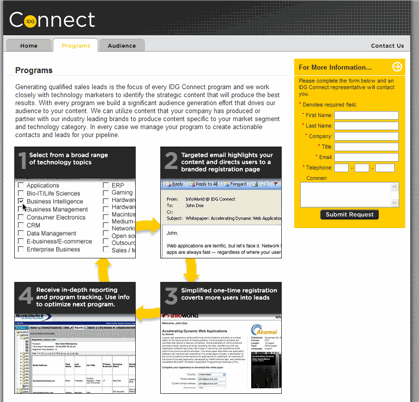 TechTarget was a real pain in my side when I was at InfoWorld, a competitor, because they offer their advertisers a very efficient way to collect full names and email addresses of people who are prequalified customer targets for an advertiser.* We were still driven almost entirely by the CPM model at the time. IDG has since rolled out similar programs such as IDGConnect, and all the tech trades offer a variation on this theme.
It works like this:
1) An advertiser or the publisher create a white paper or webcast about their product or service or about a market trend.
2) The publisher then uses its own internal marketing muscle through its web site, newsletters, RSS feeds, and email (spam) lists to tease the offering.
3) If the offering is good enough, then people will go check it out...after filling out a form with their contact details...and approval to pass their details to the advertiser
4) The publisher then gives the names to the advertiser
This model is great at finding potential customers, and it works particularly well for niche publications who can provide a ton of context around an expensive action (filling out a form and downloading something). Advertisers are willing to pay more per click or per lead when it originates from a prequalified environment instead of an unknown quantity like AdSense on MysteryPublisher.com.
I think Scott is right that as advertisers learn how to capture quality actions in addition to volume, more money will start to flow to the publishers. Publishers who aren't able to prove a click on their site is worth more than a click on a search engine will lose out on that spend.
However, a change in market share does not mean a change in growth. It would be a mistake to proclaim a reverse in search marketing spending at this point. Too many businesses depend on click volume. And search engines are delivering on that need very well. They always will.
* Why a person would value the content at a site with a name like "TechTarget" is beyond me. I know a salesman who received a bucket of leads from his marketing department who proudly collected them via TechTarget. He told me the leads were pretty bad and none of them turned into sales. Maybe they should change their name to "TechConvertToSaleDamnit".
"Will advertisers start to question the ROI of all the money they’ve dumped into search advertising?"
Click fraud is a serious problem, both real and perceived. Brand advertising does impact how people make purchase decisions. Prequalifying user intent can happen places other than search engines.
Chris Zaharias of Efficient Frontier, a SEM provider, also noted that advertisers are thinking bigger than just clicks:
"Advertisers are converting at 2.3% right now, yet good advertisers convert at 4-6%...CPC’s by themselves don’t matter. What matters is CPC times CTR."
Agencies have figured out how to dial their campaign goals to maximize clicks, but they are starting to think more about quality clicks. B2B publishing has understood this for a long time, and there are some interesting lessons from that market for the rest of us.
TechTarget was a real pain in my side when I was at InfoWorld, a competitor, because they offer their advertisers a very efficient way to collect full names and email addresses of people who are prequalified customer targets for an advertiser.* We were still driven almost entirely by the CPM model at the time. IDG has since rolled out similar programs such as IDGConnect, and all the tech trades offer a variation on this theme.It works like this:
1) An advertiser or the publisher create a white paper or webcast about their product or service or about a market trend.
2) The publisher then uses its own internal marketing muscle through its web site, newsletters, RSS feeds, and email (spam) lists to tease the offering.
3) If the offering is good enough, then people will go check it out...after filling out a form with their contact details...and approval to pass their details to the advertiser
4) The publisher then gives the names to the advertiser
This model is great at finding potential customers, and it works particularly well for niche publications who can provide a ton of context around an expensive action (filling out a form and downloading something). Advertisers are willing to pay more per click or per lead when it originates from a prequalified environment instead of an unknown quantity like AdSense on MysteryPublisher.com.
I think Scott is right that as advertisers learn how to capture quality actions in addition to volume, more money will start to flow to the publishers. Publishers who aren't able to prove a click on their site is worth more than a click on a search engine will lose out on that spend.
However, a change in market share does not mean a change in growth. It would be a mistake to proclaim a reverse in search marketing spending at this point. Too many businesses depend on click volume. And search engines are delivering on that need very well. They always will.
* Why a person would value the content at a site with a name like "TechTarget" is beyond me. I know a salesman who received a bucket of leads from his marketing department who proudly collected them via TechTarget. He told me the leads were pretty bad and none of them turned into sales. Maybe they should change their name to "TechConvertToSaleDamnit".
Wednesday, March 8
What people expect when they click on things
I was working on a powerpoint yesterday trying to address some of the important advertising trends. The designer on the team joked that he'd give me a cookie if I could make my point without drawing a funnel.
It's true. The funnel metaphor is very tired. It comes up in so many different ways, and it's not all that instructive.
His comment also reminded me that the language we use to describe advertising strategies is very cold. It's no surprise that people have soured on the advertising business over the years. Who wants to be targeted? Who wants to convert? Who wants to be squeezed through a funnel? (That would have been particularly difficult a couple of months ago when I somehow got addicted to eating large Rice Krispy treats every afternoon.)
Marketing should not be about herding people. It should be about creating opportunity for people.
How does that work in practice? I don't have a good answer. Marketing lingo is very efficient for understanding macro views of markets, but one slide started to open up this thought process for me:
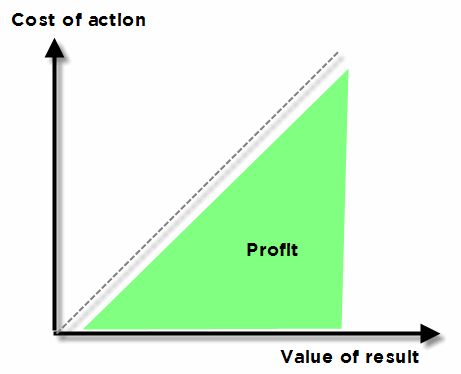
In this case, I'm talking about the ROI a person wants to get from committing to some action such as a click or filling out a form. If the cost of doing something is less than the value of the result of the action, then the person committing the action will feel fulfilled.
You can get people to do expensive things, but you can't expect them to take a loss on the exchange.
Erik owes me a cookie.
It's true. The funnel metaphor is very tired. It comes up in so many different ways, and it's not all that instructive.
His comment also reminded me that the language we use to describe advertising strategies is very cold. It's no surprise that people have soured on the advertising business over the years. Who wants to be targeted? Who wants to convert? Who wants to be squeezed through a funnel? (That would have been particularly difficult a couple of months ago when I somehow got addicted to eating large Rice Krispy treats every afternoon.)
Marketing should not be about herding people. It should be about creating opportunity for people.
How does that work in practice? I don't have a good answer. Marketing lingo is very efficient for understanding macro views of markets, but one slide started to open up this thought process for me:
In this case, I'm talking about the ROI a person wants to get from committing to some action such as a click or filling out a form. If the cost of doing something is less than the value of the result of the action, then the person committing the action will feel fulfilled.
You can get people to do expensive things, but you can't expect them to take a loss on the exchange.
Erik owes me a cookie.
Friday, March 3
Chris Zaharias (aka "Z") on the state of search advertising
I ran into Chris Zaharias of Efficient Frontier yesterday, one of the leading SEM service providers. (Chris and I went to the same high school in Palo Alto.) I've recently been wondering what would happen to the market if search advertising growth slowed, and he had some really interesting things to say about where things are going. His position in the SEM world gives him a great vantage point for understanding how advertisers are spending with the search engines.
I asked Chris what he thought of Google's preemptive performance warning the other day, and he said this was bound to happen:
As a result, spending patterns are changing, too. The combination of available terms, query volume, ad placement, user clicks, and affordable CPC's is starting to balance out into a more sensible ecosystem. Advertisers are closing in on the upper limits of their market and understand how to get what they want out of a buy.
Despite a flattening effect on average, spending should still increase in higher value areas as marketers get more clever with their tracking. The value differential between a relevant and an irrelevant keyword will start to matter more. Brand will start to matter more, too:
The trick for all the ad networks is to help advertisers reach all the way across the funnel. They need to help advertisers track and analyze performance from impression to click to purchase. There's huge potential in behavioral targeting. And there's a lot of work to be done in lead capture.
Chris backed up what we keep hearing from John Battelle about toolbar and desktop downloads. That's how Google is going to make behavioral targeting happen.
The broader upside is that Internet advertising reached over $12B in 2005, according to IAB, an increase of 30% over 2004. Internet advertising outspent radio for the first time, and that trend probably won't reverse for a long time. Google and Yahoo! will obviously capture most of that revenue, but the opportunities are growing across the board. Unlike the crash after the last bubble, a burst now could have a soft landing as revenues begin to spread out across the market.
I've been very dubious of offline market opportunities for Google, but Chris was very bullish on this opportunity:
Hmmm, I dunno. Maybe I'm not close enough to what's happening to understand how that unfolds, but I don't think Google, Yahoo or MSN are capable of delivering on that vision any time soon.
It sounds like business is booming for Efficient Frontier. It makes sense that it would. SEM is getting more and more complicated and simultaneously more and more critical. I might revise my investment wishlist to include a play in this space, too.
I asked Chris what he thought of Google's preemptive performance warning the other day, and he said this was bound to happen:
"The additional knobs they had to turn in the past to outperform are largely gone. They already have 3 ads on the top, they already have taken all the marketshare they’re gonna take, and the auction effect has already taken its upward toll on CPCs."
As a result, spending patterns are changing, too. The combination of available terms, query volume, ad placement, user clicks, and affordable CPC's is starting to balance out into a more sensible ecosystem. Advertisers are closing in on the upper limits of their market and understand how to get what they want out of a buy.
Despite a flattening effect on average, spending should still increase in higher value areas as marketers get more clever with their tracking. The value differential between a relevant and an irrelevant keyword will start to matter more. Brand will start to matter more, too:
"As well-known brands come in, they’ll get higher CTR’s than www.unknownmortgagelender.com. CPC’s by themselves don’t matter. What matters is CPC times CTR."
The trick for all the ad networks is to help advertisers reach all the way across the funnel. They need to help advertisers track and analyze performance from impression to click to purchase. There's huge potential in behavioral targeting. And there's a lot of work to be done in lead capture.
"Advertisers are converting at 2.3% right now, yet good advertisers convert at 4-6%. As advertisers get higher conversion rates, they churn it back into the channel. Behavioral targeting should add much value to search inventory as well, but Google isn’t in as good a position as Yahoo or MSN to get that data."
Chris backed up what we keep hearing from John Battelle about toolbar and desktop downloads. That's how Google is going to make behavioral targeting happen.
The broader upside is that Internet advertising reached over $12B in 2005, according to IAB, an increase of 30% over 2004. Internet advertising outspent radio for the first time, and that trend probably won't reverse for a long time. Google and Yahoo! will obviously capture most of that revenue, but the opportunities are growing across the board. Unlike the crash after the last bubble, a burst now could have a soft landing as revenues begin to spread out across the market.
I've been very dubious of offline market opportunities for Google, but Chris was very bullish on this opportunity:
"Google is kicking ass because they have a huge user base and a better auction system that nets 30-40% better monetization than Yahoo. When RFID readers and tags are cheap, in cell phones and offline media (5-10 years out), and sync’d with PCs, an advertiser will know if a user saw a billboard prior to making an online purchase and thus will be able to re-value the billboard ad on the fly -- leading publisher to auction billboard/print/TV/radio inventory in real-time, probably with Google, Yahoo, MSN’s systems at the middle of things."
Hmmm, I dunno. Maybe I'm not close enough to what's happening to understand how that unfolds, but I don't think Google, Yahoo or MSN are capable of delivering on that vision any time soon.
It sounds like business is booming for Efficient Frontier. It makes sense that it would. SEM is getting more and more complicated and simultaneously more and more critical. I might revise my investment wishlist to include a play in this space, too.
Thursday, March 2
Feedburner's publisher deals are getting interesting
I
see that Feedburner worked out a deal with the IDG publications (except
InfoWorld, strangely). We're seeing Feedburner conduct a systematic
conquest of publishers' RSS feeds with IDG, Reuters and USA Today all
formally committed. If they can get CMP or Ziff, then we'll see the
rest of tech publishing jump on board, I'm sure. Then they'll have a beach head.
 IndustryBrains, now owned by Marchex, similarly hit the publishing
market this way, quietly eroding Google's ability to play in tech
publishing. They have a really interesting model that may give some
insight into what will happen with Feedburner.
IndustryBrains, now owned by Marchex, similarly hit the publishing
market this way, quietly eroding Google's ability to play in tech
publishing. They have a really interesting model that may give some
insight into what will happen with Feedburner.
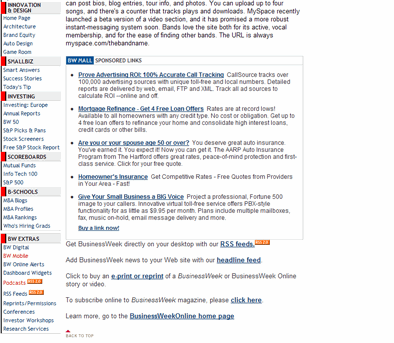
IndustryBrains serves the Sponsored Links you see at the bottom of all the pages on just about any major tech publishing web site and several finance and travel sites. Advertisers bid for placement amongst several high level categories specified by the publisher.
Why does IndustryBrains own tech publishing? It's not only because their CEO Erik Matlick calls up all his customers on a regular basis to see how they're doing. It's not only because they report exactly how much each advertiser is spending and who the advertiser contact is.
IndustryBrains owns that market because tech publishers make more money with IndustryBrains than with Google.
IndustryBrains was particularly clever with their model. When an advertiser buys a Sponsored Link on a site, they are bidding for placement specifically with that brand. A telecom services provider knows that they should pay more for the "Wireless" category on WiFi Weekly than the "Wireless" category on Big Tech Monthly and nothing at all on Kids Gaming Quarterly.
The advertiser can choose where their ads appear. They get more qualified clicks that convert better. They can afford to spend more per click. Therefore, the publisher's take home from the spend is higher. And users are seeing ads that are relevant to them. It works in all directions.
Feedburner is starting to look a lot like IndustryBrains with their commitment to serving publishers, though they've yet to land on a clear advertising model. They've certainly staked out a bigger pie than IndustryBrains has. Unlike IndustryBrains, Feedburner's product scales up and down the tail very easily with its self-serve offering. Soon it's going to be very hard for another ad service provider to talk to publishers about RSS opportunities without going through Feedburner.
I suppose the key question for Feedburner is about how advertising and RSS fit together. Or maybe RSS is just the trojan horse for taking over all those publishers' web pages.
IndustryBrains, now owned by Marchex, similarly hit the publishing
market this way, quietly eroding Google's ability to play in tech
publishing. They have a really interesting model that may give some
insight into what will happen with Feedburner.IndustryBrains serves the Sponsored Links you see at the bottom of all the pages on just about any major tech publishing web site and several finance and travel sites. Advertisers bid for placement amongst several high level categories specified by the publisher.
Why does IndustryBrains own tech publishing? It's not only because their CEO Erik Matlick calls up all his customers on a regular basis to see how they're doing. It's not only because they report exactly how much each advertiser is spending and who the advertiser contact is.
IndustryBrains owns that market because tech publishers make more money with IndustryBrains than with Google.
IndustryBrains was particularly clever with their model. When an advertiser buys a Sponsored Link on a site, they are bidding for placement specifically with that brand. A telecom services provider knows that they should pay more for the "Wireless" category on WiFi Weekly than the "Wireless" category on Big Tech Monthly and nothing at all on Kids Gaming Quarterly.
The advertiser can choose where their ads appear. They get more qualified clicks that convert better. They can afford to spend more per click. Therefore, the publisher's take home from the spend is higher. And users are seeing ads that are relevant to them. It works in all directions.
Feedburner is starting to look a lot like IndustryBrains with their commitment to serving publishers, though they've yet to land on a clear advertising model. They've certainly staked out a bigger pie than IndustryBrains has. Unlike IndustryBrains, Feedburner's product scales up and down the tail very easily with its self-serve offering. Soon it's going to be very hard for another ad service provider to talk to publishers about RSS opportunities without going through Feedburner.
I suppose the key question for Feedburner is about how advertising and RSS fit together. Or maybe RSS is just the trojan horse for taking over all those publishers' web pages.
Wednesday, March 1
How would you spend VC money if you could?
A friend of mine who spent the last several years running some Old Media companies asked me a funny question:
If understanding valuations wasn't important and the risk of losing it all was on someone else's shoulders, then I'd spend some money in one of these areas:
1) Publisher services. In the late '90's, I thought the music business had the most to gain by the dotcom explosion. Today, I think the publishers do. Understanding content and communities is the name of the game. Publishers have this in their DNA. They just need services that help them transition their businesses from tired media vehicles to the dotcom world.
2) Social search. There are lots of opportunities for companies to figure out how to help information find people. I don't know whether that comes in the form of recommendations, sharing things, subscribing to things, a combination or something else. But this is a big space with lots of room for newcomers.
3) Web services. I don't have clear insight into where exactly the best opportunity is in this space, but technologies that move data in and out of databases across the web is probably the single most important aspect of today's online world. I'd bank on companies that are making RSS the core technology behind their products.
4) Video on the web. Big media is moving quickly to move their programming to the web. The user experience for consuming video is clunky, but the pieces are all there. A new hit product is going to appear here, or an old product is going to look new again, I'm sure.
Top 5 products in these spaces, regardless of ownership? Hmmm. Personally, I like:
1) Feedburner
2) Last.fm
3) Del.icio.us
4) YouTube (and there's something very interesting about Democracy TV)
5) I can't come up with a definitive 5th, but I like SixApart, JotSpot and the 43 Things stuff.
Again, I have no idea about valuations and all that, but that's my answer to the question. Funny enough, I was writing this on the train last night, and then this piece titled, The Next Net 25 came out today on CNNMoney and Business 2.0 from Erick Schonfeld, Om Malik, and Michael V. Copeland. It's a much more thorough look at what's going on out there.
Also, Fred Wilson is a great source of insight on this type of question for those who aren't aware of him already.
"If you were able to spend a somewhat large sum of money in the Internet space now, what would you do with it?"
If understanding valuations wasn't important and the risk of losing it all was on someone else's shoulders, then I'd spend some money in one of these areas:
1) Publisher services. In the late '90's, I thought the music business had the most to gain by the dotcom explosion. Today, I think the publishers do. Understanding content and communities is the name of the game. Publishers have this in their DNA. They just need services that help them transition their businesses from tired media vehicles to the dotcom world.
2) Social search. There are lots of opportunities for companies to figure out how to help information find people. I don't know whether that comes in the form of recommendations, sharing things, subscribing to things, a combination or something else. But this is a big space with lots of room for newcomers.
3) Web services. I don't have clear insight into where exactly the best opportunity is in this space, but technologies that move data in and out of databases across the web is probably the single most important aspect of today's online world. I'd bank on companies that are making RSS the core technology behind their products.
4) Video on the web. Big media is moving quickly to move their programming to the web. The user experience for consuming video is clunky, but the pieces are all there. A new hit product is going to appear here, or an old product is going to look new again, I'm sure.
Top 5 products in these spaces, regardless of ownership? Hmmm. Personally, I like:
1) Feedburner
2) Last.fm
3) Del.icio.us
4) YouTube (and there's something very interesting about Democracy TV)
5) I can't come up with a definitive 5th, but I like SixApart, JotSpot and the 43 Things stuff.
Again, I have no idea about valuations and all that, but that's my answer to the question. Funny enough, I was writing this on the train last night, and then this piece titled, The Next Net 25 came out today on CNNMoney and Business 2.0 from Erick Schonfeld, Om Malik, and Michael V. Copeland. It's a much more thorough look at what's going on out there.
Also, Fred Wilson is a great source of insight on this type of question for those who aren't aware of him already.