
He demo'd the new Yahoo! Mail app, the RSS Alerts service, the integration of MediaRSS on My Yahoo!, the new podcast subscription manager, YPN ads in RSS feeds, etc. Seeing the whole set of offerings strung together like that makes quite an impression.
When I interviewed with Yahoo! back in July, I was told over and over again that the company had gone through the pain of embracing openness and that the products would tell the story. I believed these people were being truthful, but it was hard to imagine how this was actually going to play out. Seeing the powerpoint suddenly makes that feel very real.
Niall Kennedy asked a question about publisher services and how Yahoo! plans to share with content creators what data we're able to see happening around all these products. There are several ways the company is exposing that data, but we could clearly do more here. Enabling content creators to leverage Yahoo! as a distribution channel is one thing, but supporting their needs to make a business out of doing that is something totally different. It's a good question, and I would love to see Yahoo! really focus on this.
Kevin Burton asked about public APIs. Scott pointed him to developer.yahoo.net where the current APIs are posted and some community efforts to help facilitate more activity. He said, Yahoo! is still testing some concepts, and the company knows that this is incredibly important. And Scott said we can expect to see a lot more in that area.
 Digg
Digg Comment
How to drive your company faster
One issue that I think a lot of people in the Internet business struggle with is speed. How do you build a system that supports increasing pressure to drive fast? The answer is the subject of many books by many researchers and analysts, but these are a few obvious ones that are sometimes easy to forget.
Top 5 Things Needed by Fast Company Leaders:
- BHAG - Define a single, clear, and really big goal for your staff that keeps them focused on something really hard but also something possible to achieve. This is otherwise known as the Big Hairy Audacious Goal.
- Fear - Make your staff fear the outside world, not the inside world. It shouldn't be the threat of internal political punishment that inspires your staff to be competitive. The market is your battlefield
- Evolution
- Analyze performance in parallel with releases and iterate
quickly. A product that hasn't changed in 6 months is in a
dangerous position. Iterate constantly.
- Distance - Train people to make big decisions by giving them power over the little ones, even if you know they're wrong.
- Momentum - Identify momentum and fuel it. Steer it, but never stop it. If you don't have it, do something small to kick-start it.
Yahoo! acquires del.icio.us

Feedburner's new method for managing the RSS subscribe button problem
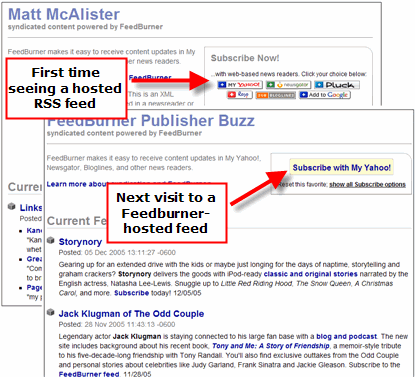 I see today that Feedburner is offering a new way to enable users to quickly and easily subscribe to RSS feeds.
When you click on a link to a feed hosted by Feedburner, the page now
shows several options for which feed reading environment you
want. The interesting new element is that they are saving this
preference for users, which means that next time I click on another
feed hosted by FeedBurner I will automatically see a link to subscribe
via my chosen reader. This action is also enabled for podcasts.
I see today that Feedburner is offering a new way to enable users to quickly and easily subscribe to RSS feeds.
When you click on a link to a feed hosted by Feedburner, the page now
shows several options for which feed reading environment you
want. The interesting new element is that they are saving this
preference for users, which means that next time I click on another
feed hosted by FeedBurner I will automatically see a link to subscribe
via my chosen reader. This action is also enabled for podcasts.Feedburner continues to impress me with their innovations. The chiclet overload problem is not over yet, but the solution is working its way out with these kinds of UI improvements. There is obviously a race to provide publishers with the best solutions for distributing their RSS feeds. Focusing on making RSS invisible to users is the right direction, no doubt.
Speed to market is a winning strategy, too. In today's online game, staying competitive or jump-starting a market is about iterating ideas rather than producing robust, deeply engineered and fully tested solutions. Greg Linden questioned whether mashups were about giving big companies a way to outsource R&D for free.
While that may be partially true, have no doubt that the ambitions of many developers and small companies out there who are innovating quickly is to come up with a product or business model that becomes a big hit.
Feedburner isn't worried about being first to market and having their ideas stolen. They're trying to win.
John Battelle speaks at Yahoo!
 John Battelle drove his book reading tour
through the Yahoo! campus today and spoke to a standing room only
crowd. I was intrigued that the questions from the crowd didn't
concern Google but rather his perspectives on issues of privacy,
marketing and the philosophical importance of search.
John Battelle drove his book reading tour
through the Yahoo! campus today and spoke to a standing room only
crowd. I was intrigued that the questions from the crowd didn't
concern Google but rather his perspectives on issues of privacy,
marketing and the philosophical importance of search. He gave some interesting answers including one thought in particular about the search user interface that I also enjoyed from his book. He talks about search as the logical next step in computer interface design from the operating system GUI. "The OS GUI is about poking things. You poke at the objects on the screen. Search is a way of navigating computer data using language, the way we communicate with each other."
When you put it in that perspective you start to think about what might come next. I'm guessing that people will want to assemple knowledge and data and other digital things into their own personal environments. I can't exactly see it in my mind, but if we went from poking things on our computer to talking at our computers, then I'm betting people will feel comfortable taking apart data and putting it back together to build things either on their own or with groups of people pretty soon. We're building our online homes out there, progressing from lean-to's to huts to structured houses which will certainly be followed by mansions, condos and Trump Towers, no doubt.
Web 2.0 matters across industries and markets...not just on the Internet
Yesterday Jon Udell wrote a blog post about 2 industries that have yet to dive into the new Web 2.0 world. These are just a small sample of all the businesses that don't know a revolution is upon them, and, once again, technology is about to enable profound change to everything everywhere.
Jon talks about a vision for the airline industry which could transform by a peer-based booking process. It could allow people to hop from local airport to local airport in a sort of air taxi system. Similarly, he noted that the energy sector could apply some of the on-demand efficiencies we've come to depend on for many other systems in the technology space.
Just as in it was in 1998, the media and communications industries were early to figure out how to capitalize on the new technology, and the excitement probably sounded like echo chamber noise until companies like Schwabb and Wal-Mart jumped into the game threatening the pure plays.
Could it be true that we're about to watch another explosion of businesses that figure out how to leverage the new technology platform? How will Virgin Airlines and Nike utilize peer-to-peer concepts, user-generated content and participation models, syndicated and distributed revenue streams, and data mashups?
Or will some new pure plays come in and challenge the now old school business models to become the new Amazons, easyJets and Yahoo!'s?
If history can teach us about the future, both cases will be true.
Yahoo!'s new RSS product - get items via Email, IM or SMS
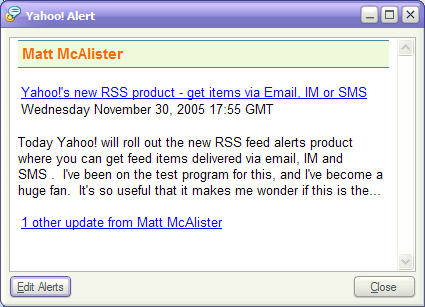 Today Yahoo! will roll out the new RSS feed alerts product where you can get feed items delivered via email, IM and SMS.
I've been on the test program for this, and I've become a huge
fan. It's so useful that it makes me wonder if this is the game
changer that makes RSS a viable mainstream consumption vehicle.
Today Yahoo! will roll out the new RSS feed alerts product where you can get feed items delivered via email, IM and SMS.
I've been on the test program for this, and I've become a huge
fan. It's so useful that it makes me wonder if this is the game
changer that makes RSS a viable mainstream consumption vehicle. I've also been using FeedBlitz for a few feeds, and I've setup my wife with a few feeds that way, as well. You don't have to know what RSS is or that it even exists when you get feed items sent to you. FeedBlitz is a little annoying with all the formatting crap that goes with it. But the concept is spot on.
My favorite feature on Yahoo!'s RSS feed alerts is that I can choose to get some feeds as SMS. This is just so useful. You can get Craigslist search queries like, say, Apartments for Rent, delivered directly to your phone as they come in so that you can be the first to call the listing owner.
This could be improved a bit, though. You can already break down news searches into individual SMS alerts, but I want to see the same functionality on blogs. In particular, I want to get Jeremy's blog posts that are only about Yahoo! sent directly to my phone so that I can get a heads up on whatever email threads are going to be flying around the office. I don't need everything he posts coming to my phone, just ones that might impact my job.
Anyhow, congrats, guys. This is a big win.
How the mashup model can complement the page view model
The first step is probably to understand and plan for the risks. If you lose traffic to mashups, then how do you make up for the lost revenue? How do you estimate performance metrics that determine whether or not your model falls apart? If you know these things, then you can impose some minimum requirements for your partners.
In
this study, the model is a revenue share based on advertising.
Either the mashers carry your ads while you kick back a share, or they
carry their own ads and kick back revenue to you...which ever earns
more for you both. I'm not taking into account the inevitable
illegal uses of your content. That can be curbed with the right
licensing strategy and the right commercial incentives.
Here are 2 different hypothetical outcomes we can use to watch what happens to the numbers. Scenario number one is where you dance in the mash up game and get lucky with a few good partners. The second is a best-case scenario where everything goes well. I'll leave it up to you to determine what the worst-case scenario looks like.
In both cases, we're talking about a fictitious publisher (mydomain.com) who has 1M uniques per month with a $30 average CPM and about $7M in revenue per year.
SCENARIO NUMBER 1: How not to lose money
In
this first model, we look at the difference between what happens before
and after going mashup. The "mashups" line is the aggregate
activity from that publisher's commercial mashup partners, including
the revenue after sharing 30% with the mashers.
| Uniques | PVs | Visits | PPV | IMP | CPM | Share | Revenue | Rev/Year | |
| Before: | |||||||||
| mydomain.com | 1,000,000 | 8,000,000 | 2 | 4 | 20,000,000 | $30 | $600,000 | $7,200,000 | |
| After: | |||||||||
| mydomain.com | 766,667 | 6,133,333 | 2 | 4 | 15,333,333 | $30 | $460,000 | $5,520,000 | |
| mashups | 1,000,000 | 8,000,000 | 2 | 4 | 20,000,000 | $10 | 30% | $140,000 | $1,680,000 |
| TOTAL | 1,766,667 | 14,133,333 | 35,333,333 | $7,200,000 |
You can see here the acceptable damage to your own page view model in order to maintain your current revenue trajectory. If your mashers capture 1M uniques and they do, in fact, deliver on the ad model, you can afford to lose about 1/3 of your traffic and still maintain your business as is. This should also incentivize your mashup partners, as there's a pool of $720,000/year to split based on whoever delivers the most traffic.
Did you say you needed more inventory to sell...? Hmmm, this looks like a solution.
SCENARIO NUMBER 2: Making the most of mashup partnerships
Now,
let's say that you spend a lot of time cultivating your relationship
with your mashers. Let's say that they start reaching your
audience and a whole new audience with some really cool tools that
bring in significant traffic. Since their sites are so good,
they're able to drive up their average CPM from $10 to $15. And
let's say that you even reward their success by giving them a larger
revenue share, as much as 50%. And since we're dreaming up the
best-case scenario, we see that all this new branding and exposure
actually means that your traffic stays flat instead of falling.
| Uniques | PVs | Visits | PPV | IMP | CPM | Share | Revenue | Rev/Year | |
| mydomain.com | 1,000,000 | 8,000,000 | 2 | 4 | 20,000,000 | $30 | $600,000 | $7,200,000 | |
| mashups | 4,000,000 | 32,000,000 | 2 | 4 | 80,000,000 | $15 | 50% | $600,000 | $7,200,000 |
| TOTAL | 5,000,000 | 40,000,000 | 100,000,000 | $14,400,000 |
In this much more optimistic scenario, it turns out that you might be able to double your revenue and increase your total reach without ever lifting a finger. That sounds fun, doesn't it?
Think of these as opportunity models rather than reality-based models. When you're telling the CEO that you want to let other people take your content, make web sites from it and sell ads against it, you'll need some backup material to make your case for the new strategy. Otherwise, you may be meeting with the CEO to make your case for keeping your job.
Tell your CEO that you think your competitor is
about to launch a mashup program and that if you don't beat them to it,
you'll never be able to regain entry into this market. Instead
you'll just watch your traffic stagnating and your ad sales team
flipping out because there's no inventory to work with. And with
an online revenue cap of $7M, you'll never be able to save your print
business. That might wake up the board room.
A new content distribution plan for online publishers
Assuming you buy into this vision, which you probably should, there are some tangible ways that publishers could shift their business to aim into the center of that world. There are some strategic decisions that will help publishers become more competitive in a world of "feed ubiquity", and there are some specific operational changes that will make your content accessible for different tools and technologies.
This list of ideas is a combination of strategic and operational recommendations for today's publisher:
2) Write better news stories, not more news stories. Pay for a wire service to fill in holes, but don't publish a single story of your own that isn't completely original. Your reporters have better contacts in your market than any wire service would, so leverage that and get those scoops that only you can dig up. The result is better, wider, deeper coverage of your market that is more likely to get picked up by external sources.
3) Unleash your reviews to the wild using microformats, tags and user-contributed ratings. Publish RSS feeds of your content marked up with the hReview format. Add tags. Pull in related links from the tagosphere. Incorporate user ratings and syndicate those with your content. (Read about our experiments with del.icio.us back at InfoWorld 1, 2)
4) Glorify your columnists. Make them part of your brand, and promote them heavily on your home page. The impersonal news-driven machine won't build reader loyalty, as there's always another site with news that's better than yours. Pay them well, and expect them to provide leadership in your market with their intelligence and insight. If bloggers aren't linking to their columns, then that's a good sign that they are failing to serve their market.
5) Every editor on staff should be blogging. They shouldn't be posting just to link to things. They should be posting about what they are learning in their beat. You will never corner the conversation on whatever your market covers. But you can make your staff accessible to your market through their blogs and then capable of getting those scoops that will drive #2.
6) Lastly, engage the mash up community. Offer rewards to developers for building mashups. Use the Creative Commons Attribution Noncommercial Share-Alike license (or something similar) so that people can legally take your content and do things with it. But you must also offer commercial licenses of your content where you share revenue with your partner. Help them make money, and they will help you make money.
The idea is to make your content mash up ready and to build incentives for people to use your content. "Because you can" is not an incentive. People will use your content when it helps them to either solve a problem or to earn money. Make it possible for people to do both.
If Dick's vision is right, then there will be (or already is) a race for content creators to produce material that is exciting, accessible, useful, connected, and legal to redistribute. You used to have 2 customers: advertisers and readers. You now have a 3rd: mashers.
The science of spontaneity
Rex Hammock, Richard MacManus and Joshua Porter gave mashup presentatons and even posted the powerpoint files on their blogs. Verne Kopytoff of The SF Chronicle and Elinor Mills of CNET posted news analysis pieces on mashups.
There's nothing new about a meme. In fact, there's nothing all that new about this particular meme. But what is strange is the angle of the story that is nearly identical in content and in timing. An effort to humanize Web 2.0 concepts through mashups shot through several vehicles nearly simultaneously. Why does this happen?
I've seen some interesting ways of analyzing this kind of thing after it happens. Tag clouds give a slow-moving perspective of meme movement. Memeorandom does a nice job of grouping popular topics as they are forming during the day. Slashdot and Digg both capture common interest and spread it like wildfire (Though now we have diggdot.us which combines Slashdot, Digg and del.icio.us to capture interest).
These are all reflections of spontaneity not occurances of it being expressed. Rex, Richard, Joshua, Verne and Elinor all probably read many of the same blogs and feeds that I read. But I am certain that nothing any of us read made us all generate the same idea at the same time. My presentation was scheduled not coordinated.
I find it bizarre yet not necessarily surprising that people process the same ideas at nearly the same time. What surprises me is that there isn't more scientific understanding of why this occurs. Maybe the next leap in search after social and semantic connections is the study of spontaneous order. If so, then somewhere in the Silicon Valley there are super secret research projects that aim to identify memes before they actually get expressed.
Does schwag do what it's supposed to do?
 On your first day at Yahoo! they give you a backpack for your
laptop. It's a really nice backpack. Everything I need fits
nicely in it, and the pockets are in the right places, and it's sturdy,
and it's not ugly.
On your first day at Yahoo! they give you a backpack for your
laptop. It's a really nice backpack. Everything I need fits
nicely in it, and the pockets are in the right places, and it's sturdy,
and it's not ugly.But there's one problem. It has a big silver Yahoo! logo (the corporate "Y-bang") stitched into it.
With several thousand employees now, you're going to commute with people that you know if you take the train...along with many competitors who all converge on the Mt. View station. And you're often a little more open-minded and free with your opinions once you step outside the office, for some reason. But the backpack has a way of muting your Caltrain conversations that could otherwise turn into productive meetings.
Your competitors are all disguised in their daily kit, but you're standing there like a proud peacock.
Seeing the silver flag on the train and at the station reminds me of college when you would see greek baseball caps parading through campus in groups. I'm pretty sure people don't see the logo and think I'm a disgusting person, but it's completely possible.
Don't get me wrong -- I'm not complaining. I really like the backpack. I've just always wondered if tchotchkes have the effect on people that marketing people think they have.
Riffs.com: File under "Simple Idea, Excellent Execution, Wish I'd Thought of It"
I'd like to say that I thought of doing something very similar, but that's a meaningless claim since I have nothing to show for it. Somebody actually delivered, and, damn, they did a really nice job.
They even have a bookmarklet and a "Riff Roll". If they opened their APIs so that other sites could read and write to this system, then I think they would see mass adoption in short order.
Regardless, well done whoever you are.
Mainstreaming RSS subscription user interfaces
We also know that verbs make much better calls to action than nouns. So, what is the right verb for RSS feeds? Is it "Subscribe"? How about "Add"? Or "Track"?
Tom Raftery thinks 'Subscribe' with a little tooltip next to it is the right way to present the experience. Pete Freitag came up with a nice UI in his SoloSub experiment, but it's definitely missing a clear call-to-action for non-initiated users.
Of course, Dave Winer, Jeremy Zawodny, Dare Obasanjo, Tim Bray and several others, have had debates about what the behavior of that button should be. Regardless of the browser behavior, we still have a verb problem.
Yahoo! currently uses "Add Content" on My Yahoo!. And that seems to have paid off pretty well, but it was designed for a dashboard interface. In any other enviornment, "Subscribe" is probably a better action word.
However any research will tell you that people find the word "Subscribe" to be a loaded concept...it might have pay implications...it might mean that I have to do something to get something...it might mean I need to cancel something...it feels permanent.
Perhaps more importantly, the word "Subscribe" may be a conflicting term when you also have paid services that people subscribe to or email newsletters promoted on the same page.
So, then you start thinking "Add Feeds" might make more sense, in general. But where you are "Adding" these things becomes crucial to that experience. And "Add" is being used in many different contexts for other content types. It may work as the right action in a very specific context, but it can't be applied the moment you abstract the UI out of the local environment.
If I'm on a news site somewhere, and I see a button to "Add Feeds" I have no idea where they are going and if I'll ever see them again after I "Add" them. Does "Adding" a feed do the same thing as "Adding an Event" to my calendar? Is it like "Adding" a friend in my social network? Am I "Adding" two things together to make one thing? There's no concept that I can have an ongoing relationship with the content of the feed with the word "Add". And the word will get even less meaningful over time as there are more things people can add to more environments.
I would like to push for "Subscribe" and "Subscriptions", as it's a more scaleable nomenclature and more accurate for the experience. But I have trouble arguing that mainstream users are ready to "Subscribe" to things as readily as they will "Add" things.
If we're ever going to solve the chiclet overload problem, we need to come up with something that the 95% of the Internet audience who doesn't yet grasp RSS can relate to without having to be trained.
Of course, there’s a lot to do in terms of improving the ways people consume RSS, too. But that’s a different debate.
Testing the hReview Creator from microformats.org
Thumbs Up for The Office
Nov 16, 2005 by Matt McAlister The Office★★★★★Though I'm disappointed this show doesn't measure up to the original from Ricky Gervais, I find it to be easily one of the best programs on TV. It's a guaranteed laugh for me.
I just wanted to test what would happen if I put a review in my feed that was tagged with the correct hReview microformat.
hReview Creator tool: http://microformats.org/code/hreview/creator
How to present Web 2.0 ideas that resonate with non-technical people
 I was reminded of this yesterday while giving a presentation to a group of publishers at Stanford's Publishing on the Web course run by Holly Brady and Janet Wright. Except this time I had a little more perspective than my view only a year out of university back at Amdahl.
They were there to learn smart strategies for operating their businesses. I was there to talk about RSS, Tagging, Social Networks and the pending threats and opportunities for publishers in the new world. (PowerPoint 6.3MB)
I struggled a bit coming up with a thesis for my talk. I wanted to go through the implications of these new things on the content business, but it wasn't until I looked up "Mashup" in Wikipedia that the message became clear to me.
Telling the Web 2.0 story is full of buzziness that only a VC can love. But when I positioned the talk around 'Mashups' I think I stumbled on a concept that people can lock on to.
I started with a definition of Mashup by talking about music, sampling and Hip Hop. Everyone understands that.
I then went through the trends I see affecting publishers in terms of their home page traffic (RSS readers and new browsers taking away attention), navigation (semantics and tagging becoming the new concepts for user interfaces) and then communities that are forming in different ways (social networks driving usage away from publishers).
I followed that by explaining how these pieces can contribute to a 'Mashup' using a few examples like the Yahoo! Event mashup, BBC's various traffic mashups and Trulia.
Finally, I went through a few concepts for business models and then stepped through the various arguments against making your content more Mashup-friendly, posing some challenges to each.
The response seemed mixed, but based on some of the questions I got ("Explain again how I make money with someone else using my content?" and "How can I track what's happening with my content out there?") and even some of the challenges ("You're saying that I should encourage people to take my most valuable content and reuse it? No. I don't see it." and "Isn't a mashup copyright infringement?") the message of what a Mashup is got through.
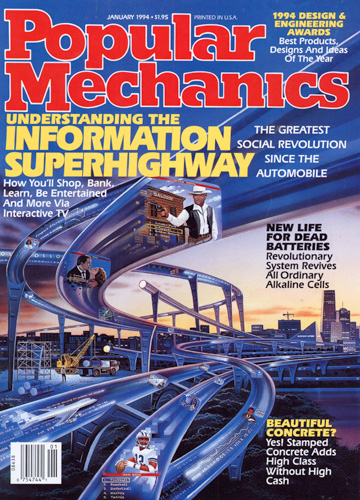
From what I could tell, everyone in the room understood Web 2.0 despite the fact that I didn't once mention the term. Remember the idea of the "Information Superhighway"? That was a very effective way of grasping the Internet in 1994. It seems the "Mashup" might be the smartest way to give today's Internet trends life for the non-technical.
Letting obsessed music lovers create my recommendations for me
 He had some interesting ideas on how people discover new music. He's clearly an advanced music searcher, perhaps obsessed even, with several different methods for staying in tune with the market. Being an employee at MySpace gives him a lot of visibility into the underground scene. As a content creator, he has self-imposed deadlines for finding a few new tracks each week to play for his audience. Listeners to his show email him ideas for things to play. He goes to live shows. His friends are obsessed with music. He has a handful of labels that provide jumping off points to new artists. He subscribes to some email newsletters. And he gets a CD delivered to him each month, a compilation of new music called the Cornerstone Player.
I asked Mitch to estimate how much of his time is spent finding new music, including listening to things for the purpose of learning as opposed to simply enjoying music.
There's a certain gratification in finding an unheard of band. He said discovery can even be a competitive thing. A band is suddenly not as interesting when someone else finds it first or when someone less sophisticated in their music tastes mentions it.
Discovering new music is part of life for him. But it seems to me that there must be ways to help people who have a genuine interest in music to get closer to the discovery trail that Mitch is blazing without all the heavy lifting. I have a lower tolerance for a bad signal to noise ratio when it comes to music than he does.
Fortunately, I can listen to Mitch's podcast and get a glimpse into his world, but I don't like all the same music he likes. He can't be my only filter into the world of music. I want to stitch together a network of the obsessed in the genres along several different content axes that interest me and let them pull me along in their journeys.
I wonder then how this translates into other genres of content such as photos and world news and local events and shopping deals and Hollywood gossip. The obsessed are putting context around their worlds that the rest of us should have access to in sensible ways. They are uncovering new depths and adding value in their perpetual quests.
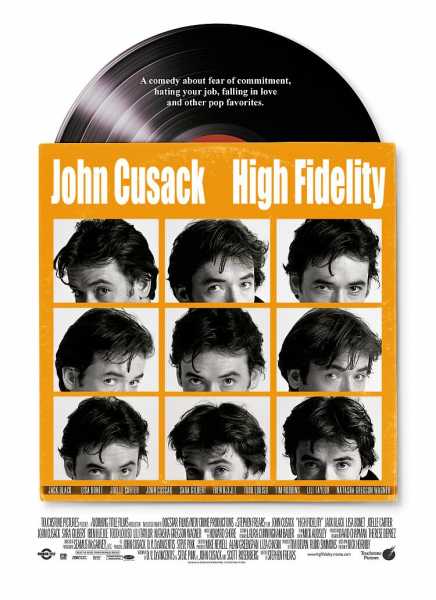
Nick Hornby might have characterized Rob Gordon in his book High Fidelity a little more like Mitch had he written it in 2005, constantly online jumping from source to source to source on a neverending search. If you're like me, you may have heard of the Beta Band before that film, but it was just another source in a genre until the view through his obsessed world brought life to that track Dry the Rain.
Show me the Top 5 music freaks in my Top 5 favorite genres. Then give me the Top 5 most-listened to tracks amongst their followers. Throw in X random tracks per 100. Flag the ones my friends like for context. Readjust monthly.
Now that would be a kick ass music station to listen to.
The distance that grows as interactivity improves
As I post this I'm wondering if the engineer who sits maybe 2 feet away from me will know that I'm blogging about her. We exchange pleasantries most days, but since we're not working on the same projects, we might as well be in different countries.
Email, IM, blogging, RSS and all the Internet-based forms of communication encourage a lightweight human interaction model that is replacing real world human interaction.
We can interact with more people, but we interact less with each person. Is this bad?
The writing is on the front page
Though many newspapers are claiming that they are removing wasted circulation from their file, that's actually code for cutting printing costs because they aren't making enough money to justify the number of issues being printed. You can also expect the industry to make claims about 'readership' as opposed to circulation which is a measure of the number of people who read a publication perhaps from pass-along from friends rather than a measure of one reader per printed copy. Again, this is a way to float larger audience numbers to advertisers to justify the cost of printed pages.
I won't proclaim the end of print as a medium. I enjoy skimming through The Chronicle every morning on the train very much. But if you can't see that the online space is where it's at by now, then you probably deserve to watch your print circulation business slip into oblivion. I've heard the excuse that the money isn't there yet. Well, you're on the edge of losing the revenue stream that could be used to figure out how to make enough money online to support the staff and infrastructure that keeps your business alive.
Dear Mr. Print Publsher - The next time an editor says she wants to pay a blogger to post on the site, I suggest you reply, "Yes, please. Shall we pay bloggers $2 per word? Let's put that blog on the home page. Would you like more engineers to work with? What is the minimum number of people we need to keep the print product alive? I want to move all the talent over to the online side of the business. Who wants the corner office where the Art Director used to sit?"
By the way, kudos to Tom Abate and The Chronicle for printing this story on the front page of the Business section...in print. Bold.