
Justin Fox of Fortune (who happens to be a good family friend, actually) asks if the role of the traditional editor is getting hijacked on the Internet, then what is going to replace the need for social reference points?
"There is nothing natural or inherently superior about the monolithic media institutions of the mid-to-late 20th century. But there is still a need for the community-building, consensus-shaping role that the best of the media gatekeepers can play. The question is, who's going to play it? And how are they going to make it work economically?"
Google's PageRank algorhythm was a landmark differentiator in the web-based world of machine-driven editorial decision-making because it placed value on one very important social action, the hyperlink. The existence of a hyperlink to a web site implied human value because it was assumed that the link was created by a human who valued that destination page. Therefore, that page should be ranked higher than other pages valued less by humans. That factor more than any other made the Google search results better than everything else out there at the time.
It's not obvious to me that Google learned from that breakthrough in their new recommendation editor in Google News. It appears to be based entirely on machine learning. Just like all the content in Google News, the results are pretty good in a sort of categorical way and in terms of immediacy, but the machine context isn't enough to create any kind of emotive response to the recommendations they give me.
(Update: Google News posted some info on what's happening: "Google News has no human editors selecting stories or deciding which ones deserve top placement. Our headlines are selected by computer algorithms, based on factors including how often and on what sites a story appears online...Google News can automatically recommend relevant stories just for you by using smart algorithms that analyze your selections.")
The New York Times published a Recommendations 101 piece this week where they described why recommendations matter, and they noted a key flaw in the concept:
"Earlier this month, Walmart.com issued a public apology and took down its entire cross-selling recommendation system when customers who looked at a boxed set of movies that included 'Martin Luther King: I Have a Dream' and 'Unforgivable Blackness: The Rise and Fall of Jack Johnson' were told they might also appreciate a 'Planet of the Apes' DVD collection, as well as 'Ace Ventura: Pet Detective' and other irrelevant titles."
If recommendation engines are to replace traditional editors, they need to have a more direct connection to the human-powered web. This is one of the reasons I like del.icio.us so much. The output and display of content there is very purely machine-driven, but all of the input is human-driven. It's a fantastic combination of the two forces working together.
Noah Brier agrees that the role of the editor in a media company is changing quickly:
"In many ways, recommendation systems spell the end of the editor as we know it. Of course there will always be a place for human editors somewhere, but increasingly technology is going to find ways to deliver information without their help."
Our social actions create the editorial filter through which we will discover things that matter to us. Recommendations are very trendy and for a good reason, but the juice that makes it a powerful force is not the machines behind it...it's the people.
 Digg
Digg Comment
Monday, January 23
A glimpse into the future: China and virtual economies
Two interesting sidebar pieces in the SF Chronicle this morning offer a glimpse into the future of the online world (though I can't find either on their web site):
- The Chinese Internet population reached 111 million people, growing by 17 million in 2005. That's over 46,000 people a day. Of course, the density of the activity is in the cities. And I'm sure the mobile device adoption plays a huge role in those figures. Regardless, things are moving fast in Asia.
- PC Gamer announced that they are no longer accepting advertising from "gold farmers", brokers and resellers of virtual gaming currencies and high-powered players. Throwing out an advertising revenue stream requires a deep philosohpical divide, which means there's also enough momentum from this economy to cause a real threat to the current state of play.
Friday, January 20
Getting user participation through the right value exchange
The user interaction model that drives participation online can be drawn in several ways, but I'm most interested in the way web sites reflect participation back to the users.
The traditional message board was cool because you felt like you were able to jump from room to room at a party throwing in your $0.02 and jumping back out without consequence. You saw your post on the site with your fake name next to it, and it was exhilarating the first few times, addictive to many. The blogging model changed this by forcing people to own up to their remarks and lowering conversation barriers...there were suddenly no moderators, and your name was attached to everything you said forever.
At the other end of the spectrum, there are some very very lightweight ways that I can affect change on the Internet without making such a heavy commitment. I can vote for other people's blog posts and news articles on Digg. I can rate a song on Yahoo! Music Engine. I can save an article with descriptive tags in del.icio.us.
The most important element of the user interaction model in these lightweight participation systems is the tangible and immediate feedback loop, one where my contribution has a specific effect on the wider pool. My vote in Digg boosts the importance of an article for the entire community. My song rating in YME gives me highly relevant playlists. My tags in del.icio.us build a data pool I can leverage for myself and share with other people for a range of purposes.
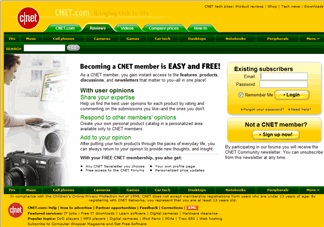 But there are plenty of ways to fail at getting lightweight participation right, too. For example, I find the CNet style product ratings very annoying. They actually invite me to give them my email address and to register for the site with this enticing marketing copy: "Help us find the best user opinions for each product by rating and commenting on
the submissions you like--and the ones you don't.". Why should I do that? There's no benefit to participating. They get much more out of using my data and my contribution than I do. Forget it.
But there are plenty of ways to fail at getting lightweight participation right, too. For example, I find the CNet style product ratings very annoying. They actually invite me to give them my email address and to register for the site with this enticing marketing copy: "Help us find the best user opinions for each product by rating and commenting on
the submissions you like--and the ones you don't.". Why should I do that? There's no benefit to participating. They get much more out of using my data and my contribution than I do. Forget it.
The right model is one where I'm getting more value in return than it costs me to participate. If I'm not personally making a profit of some sort, then there had better be a gain for the community as a whole. Otherwise, my participation is only helping the proud owners of the site that invited it.
The traditional message board was cool because you felt like you were able to jump from room to room at a party throwing in your $0.02 and jumping back out without consequence. You saw your post on the site with your fake name next to it, and it was exhilarating the first few times, addictive to many. The blogging model changed this by forcing people to own up to their remarks and lowering conversation barriers...there were suddenly no moderators, and your name was attached to everything you said forever.
At the other end of the spectrum, there are some very very lightweight ways that I can affect change on the Internet without making such a heavy commitment. I can vote for other people's blog posts and news articles on Digg. I can rate a song on Yahoo! Music Engine. I can save an article with descriptive tags in del.icio.us.
The most important element of the user interaction model in these lightweight participation systems is the tangible and immediate feedback loop, one where my contribution has a specific effect on the wider pool. My vote in Digg boosts the importance of an article for the entire community. My song rating in YME gives me highly relevant playlists. My tags in del.icio.us build a data pool I can leverage for myself and share with other people for a range of purposes.
But there are plenty of ways to fail at getting lightweight participation right, too. For example, I find the CNet style product ratings very annoying. They actually invite me to give them my email address and to register for the site with this enticing marketing copy: "Help us find the best user opinions for each product by rating and commenting on
the submissions you like--and the ones you don't.". Why should I do that? There's no benefit to participating. They get much more out of using my data and my contribution than I do. Forget it.The right model is one where I'm getting more value in return than it costs me to participate. If I'm not personally making a profit of some sort, then there had better be a gain for the community as a whole. Otherwise, my participation is only helping the proud owners of the site that invited it.
Inside Old Media and the role of the editorial gatekeeper
I'm enjoying the recent blogging activity from Scott Karp of Atlantic Monthly on "Old Media". What's particularly refreshing is that his comments are coming from within old media itself, a position shared by few who criticize it.
He sits in a difficult position riding the fence between shouting at the people around him who are slow on the uptake in New Media and representing those same people in their defense against boisterous New Media idealism. We need more people like Scott to step up and speak out on the things that matter to them. Otherwise, the blogosphere will just keep barking at the same dogs until everyone gets bored and goes back to watching TV.
That said, I have to challenge a notion that keeps coming up in his viewpoints.
Insistence that there's an editorial gatekeeper required in the media model is going to hold Old Media back from embracing New Media at any truly valuable level. The editorial gatekeeper is a role that won't go away, but it's importance is quickly fading.
In Old Media, you have a whole team of people thinking about things like the table of contents all day long. If those same people spent all that time thinking about how to engage with the audience online instead, I'm certain you'd see a more dynamic response to your brand in short order.
The traditional editor isn't a cornerstone in the media model anymore. The traditional editor needs to start writing that damn book he or she has been wanting to write since college or to at least get on the blog train. The voice is now coming from the web site UI, the software engineer and his clever tricks, the community itself and what they contribute, and the product managers who drive the development roadmap.
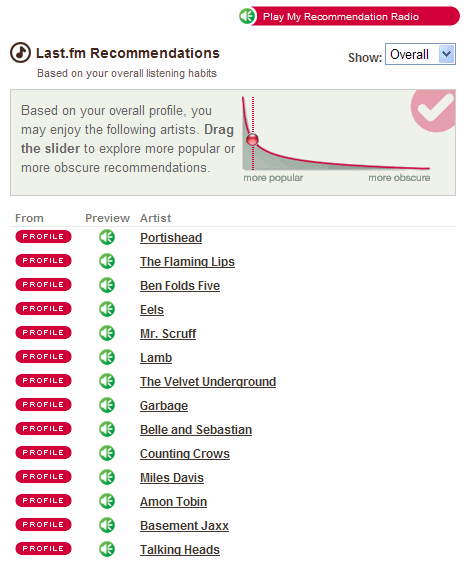 Last.fm has a really cool music recommendation and social network platform that operates by tracking what I'm playing in iTunes, Yahoo! Music Engine, Windows Media Player...whatever.
The premise of the platform's value is that it gets better the more data I give it. There's an obvious and direct correlation between what personal info I'm giving to Last.fm and the recommendations they give back to me. I can even see what data they are collecting.
Similarly, the iTunes store now makes recommendations at the bottom of your screen. It does so by looking at whatever you are viewing in your library and making the Amazonian-style "People who liked this also liked..." kind of recommendation for related albums you can buy.
But Apple raised several eyebrows with this trick. From BBC: "Privacy advocates complained that Apple had not done enough to warn people about the information that was being collected, nor what was being done with the collected data."
Everyone in the media business is trying to extract more money from current users, as the margins on new user acquisition look uglier and uglier all the time. The idea is to get your current users to click on more pages or to buy more product. It's all about increasing engagement metrics.
Well, it's no secret that people respond well to good recommendations. We've all been caught in Amazon's trap and ordered an extra thing while placing an order. You could always justify a few extra bucks on it, too, "I was going to get that anyhow."
The trade off seems fair on both sides. I let you track what I'm doing, and you show me something I don't know. If I don't spend 20 minutes reading your privacy policy, I'm going to have to trust that you don't betray me with the personal data I offer you.
Apple freaked everyone out by being opaque with their iTunes recommendation data. Jobs himself had to step in and clear the air. Is Apple giving me recommendations because it wants me to be happy or is it doing so to make money in other ways that I'm not privvy to?
Motivations must be clear when dealing with personal data, and you have to give your users insight into what is happening with that data. In an increasingly trust-driven economy, Last.fm will get my business over iTunes any time I'm given the choice.
He sits in a difficult position riding the fence between shouting at the people around him who are slow on the uptake in New Media and representing those same people in their defense against boisterous New Media idealism. We need more people like Scott to step up and speak out on the things that matter to them. Otherwise, the blogosphere will just keep barking at the same dogs until everyone gets bored and goes back to watching TV.
That said, I have to challenge a notion that keeps coming up in his viewpoints.
Scott asks in his last post, "as Old Media gatekeepers fade, who will ultimately take there place?
Will it be thousands of micro-gatekeepers (oh, my head hurts), or will
there emerge a handful of new uber-gatekeepers (like the three TV
networks)?"
Insistence that there's an editorial gatekeeper required in the media model is going to hold Old Media back from embracing New Media at any truly valuable level. The editorial gatekeeper is a role that won't go away, but it's importance is quickly fading.
In Old Media, you have a whole team of people thinking about things like the table of contents all day long. If those same people spent all that time thinking about how to engage with the audience online instead, I'm certain you'd see a more dynamic response to your brand in short order.
The traditional editor isn't a cornerstone in the media model anymore. The traditional editor needs to start writing that damn book he or she has been wanting to write since college or to at least get on the blog train. The voice is now coming from the web site UI, the software engineer and his clever tricks, the community itself and what they contribute, and the product managers who drive the development roadmap.
Wednesday, January 18
Last.fm + personal data = excellent music
Last.fm has a really cool music recommendation and social network platform that operates by tracking what I'm playing in iTunes, Yahoo! Music Engine, Windows Media Player...whatever. The premise of the platform's value is that it gets better the more data I give it. There's an obvious and direct correlation between what personal info I'm giving to Last.fm and the recommendations they give back to me. I can even see what data they are collecting.
Similarly, the iTunes store now makes recommendations at the bottom of your screen. It does so by looking at whatever you are viewing in your library and making the Amazonian-style "People who liked this also liked..." kind of recommendation for related albums you can buy.
But Apple raised several eyebrows with this trick. From BBC: "Privacy advocates complained that Apple had not done enough to warn people about the information that was being collected, nor what was being done with the collected data."
Everyone in the media business is trying to extract more money from current users, as the margins on new user acquisition look uglier and uglier all the time. The idea is to get your current users to click on more pages or to buy more product. It's all about increasing engagement metrics.
Well, it's no secret that people respond well to good recommendations. We've all been caught in Amazon's trap and ordered an extra thing while placing an order. You could always justify a few extra bucks on it, too, "I was going to get that anyhow."
The trade off seems fair on both sides. I let you track what I'm doing, and you show me something I don't know. If I don't spend 20 minutes reading your privacy policy, I'm going to have to trust that you don't betray me with the personal data I offer you.
Apple freaked everyone out by being opaque with their iTunes recommendation data. Jobs himself had to step in and clear the air. Is Apple giving me recommendations because it wants me to be happy or is it doing so to make money in other ways that I'm not privvy to?
Motivations must be clear when dealing with personal data, and you have to give your users insight into what is happening with that data. In an increasingly trust-driven economy, Last.fm will get my business over iTunes any time I'm given the choice.

Saturday, January 14
The "Old Media" rebuttal to the noisy blogosphere
I've recently been hearing "Old Media" defending itself against the noisy blogosphere (Scott Karp of Atlantic Monthly, Simon Waldman of The Guardian, among others). I think they're tired of hearing condescending chatter from people who don't know what it looks like inside today's media company.
You can't convince an Old Media company that readers don't value editorially vetted and professionally packaged content. And it does no good to tell them that they have to get on the cluetrain. They get it. But the cluetrain's destination isn't Revenueville. Hiring, firing and reorganizing cannot be done without a known outcome. You can bet executives at the highest levels are wrestling with this, most of whom read the FT:
But I think the failure to find successful revenue streams is a function of a failure to see what your users want from you. Yes, they want your content, and they're happy you pay people to fact check. But they really want to use your brand to socialize and discover things much more than they want to scan headlines on your home page.
The message that may be getting lost in the blogosphere noise is that Old Media is failing because of its dependence on old revenue models at the expense of serving their visitors. Matt Blumberg has 2 very insightful posts on what the model should look like (via Fred Wilson):
Stop thinking about how to shove bigger ads onto your pages and ways to make people click on things. Stop having meetings about how many articles should appear on your home page. Stop wasting money on new content management systems and site redesigns.
Where's the revenue? Advertising. Paid content and services.
The problem isn't the revenue models. The problem is that your web site is becoming less and less compelling as more and more competitors are helping people do what they want to do on the Internet. Advertising and paid content will work a lot better when your visitors are there because they want to be.
I don't think the critical blogosphere noise will stop until Old Media invests in the new user interaction models rather than continue its fight to preserve traditional advertising metrics.
You can't convince an Old Media company that readers don't value editorially vetted and professionally packaged content. And it does no good to tell them that they have to get on the cluetrain. They get it. But the cluetrain's destination isn't Revenueville. Hiring, firing and reorganizing cannot be done without a known outcome. You can bet executives at the highest levels are wrestling with this, most of whom read the FT:
"Music companies, television and radio networks, newspapers and magazines are all facing upheaval as the internet changes how people receive information and entertainment."
But I think the failure to find successful revenue streams is a function of a failure to see what your users want from you. Yes, they want your content, and they're happy you pay people to fact check. But they really want to use your brand to socialize and discover things much more than they want to scan headlines on your home page.
The message that may be getting lost in the blogosphere noise is that Old Media is failing because of its dependence on old revenue models at the expense of serving their visitors. Matt Blumberg has 2 very insightful posts on what the model should look like (via Fred Wilson):
Part 1: "The New Media deal is that we as American consumers are willing to share a certain amount of personal information in exchange for even better content, more personalized services, or even more targeted marketing."
Part 2: "The We Media Deal has two components to it: (1) the value of the service to you increases in lock-step as you contribute more data to it, and (2) the more transparent the value exchange, the more willing you are to share your data."
Part 2: "The We Media Deal has two components to it: (1) the value of the service to you increases in lock-step as you contribute more data to it, and (2) the more transparent the value exchange, the more willing you are to share your data."
Stop thinking about how to shove bigger ads onto your pages and ways to make people click on things. Stop having meetings about how many articles should appear on your home page. Stop wasting money on new content management systems and site redesigns.
Where's the revenue? Advertising. Paid content and services.
The problem isn't the revenue models. The problem is that your web site is becoming less and less compelling as more and more competitors are helping people do what they want to do on the Internet. Advertising and paid content will work a lot better when your visitors are there because they want to be.
I don't think the critical blogosphere noise will stop until Old Media invests in the new user interaction models rather than continue its fight to preserve traditional advertising metrics.
Friday, January 13
Digg vs Slashdot: the difference is commitment
Jason Kottke posted an interesting analysis of Digg versus Slashdot. He said that Digg's size is undeniable but the Slashdot audience is more influential:
This difference is due to the participation models.
Digg is very lightweight. The voting process is widely distributed and flat. The act of posting is open to anyone, and it takes only a minute to do.
Slashdot requires more work for participation and the approval process is hierarchical. Voting rights are given only to a few. And a second layer of moderators keeps an eye on the voters themselves. CmdrTaco may not be a dictator, but his presence at the top of the pyramid is felt by all.
Digg requires less commitment and therefore the dedication to the service and engagement with the content there is going to matter less to the participants. I bet they noticeably surpass Slashdot traffic before June '06, but a visitor coming to your site from Digg will have much less context for understanding your site.
Slashdot requires an investment of time and energy to participate and therefore the participants care a lot more about the content they visit. They are more likely to pass URLs around and blog about them on their own sites. So, it's no surprise that a visitor from Slashdot is going to be more engaged with your content.
The spectrum of source traffic might look something like this:

Of course, neither are impervious to devious SEM. I'm sure Digg is full of self-serving posts. Slashdot is harder to crack, but I've had some success in the past getting traffic-driving posts submitted on Slashdot.
The data aside, the Digg link was fun and all but ultimately
insignificant. The Slashdot link brought significantly more readers to
the site, spurred many other sites to link to it, and appears to have
left me with a sizable chunk of new readers. As an online publisher,
having those new long-term readers is a wonderful thing.
This difference is due to the participation models.
Digg is very lightweight. The voting process is widely distributed and flat. The act of posting is open to anyone, and it takes only a minute to do.
Slashdot requires more work for participation and the approval process is hierarchical. Voting rights are given only to a few. And a second layer of moderators keeps an eye on the voters themselves. CmdrTaco may not be a dictator, but his presence at the top of the pyramid is felt by all.
Digg requires less commitment and therefore the dedication to the service and engagement with the content there is going to matter less to the participants. I bet they noticeably surpass Slashdot traffic before June '06, but a visitor coming to your site from Digg will have much less context for understanding your site.
Slashdot requires an investment of time and energy to participate and therefore the participants care a lot more about the content they visit. They are more likely to pass URLs around and blog about them on their own sites. So, it's no surprise that a visitor from Slashdot is going to be more engaged with your content.
The spectrum of source traffic might look something like this:
Of course, neither are impervious to devious SEM. I'm sure Digg is full of self-serving posts. Slashdot is harder to crack, but I've had some success in the past getting traffic-driving posts submitted on Slashdot.
How to game Slashdot
This kind of hack is not programmatic or via some robot of any kind. It's an editorial hack. I learned it through trial and error, though I must admit that I didn't fully test it. Here's how it works:
- You need to start reading Slashdot carefully and get a feel for what kinds of posts make it big. There's no formula, but there are certainly some patterns:
- It must be a breaking story. By the time it reaches a printed newspaper, it's probably too late.
- News isn't enough. The post must be insightful. They don't care about product releases unless it's something that will change a market.
- The post needs to take a position. It must imply a threat to a traditional technology or offer a key evolution of a technology.
- Language is important. The moderators look for bad writing and may kill a post based on it being poorly written. They may even change the headline.
- Excerpts, quotes and pointers to the source are required. Sometimes a post will read like a footnote from an academic journal.
- You need to start posting with some frequency. Your first post won't likely make it. The moderators are so close to the system that they know certain posters by their handle. A new guy needs to prove himself and write several entries before being accepted into the club.
- Reference several sources. They may pick up on the fact that you're trying to drive traffic to your site, so link to your competitors now and again to disguise the scent of bad behavior.
- Help them moderate. After your first or second accepted post, you may be invited to be a meta moderator. Take it seriously. Help them moderate. This will boost your karma. And the higher your karma, the more freedom and power you earn.
I wanted to hire someone to do this for us, as it would have been a much better use of traffic marketing budget, but you need someone who knows your content really well. You're only going to find that kind of talent on your editorial staff. And then you get into some weird integrity issues when your editors are also flogging stories.
Your on-staff marketing people, however, should be smart enough to write an intelligent Slashdot post. Get your editors to train them. Make them do some real work for once 
Thursday, January 12
Local news meets comedy
The Ricky Gervais podcast kills me. It's comical on so many levels. And the very fact that it is so much about comedy makes its presence as part of The Guardian's arsenal feel kind of weird but also very appropriate. Jeff Jarvis picked up on it:
I don't know what The San Francisco Chronicle could do to match it for us here on the left coast. I wonder if local comedian Robin Williams could reignite his career this way.
This opens all sorts of horizons for a newspaper as news-and-entertainment venture.
When
you think about it, why shouldn’t The Times have produced Seinfeld:
sophisticated New York jokes for sophisticated New Yorkers?
I don't know what The San Francisco Chronicle could do to match it for us here on the left coast. I wonder if local comedian Robin Williams could reignite his career this way.
Monday, January 9
Top Stories from 2005
The following posts here seemed to resonate with people or perhaps got some good link love last year:
On Publishing Models...
- What is the future for Web sites in a world of RSS? (May 23)
- A Web 2.0 business model for publishers (September 8)
- How to present Web 2.0 ideas that resonate with non-technical people (November 16)
- A new content distribution plan for online publishers (November 26)
- Social Media ROI - the Netflix example (August 22)
- RSS ads are now 2 years old -- time to push the envelope again (June 9)
On Tags...
- Recreating your own Google News with del.icio.us (May 3)
- How to combine both freeform and structured tags (April 15)
- Using del.icio.us to discard stodgy taxonomies and enable the semantic web (March 15)
- Tagsonomy - Or How I Learned to Stop Worrying and Love The Semantic Web (June 20)
For fun...
The Mother-in-law Case Study: VoIP versus telephones
I've tried on several occasions to setup my mother-in-law's PC so that she and my wife can talk over IP, but it never seems to catch on with them. They gravitate to the phone no matter how much they like the demos I give them. And it makes me wonder about the future of the PC.
I can usually motivate my wife to do something based on saving money. Free calls is a very attractive offer, particularly since her family is in London, but Jessica still buys a $20 EuroKing phone card every few weeks. It gets her about $0.03/minute.
Some of the other cards jack you with a connection fee and then crank the clock faster than time moves as the rest of us understand it. But $0.03/minute is worth paying even if you chalk up several hours per week, because VoIP isn't good enough for them.
There are two problems -- convenience and fear. The PC may never be more convenient than today's phone. And until the PC moves into the living room, VoIP will be a second-class citizen at best.
Perhaps more importantly, the software needs to surprise people less. My mother-in-law came shooting down the stairs in a panic the other day. "Matt! The phone! It's your brother!" I could here Skype ringing. "Either he's calling you or I'm calling him."
I forgot to logoff when I was on the PC earlier, and she inadvertently hit something that triggered a call to my brother Mitch. My mother-in-law didn't want to talk to him, obviously, and she wasn't clear what was happening. It scared her.
Clearly, this case is an example of user error. But it's these little things that make it impossible for me to convince her to use Skype instead of the phone. Each surprise sets me back at least 3 months.
There must have been a learning curve for the masses when the first telephone appeared on the scene, but I wonder where the line is on what we expect people to learn and how simple we need to make the tools. There's an aging generation that is less and less willing to learn new tools. And it's that same generation that may be the biggest opportunity for VoIP services in the coming years.
I used to think that the phone and the TV would morph into a more PC-like device. But it seems to be moving the other direction. I now wonder if the idea of a PC will be totally foreign to my daughter when she reaches her teens.
UPDATE: Chad Dickerson has a funny post on the pain of setting up a new PC...yet another reason why my mother-in-law won't ever become a PC person.
I can usually motivate my wife to do something based on saving money. Free calls is a very attractive offer, particularly since her family is in London, but Jessica still buys a $20 EuroKing phone card every few weeks. It gets her about $0.03/minute.
Some of the other cards jack you with a connection fee and then crank the clock faster than time moves as the rest of us understand it. But $0.03/minute is worth paying even if you chalk up several hours per week, because VoIP isn't good enough for them.
There are two problems -- convenience and fear. The PC may never be more convenient than today's phone. And until the PC moves into the living room, VoIP will be a second-class citizen at best.
Perhaps more importantly, the software needs to surprise people less. My mother-in-law came shooting down the stairs in a panic the other day. "Matt! The phone! It's your brother!" I could here Skype ringing. "Either he's calling you or I'm calling him."
I forgot to logoff when I was on the PC earlier, and she inadvertently hit something that triggered a call to my brother Mitch. My mother-in-law didn't want to talk to him, obviously, and she wasn't clear what was happening. It scared her.
Clearly, this case is an example of user error. But it's these little things that make it impossible for me to convince her to use Skype instead of the phone. Each surprise sets me back at least 3 months.
There must have been a learning curve for the masses when the first telephone appeared on the scene, but I wonder where the line is on what we expect people to learn and how simple we need to make the tools. There's an aging generation that is less and less willing to learn new tools. And it's that same generation that may be the biggest opportunity for VoIP services in the coming years.
I used to think that the phone and the TV would morph into a more PC-like device. But it seems to be moving the other direction. I now wonder if the idea of a PC will be totally foreign to my daughter when she reaches her teens.
UPDATE: Chad Dickerson has a funny post on the pain of setting up a new PC...yet another reason why my mother-in-law won't ever become a PC person.
Wednesday, December 21
The automatic Internet industry prediction generator
There have been a lot of Best-of-2005 and 2006 Predictions blog posts out there. I couldn't decide what to say, and they all seem to be pretty vague anyhow. And I figured I wasn't the only person thinking this way, so I wrote a quick form that will help you write your predictions for next year, too.
Enjoy.
Enjoy.
Friday, December 16
Switching back to del.icio.us from My Web
There are some really interesting aspects of the Yahoo! My Web tool, but none of them are compelling enough to keep me using the service as my primary bookmarking environment now that del.icio.us is part of the team here. I do hope, however, that del.icio.us can incorporate things like:
I almost thought I had done this transition prematurely when I started seeing the server problems this week, but I'm really pleased to be back in the del.icio.us pool.
Why? Well, there are several reasons, but they're sometimes subtle or hard to articulate:
I can't tell you how nice it is to have a meeting with the Yahoo! Search team now and discuss the world of possibilities rather than fret the competitive landscape. It's going to take a pretty impressive tool to get me to switch from del.icio.us now.
- private bookmarks. I was planning a trip not too long ago, and it was nice to save pages just for my own benefit. I think this has been addressed with del.icio.us using the "for:" tag, but the My Web privacy features are nicely done.
- integration with my community. I like looking at what my friends are saving in the My Web UI. This is easy enough to do using del.icio.us feeds in a reader, but the My Web UI has some nice views to my community's saved pages with just a few clicks.
- my results in search. This is the best feature of all. I find myself clicking on Yahoo!'s personalized search results more and more these days and less and less on organic results. I really like being able to search within the pages my community is saving as part of my default search engine UI.
I almost thought I had done this transition prematurely when I started seeing the server problems this week, but I'm really pleased to be back in the del.icio.us pool.
Why? Well, there are several reasons, but they're sometimes subtle or hard to articulate:
- One click tagging from the Firefox plugin
- Mixing my pages and tags in with a wider pool of very active taggers
- Related pages
- Open and easy-to-see namespaces
- Greasemonkey scripts galore
- RSS access to everything across all dimensions
I can't tell you how nice it is to have a meeting with the Yahoo! Search team now and discuss the world of possibilities rather than fret the competitive landscape. It's going to take a pretty impressive tool to get me to switch from del.icio.us now.
Where's the revenue model?
There are two kinds of online publishers in this world: those who depend on their advertisers for survival and those who depend on their readers.
I was speaking with a publisher of a big media company at the Syndicate Conference in San Francisco and sharing my excitement over the Open Content session with the Washingtonpost. His first question was, "Where's the revenue model?" I was surprised by the question...not because I didn't have an answer but because that was his first question. He didn't see that this was a good idea and threw out the time-tested dismissive challenge to new ideas, "That's fine, kid, but we've got mouths to feed here."
The concept that a publisher should do whatever possible to give his readers what they want is idealistic to him. The revenue model is what rationalizes his decisions, not the wants and needs of his readers.
Of course, you have no business if you don't have revenue. And there were a lot of companies that were rewarded for not jumping into the late '90's dotcom madness when they stepped out of their bombshelters in 2003 with all their parts still functioning...including their old revenue streams. It's understandable that someone leading a large business would think that an idea whose revenue model is unproven should be considered cautiously. Nobody wants to be the fall guy when this next bubble bursts.
But the economics don't add up for the old school revenue-ists. There are more and more people creating content and publishing it on the Internet every day. Groups of people are forming around issues and topics spontaneously. More and more tools are learning how to aggregate content and facilitate dialog amongst people. The supply of information and sources for it is far too great to satiate the demand. And even if the supply of really really good and highly relevant information is low in your little market, you command less and less ownership of your audience's attention.
Advertisers get this. They know they have to distribute their marketing dollars widely. They're aware that it makes more sense to spend more money for custom programs at niche sites that yield better leads, but they also know that they can always spend their money elsewhere to hit their targets.
So, the revenue-ists are stuck with web sites that have a revenue cap. You can't raise your rates, because your advertisers will go elsewhere and still achieve their goals. Your traffic is inching up a little each month, but you're spending more and more to acquire it. And that means your margins are falling.
Ugh. How do we get out of this death spiral? Call in the idealists!
The revenue models are all around you, and you'll kick yourself for not starting sooner when it begins working for you. What do the following models all have in common?
In nearly every meeting I've had at Yahoo!, the driving force behind every decision is the question, "What do users want?" People often disagree on the answer, but Yahoo! knows that you lose when users aren't satisfied. Somebody else will satisfy them, and they will leave.
It's not idealistic. It's just smart.
I was speaking with a publisher of a big media company at the Syndicate Conference in San Francisco and sharing my excitement over the Open Content session with the Washingtonpost. His first question was, "Where's the revenue model?" I was surprised by the question...not because I didn't have an answer but because that was his first question. He didn't see that this was a good idea and threw out the time-tested dismissive challenge to new ideas, "That's fine, kid, but we've got mouths to feed here."
The concept that a publisher should do whatever possible to give his readers what they want is idealistic to him. The revenue model is what rationalizes his decisions, not the wants and needs of his readers.
Of course, you have no business if you don't have revenue. And there were a lot of companies that were rewarded for not jumping into the late '90's dotcom madness when they stepped out of their bombshelters in 2003 with all their parts still functioning...including their old revenue streams. It's understandable that someone leading a large business would think that an idea whose revenue model is unproven should be considered cautiously. Nobody wants to be the fall guy when this next bubble bursts.
But the economics don't add up for the old school revenue-ists. There are more and more people creating content and publishing it on the Internet every day. Groups of people are forming around issues and topics spontaneously. More and more tools are learning how to aggregate content and facilitate dialog amongst people. The supply of information and sources for it is far too great to satiate the demand. And even if the supply of really really good and highly relevant information is low in your little market, you command less and less ownership of your audience's attention.
Advertisers get this. They know they have to distribute their marketing dollars widely. They're aware that it makes more sense to spend more money for custom programs at niche sites that yield better leads, but they also know that they can always spend their money elsewhere to hit their targets.
So, the revenue-ists are stuck with web sites that have a revenue cap. You can't raise your rates, because your advertisers will go elsewhere and still achieve their goals. Your traffic is inching up a little each month, but you're spending more and more to acquire it. And that means your margins are falling.
Ugh. How do we get out of this death spiral? Call in the idealists!
The revenue models are all around you, and you'll kick yourself for not starting sooner when it begins working for you. What do the following models all have in common?
- McDonald's Franchises
- Wintel (Windows and Intel)
- Google AdSense
In nearly every meeting I've had at Yahoo!, the driving force behind every decision is the question, "What do users want?" People often disagree on the answer, but Yahoo! knows that you lose when users aren't satisfied. Somebody else will satisfy them, and they will leave.
It's not idealistic. It's just smart.
Thursday, December 15
Washingtonpost.com jumps into open content in a big way
The open content models session at the Syndicate Conference
in San Francisco gave us a sneek peak into the future of online
publishing. Dave Panos of Pluck led a panel with Jim Brady of
Washingtonpost.com, Andrew Eisner formerly of PCWorld and Amy McDonough
of CNet.
Jim's team has done some of the most forward-thinking work in big media publishing out there both in terms of what they're delivering and how they're approaching the problems of openness. They have emulated BBC's Backstage effort, but BBC has the luxury of not worrying about revenue. Washingtonpost.com is the first major media outlet to employ the open content model more broadly.
Among the highlights:
Jim's team has done some of the most forward-thinking work in big media publishing out there both in terms of what they're delivering and how they're approaching the problems of openness. They have emulated BBC's Backstage effort, but BBC has the luxury of not worrying about revenue. Washingtonpost.com is the first major media outlet to employ the open content model more broadly.
Among the highlights:
They launched a web site called post/remix.
Here they have a blogger posting what they're doing and linking to
their resources. This will likelty serve as a gallery pointing to
mashup examples they find. You can get lots of different feeds
here, and I imaging they'll expose APIs here when they have them.
Washingtonpost.com provides voting records of your local Congressman via RSS. This is a direct hit to Congressional Quarterly's robust paid service and the CQ House ActionTracker. You could, for example, see which politicians are voting to renew the Patriot Act. (update: the link to this vote is down as of this post. update2: I had the wrong link. corrected now. thanks, Adrian.)
They're offering content licenses using something similar to the Creative Commons Noncommercial Share Alike license, though they should consider including attribution. Jim details the usage conditions:
Washingtonpost.com provides voting records of your local Congressman via RSS. This is a direct hit to Congressional Quarterly's robust paid service and the CQ House ActionTracker. You could, for example, see which politicians are voting to renew the Patriot Act. (update: the link to this vote is down as of this post. update2: I had the wrong link. corrected now. thanks, Adrian.)
They're offering content licenses using something similar to the Creative Commons Noncommercial Share Alike license, though they should consider including attribution. Jim details the usage conditions:
- Your efforts must be for personal, and not for commercial, use. You may not sell applications that use or incorporate washingtonpost.com content.
- You recognize that Washingtonpost.Newsweek Interactive retains all intellectual property rights in all washingtonpost.com content and you that acquire no such rights by participating in Post Remix.
- Washingtonpost.com may incorporate your ideas into future projects it develops.
- Customer acquisition. Distributing links to your stuff is going to yield new customers who might not otherwise know you exist.
- Retention. If you are the dominant source for a particular type of content, then people will come to you when they need that content or similar content.
- Branding. Your brand gets distributed with your links. And the mashups may leverage your brand to validate the tools they create using your content. Again, your brand becomes associated with the utility of the content.
- Partner Loyalty. Or perhaps it's more
like partner lock-in. Once a partner figures out how to do
something successful with your content, the switching cost to another
similar content provider will likely be too high.
- Cost Savings. Washingtonpost.com doesn't hide the fact that they intend to use some of the ideas the evolve from the mashup partners. They get free product development this way.
- Distributed Ad Revenue. Washingtonpost.com does not allow anyone to make money from using their content, but they could. If there was a partner doing something smart that they liked, they could run advertising on that site together and share the revenue. This is how you break out of the online revenue cap problem that many online publishers are facing.
Wednesday, December 14
Scott Gatz Keynote: All the ways Yahoo! is using RSS
Scott Gatz gave the lunch keynote today at Syndicate
in San Francisco. He went through Yahoo!'s range of products that
are leveraging RSS in one way or another, positioning the company's
activites as serving users whatever content they want, where and when
they want it, however they want.
He demo'd the new Yahoo! Mail app, the RSS Alerts service, the integration of MediaRSS on My Yahoo!, the new podcast subscription manager, YPN ads in RSS feeds, etc. Seeing the whole set of offerings strung together like that makes quite an impression.
When I interviewed with Yahoo! back in July, I was told over and over again that the company had gone through the pain of embracing openness and that the products would tell the story. I believed these people were being truthful, but it was hard to imagine how this was actually going to play out. Seeing the powerpoint suddenly makes that feel very real.
Niall Kennedy asked a question about publisher services and how Yahoo! plans to share with content creators what data we're able to see happening around all these products. There are several ways the company is exposing that data, but we could clearly do more here. Enabling content creators to leverage Yahoo! as a distribution channel is one thing, but supporting their needs to make a business out of doing that is something totally different. It's a good question, and I would love to see Yahoo! really focus on this.
Kevin Burton asked about public APIs. Scott pointed him to developer.yahoo.net where the current APIs are posted and some community efforts to help facilitate more activity. He said, Yahoo! is still testing some concepts, and the company knows that this is incredibly important. And Scott said we can expect to see a lot more in that area.
He demo'd the new Yahoo! Mail app, the RSS Alerts service, the integration of MediaRSS on My Yahoo!, the new podcast subscription manager, YPN ads in RSS feeds, etc. Seeing the whole set of offerings strung together like that makes quite an impression.
When I interviewed with Yahoo! back in July, I was told over and over again that the company had gone through the pain of embracing openness and that the products would tell the story. I believed these people were being truthful, but it was hard to imagine how this was actually going to play out. Seeing the powerpoint suddenly makes that feel very real.
Niall Kennedy asked a question about publisher services and how Yahoo! plans to share with content creators what data we're able to see happening around all these products. There are several ways the company is exposing that data, but we could clearly do more here. Enabling content creators to leverage Yahoo! as a distribution channel is one thing, but supporting their needs to make a business out of doing that is something totally different. It's a good question, and I would love to see Yahoo! really focus on this.
Kevin Burton asked about public APIs. Scott pointed him to developer.yahoo.net where the current APIs are posted and some community efforts to help facilitate more activity. He said, Yahoo! is still testing some concepts, and the company knows that this is incredibly important. And Scott said we can expect to see a lot more in that area.
Monday, December 12
How to drive your company faster
Now is the time of year for lists. We're starting to see
predictions for 2006, 'Best of' lists from 2005 and Top 10 this and
that. So, here's my first list of the month.
One issue that I think a lot of people in the Internet business struggle with is speed. How do you build a system that supports increasing pressure to drive fast? The answer is the subject of many books by many researchers and analysts, but these are a few obvious ones that are sometimes easy to forget.
Top 5 Things Needed by Fast Company Leaders:
One issue that I think a lot of people in the Internet business struggle with is speed. How do you build a system that supports increasing pressure to drive fast? The answer is the subject of many books by many researchers and analysts, but these are a few obvious ones that are sometimes easy to forget.
Top 5 Things Needed by Fast Company Leaders:
- BHAG - Define a single, clear, and really big goal for your staff that keeps them focused on something really hard but also something possible to achieve. This is otherwise known as the Big Hairy Audacious Goal.
- Fear - Make your staff fear the outside world, not the inside world. It shouldn't be the threat of internal political punishment that inspires your staff to be competitive. The market is your battlefield
- Evolution
- Analyze performance in parallel with releases and iterate
quickly. A product that hasn't changed in 6 months is in a
dangerous position. Iterate constantly.
- Distance - Train people to make big decisions by giving them power over the little ones, even if you know they're wrong.
- Momentum - Identify momentum and fuel it. Steer it, but never stop it. If you don't have it, do something small to kick-start it.
Friday, December 9
Yahoo! acquires del.icio.us
I needed some good news this week, and here it is. Welcome Joshua!
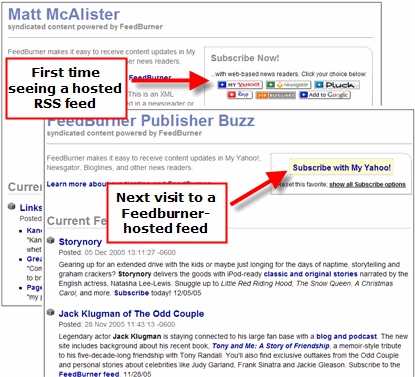 I see today that Feedburner is offering a new way to enable users to quickly and easily subscribe to RSS feeds.
When you click on a link to a feed hosted by Feedburner, the page now
shows several options for which feed reading environment you
want. The interesting new element is that they are saving this
preference for users, which means that next time I click on another
feed hosted by FeedBurner I will automatically see a link to subscribe
via my chosen reader. This action is also enabled for podcasts.
I see today that Feedburner is offering a new way to enable users to quickly and easily subscribe to RSS feeds.
When you click on a link to a feed hosted by Feedburner, the page now
shows several options for which feed reading environment you
want. The interesting new element is that they are saving this
preference for users, which means that next time I click on another
feed hosted by FeedBurner I will automatically see a link to subscribe
via my chosen reader. This action is also enabled for podcasts.
Feedburner continues to impress me with their innovations. The chiclet overload problem is not over yet, but the solution is working its way out with these kinds of UI improvements. There is obviously a race to provide publishers with the best solutions for distributing their RSS feeds. Focusing on making RSS invisible to users is the right direction, no doubt.
Speed to market is a winning strategy, too. In today's online game, staying competitive or jump-starting a market is about iterating ideas rather than producing robust, deeply engineered and fully tested solutions. Greg Linden questioned whether mashups were about giving big companies a way to outsource R&D for free.
While that may be partially true, have no doubt that the ambitions of many developers and small companies out there who are innovating quickly is to come up with a product or business model that becomes a big hit.
Feedburner isn't worried about being first to market and having their ideas stolen. They're trying to win.
Wednesday, December 7
Feedburner's new method for managing the RSS subscribe button problem
I see today that Feedburner is offering a new way to enable users to quickly and easily subscribe to RSS feeds.
When you click on a link to a feed hosted by Feedburner, the page now
shows several options for which feed reading environment you
want. The interesting new element is that they are saving this
preference for users, which means that next time I click on another
feed hosted by FeedBurner I will automatically see a link to subscribe
via my chosen reader. This action is also enabled for podcasts.Feedburner continues to impress me with their innovations. The chiclet overload problem is not over yet, but the solution is working its way out with these kinds of UI improvements. There is obviously a race to provide publishers with the best solutions for distributing their RSS feeds. Focusing on making RSS invisible to users is the right direction, no doubt.
Speed to market is a winning strategy, too. In today's online game, staying competitive or jump-starting a market is about iterating ideas rather than producing robust, deeply engineered and fully tested solutions. Greg Linden questioned whether mashups were about giving big companies a way to outsource R&D for free.
"They offer the APIs so people can build clever toys, the best of which
the company will grab -- thank you very much -- and develop further on
their own."
While that may be partially true, have no doubt that the ambitions of many developers and small companies out there who are innovating quickly is to come up with a product or business model that becomes a big hit.
Feedburner isn't worried about being first to market and having their ideas stolen. They're trying to win.