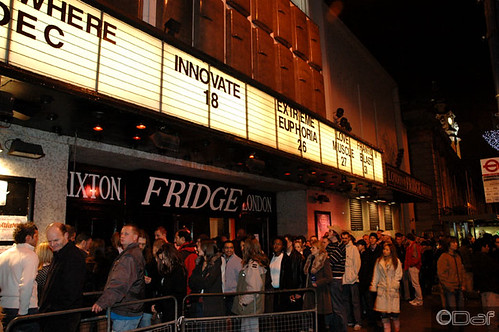
The liveblog was a revelation for us at the Guardian. The sports desk had been doing them for years experimenting with different styles, methods and tone. And then about 3 years ago the news desk started using them liberally to great effect.
I think it was Matt Wells who suggested that perhaps the liveblog was *the* network-native format for news. I think that’s nearly right…though it’s less the ‘format’ of a liveblog than the activity powering the page that demonstrates where news editing in a networked world is going.
It’s about orchestrating the streams of data flowing across the Internet into a compelling use in one form or another. One way to render that data is the liveblog. Another is a map with placemarks. Another is a RSS feed. A stream of tweets. Storify. Etc.
I’m not talking about Big Data for news. There is certainly a very hairy challenge in big data investigations and intelligent data visualizations to give meaning to complex statistics and databases. But this is different.
I’m talking about telling stories by playing DJ to the beat of human observation pumping across the network.
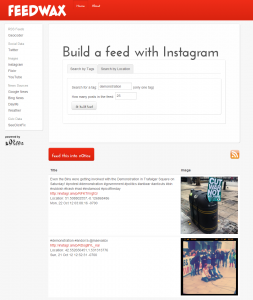
We’re working on one such experiment with a location-tagging tool we call FeedWax. It creates location-aware streams of data for you by looking across various media sources including Twitter, Instagram, YouTube, Google News, Daylife, etc.
The idea with FeedWax is to unify various types of data through shared contexts, beginning with location. These sources may only have a keyword to join them up or perhaps nothing at all, but when you add location they may begin sharing important meaning and relevance. The context of space and time is natural connective tissue, particularly when the words people use to describe something may vary.
We’ve been conducting experiments in orchestrated stream-based and map-based storytelling on n0tice for a while now. When you start crafting the inputs with tools like FeedWax you have what feels like a more frictionless mechanism for steering the flood of data that comes across Twitter, Instagram, Flickr, etc. into something interesting.
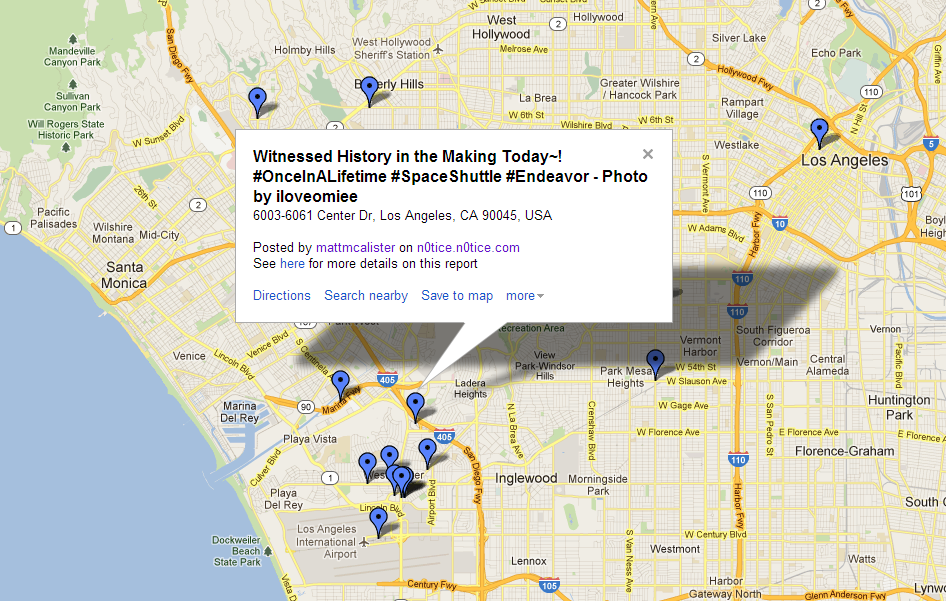
For example, when the space shuttle Endeavour flew its last flight and subsequently labored through the streets of LA there was no shortage of coverage from on-the-ground citizen reporters. I’d bet not one of them considered themselves a citizen reporter. They were just trying to get a photo of this awesome sight and share it, perhaps getting some acknowledgement in the process.
Interestingly, the location of the photos gives you a very clear picture of the flight path. This is crowdmapping without requiring that anyone do anything they wouldn’t already do. It’s orchestrating streams that already exist.
This behavior isn’t exclusive to on-the-ground reporting. I’ve got a list of similar types of activities in a blog post here which includes task-based reporting like the search for computer scientist Jim Gray, the use of Ushahidi during the Haiti earthquake, the Guardian’s MPs Expenses project, etc. It’s also interesting to see how people like Jon Udell approach this problem with other data streams out there such as event and venue calendars.
Sometimes people refer to the art of code and code-as-art. What I see in my mind when I hear people say that is a giant global canvas in the form of a connected network, rivers of different colored paints in the form of data streams, and a range of paint brushes and paint strokes in the form of software and hardware.
The savvy editors in today’s world are learning from and working with these artists, using their tools and techniques to tease out the right mix of streams to tell stories that people care about. There’s no lack of material or tools to work with. Becoming network-native sometimes just means looking at the world through a different lens.
We’ve had a sort of Hack Week at the Guardian, or “Discovery Week“. So, I took the opportunity to mess around with the n0tice API to test out some ideas about distributed reporting.
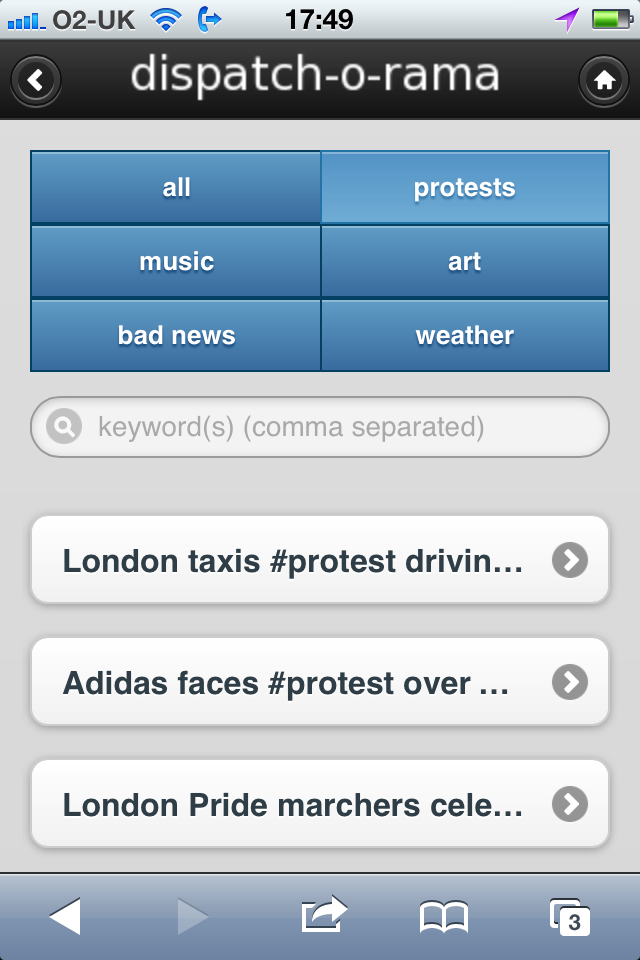
This is what it became (best if opened in a mobile web browser):
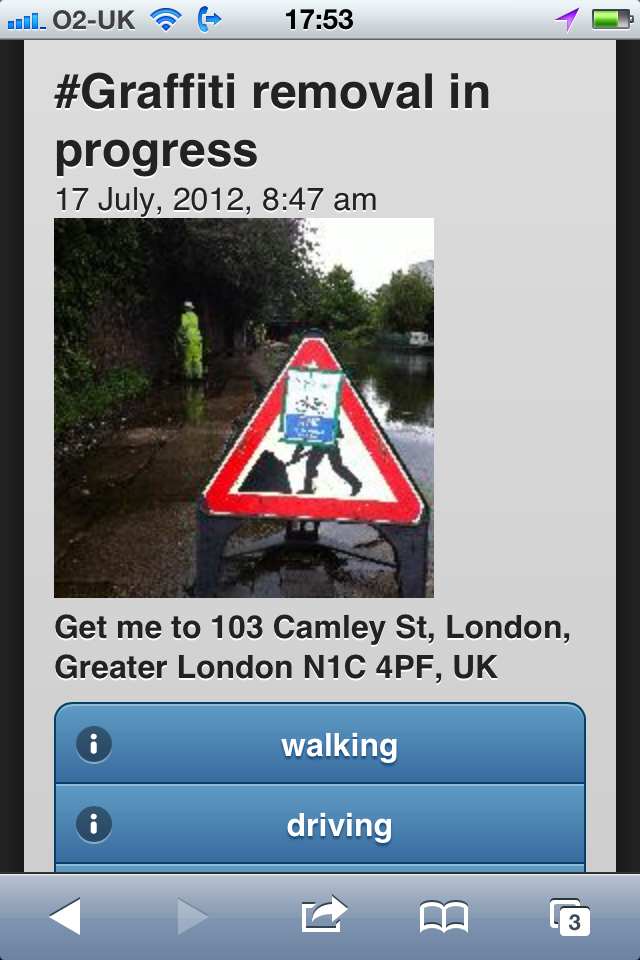
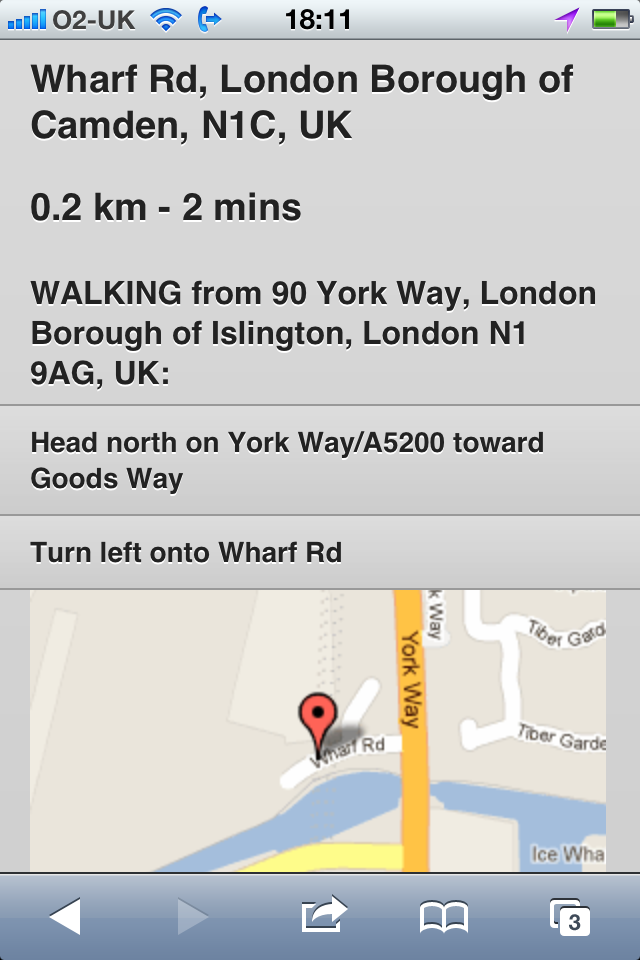
It’s a little web app that looks at your location and then helps you to quickly get to the scene of whatever nearby news events are happening right now.
The content is primarily coming from n0tice at the moment, but I’ve added some tweets with location data. I’ve looked at some geoRSS feeds, but I haven’t tackled that, yet. It should also include only things from the last 24 hours. Adding more feeds and tuning the timing will help it feel more ‘live’.
The concept here is another way of thinking about the impact of the binding effect of the digital and physical worlds. Being able to understand the signals coming out of networked media is increasingly important. By using the context that travels with bits of information to inform your physical reality you can be quicker to respond, more insightful about what’s going on and proactive in your participation, as a result.
I’m applying that idea to distributed news events here, things that might be happening in many places at once or a news event that is moving around.
In many ways, this little experiment is a response to the amazing effort of the Guardian’s Paul Lewis and several other brave reporters covering last year’s UK riots.
There were 2 surprises in doing this:
The twitter location-based tweets are really all over the place and not helpful. You really have to narrow your source list to known twitter accounts to get anything good, but that kind of defeats the purpose.
I haven’t done a ton of research, yet, but there seems to be a real lack of useful geoRSS feeds out there. What happened? Did the failure of RSS readers kill the geoRSS movement? What a shame. That needs to change.
After seeing Google’s “News near you” service announced on Friday I thought it was a good time to jump into the conversation and share what I’m up to. Â Clearly, there are a lot of people chasing the same or similar issues.
First, here’s some background. Â Then I’ll detail what it does, how it works, and what I hope it will become.
What is n0tice?
It began as a simple hack day project over a year ago. Â I was initially just curious about how location worked on the phone. Â At first I thought that was going to be beyond me, and then Simon Willison enlightened me to the location capabilites inherent in modern web browsers. There are many solutions published out there. Here’s one.
It took half a second from working out how to identify a user’s location to realizing that this feature could be handy for citizen reporters.
Around the same time there was a really interesting little game called noticin.gs going around which was built by Tom Taylor and Tom Armitage, two incredibly talented UK developers. Â The game rewarded people for being good at spotting interesting things in the world and capturing a photo of them.
Ushahidi was tackling emergency response reporting. And, of course, Foursquare was hitting its stride then, too.
These things were all capturing my imagination, and so I thought I would try something similar in the context of sharing news, events and listings in your community.
Photo by Roo Reynolds
However, I was quite busy with the Guardian’s Open Platform, as the team was moving everything out of beta, introducing some big new services and infusing it into the way we operate. Â I learned a lot doing that which has informed n0tice, too, but it was another 12 months before I could turn my attention back to this project. Â It doesn’t feel any less relevant today than it did then. It’s just a much more crowded market now.
What does n0tice do?
The service operates in two modes – reading and posting.
When you go to n0tice.com it will first detect whether or not you’re coming from a mobile device. Â It was designed for the iPhone first, but the desktop version is making it possible to integrate a lot of useful features, too.
(Lesson:  jQuery Mobile is amazing. It makes your mobile projects better faster. I wish I had used it from day one.)
It will then ask your permission to read your location. Â If you agree, it grabs your latitude and longitude, and it shows you what has been published to n0tice within a close radius.
(Lesson: It uses Google Maps and their geocoder to get the location out of the browser, but then it uses Yahoo!’s geo services to do some of the other lookups since I wanted to work with different types of location objects. Â This combination is clunky and probably a bad idea, but those tools are very robust.)
You can then zoom out or zoom in to see broader or more precise coverage.
Since it knows where you are already, it’s easy to post something you’ve seen near you, too. Â You can actually post without being logged in, but there are some social incentives to encourage logged in behavior.
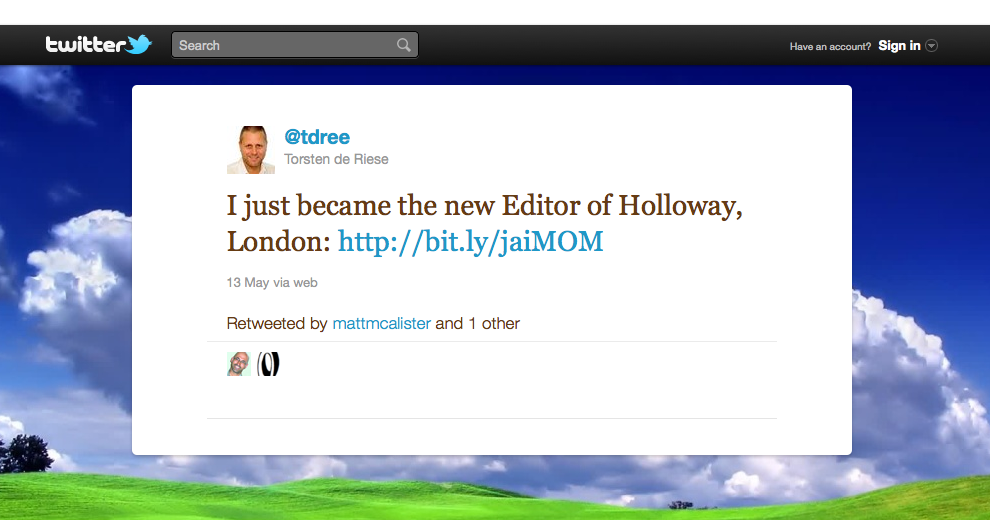
Like Foursquare’s Mayor analogy, n0tice has the ‘Editor’ badge.
The first person to post in a particular city becomes the Editor of that city. Â The Editor can then be ousted if someone completes more actions in the same city or region.
It was definitely a challenge working out how to make sensible game mechanics work, but it was even harder finding the right mix of neighborhood, city, country, lat/long coordinates so that the idea of an ‘Editor’ was consistent from place to place.
London and New York, for example, are much more complicated given the importance of the neighborhoods yet poorly defined boundaries for them.
(Lesson: Login is handled via Facebook. Their platform has improved a lot in the last 12 months and feels much more ‘give-and-take’ than just ‘take’ as it used to. Now, I’m not convinced that the activities in a person’s local community are going to join up naturally via the Facebook paradigm, so it needs to be used more as a quickstart for a new service like this one.)
The ‘Editor’ mechanics are going to need a lot more work. Â But what I like about the ‘Editor’ concept is that we can now start to endow more rights and priveleges upon each Editor when an area matures.
Perhaps Editors are the only ones who can delete posts. Perhaps they can promote important posts. Maybe they can even delegate authority to other participants or groups.
Of course, quality is always an issue with open communities. Having learned a few things about crowdsourcing activities at the Guardian now, there are some simple triggers in place that should make it easier to surface quality should the platform scale to a larger audience.
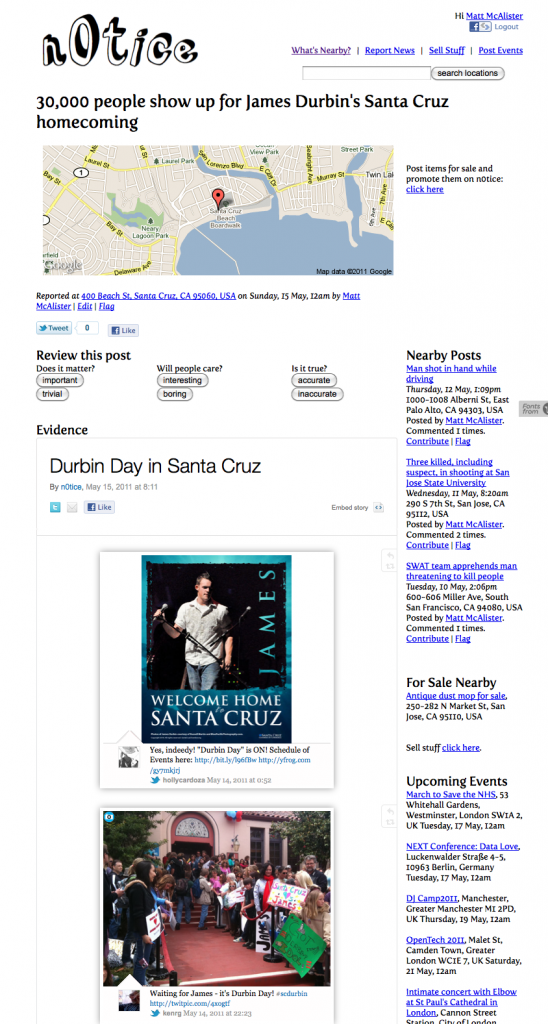
For example, rather than comments, n0tice accepts ‘Evidence’.
You can add a link to a story, post a photo, embed a video or even a storify feed that improve the post.
Also, the ratings aren’t merely positive/negative. Â They ask if something matters, if people will care, and if it’s accurate. That type of engagement may be expecting too much of the community, but I’m hopeful it will work.
Of course, all this additional level of interactivity is only available on the desktop version, as the mobile version is intended to serve just two very specific use cases:
getting a snapshot of what’s happening near you now
posting something you’ve seen quickly and easily
How will n0tice make money?
Since the service is a community notice board, it makes sense to use an advertising model that people already understand in that context: classifieds.
Anyone can list something on n0tice for free that they are trying to sell. Â Then they can buy featured promotional positions based on how large the area is in which they want their item to appear and for how long they want it to be seen there.
(Lesson: Integrating PayPal for payments took no time at all. Their APIs and documentation feel a little dated in some ways, but just as Facebook is fantastic as a quickstart tool for identity, PayPal is a brilliant quickstart for payments.)
Promotion on n0tice costs $1 per 1 mile radius per day. That’s in US dollars.
While still getting the word out and growing the community $1 will buy you a featured spot that lasts until more people come along and start buying up availability.
But there’s a lot we can do with this framework.
For example, I think it would make sense that a ‘Publisher’ role could be defined much like the ‘Editor’ for a region.
Perhaps a ‘Publisher’ could earn a percentage of every sale in a region. Â The ‘Publisher’ could either earn that privelege or license it from us.
I’m also hopeful that we can make some standard affiliate services possible for people who want to use the ad platform in other apps and web sites across the Internet. Â That will only really work if the platform is open.
How will it work for developers and partners?
The platform is open in every way.
There are both read and write APIs for it. Â The mobile and desktop versions are both using those APIs, in fact.
The read API can be used without a key at the moment, and the write API is not very complicated to use.
So, for example, here are the 10 most recent news reports with the ‘crime’ tag in machine-readable form:
The client code for the mobile version is posted on Github with an open license (we haven’t committed to which license, yet), though it is a few versions behind what is running on the live site. Â That will change at some point.
The idea in this approach to openness is that the value is in the network itself, the connections between things, the reputation people develop, the impact they have in their communities.
The data and the software are enablers that create and sustain the value. Â So the more widely used the data and software become the more valuable the network is for all the participants.
How scalable is the platform?
The user experience can scale globally given it is based on knowing latitude and longitude, something treated equally everywhere in the world. Â There are limitations with the lat/long model, but we have a lot of headroom before hitting those problems.
The architecture is pretty simple at the moment, really. Â There’s not much to speak of in terms of directed graphs and that kind of thing, yet. Â So the software, regardless of how badly written it is, which it most definitely is, could be rewritten rather quickly. Â I suspect that’s inevitable, actually.
The software environment is a standard LAMP stack hosted on Dreamhost which should be good enough for now. Â I’ve started hooking in things like Amazon’s CloudFront, but it’s not yet on EC2. Â That seems like a must at some point, too.
The APIs should also help with performance if we make them more cacheable.
The biggest performance/scalability problem I foresee will happen when the gaming mechanics start to matter more and the location and social graphs get bigger. Â It will certainly creak when lots of people are spending time doing things to build their reputation and acquire badges and socialize with other users.
If we do it right, we will learn from projects like WordPress and turn the platform into something that many people care about and contribute to. Â It would surely fail if we took the view that we can be the only source of creative ideas for this platform.
To be honest, though, I’m more worried about the dumb things like choking on curly quotes in users’ posts and accidentally losing users’ badges than I’m worried about scaling.
It also seems likely that the security model for n0tice is currently worse than the performance and scalability model. The platform is going to need some help from real professionals on that front, for sure.
What’s the philosophy driving it?
There’s most definitely an ideology fueling n0tice, but it would be an overstatement to say that the vision is leading what we’re doing at the moment.
In its current state, I’m just trying to see if we can create a new kind of mobile publishing environment that appeals to lots of people.
There’s enough meat to it already, though, that the features are very easy to line up against the mission of being an open community notice board.
Local UK community champion Will Perrin said it felt like a “floating cloud of data that follows you around without having to cleave to distribution or boundary.”
I really like that idea.
Taking a wider view, the larger strategic context that frames projects like this one and things like the Open Platform is about being Open and Connected. Â Recently, I’ve written about Generative Media Platforms and spoken about Collaborative Media. Â Those ideas are all informing the decisions behind n0tice.
My hope is that we can move n0tice from being a hack to becoming a new GMG business that supports the Guardian more broadly.
The support n0tice provides should come in two forms: 1) new approaches to open and collaborative journalism and 2) new revenue streams.
It’s also very useful to have living projects that demonstrate the most extreme examples of ‘Open and Connected‘ models. Â We need to be exploring things outside our core business that may point to the future in addition to moving our core efforts where we want to go.
We spend a lot of time thinking about openness and collaboration and the live web at the Guardian. Â If n0tice does nothing more than illustrate what the future might look like then it will be very helpful indeed.
However, the more I work on this the more I think it’s less a demo of the future and more a product of the present.
Like most of the innovations in social media, the hard work isn’t the technology or even the business model.
The most challenging aspect of any social media or SoLoMo platform is making it matter to real people who are going to make it come alive.
If that’s also true for n0tice, then the hard part is just about to begin.
* The hack was originally called ‘News Signals’. Â But after trying and failing to convince a few people that this was a good idea, including both technical people and potential users, such as my wife, I realized the name really mattered.
I’ve spent a lot of time thinking about generative media platforms, and the name needed to reflect that goal, something that spoke to the community’s behaviors through the network. It was supposed to be about people, not machines.
Now, of course, it’s hard to find a short domain name these days, but digits and dots and subdomains can make things more interesting and fun anyhow. Luckily, n0tice.com was available…that’s a zero for an ‘o’.
Jay Rosen has an interesting post on the failure of AssignmentZero, an effort to build a publicly funded crowdsourced news organization.
Among the many lessons, he keeps coming back to motivation and incentive.
“A well managed project correctly estimates what motivates people to join in, what the various rewards are for participants, and where the practical limits of their involvement lie.
…amateur production will never replace the system of paid correspondents. It only springs to life when people are motivated enough to self-assign and follow through.”
The idea wasn’t fundamentally broken, in my mind. Crowdsourced news is very powerful. As Derek Powazek said,
“At its best, crowdsourcing is about expanding the walls of the newsroom to the internet, giving an opportunity to people with real experience to share their expertise. This is a point that’s often lost on people who are just looking to make a quick buck on Web 2.0.”
More than anything else, I suspect that AssignmentZero failed because there weren’t any readers. Motivation wouldn’t have been a problem with a NYTimes-sized audience.
To date, I’ve never seen a better explanation of the motivations in collaborative online experiences than Yochai Benkler’s paper called Coase’s Penguin. One of my favorite excerpts from that is where he warns against paying for contributions from the community:
“An act of love drastically changes meaning when one person offers the other money at its end, and a dinner party guest who will take out a checkbook at the end of dinner instead of bringing flowers or a bottle of wine at the beginning will likely never be invited again.”
There are as many motivations as there are contributors in a shared media project. What holds them together is more art than science. Some of that art includes good timing and luck. But it also requires a unique kind of commitment and salesmanship from the leaders of the project.
I’ve begun to wonder if the tipping point happens when the confluence of the community size, the ROI to the contributors and the depth of the trust relationship with the company or the brand creates more value than the sum of the parts. Maybe the science of collaboration services can be found by quantifying the meaning of the relationships between those elements: size, cost, benefit and trust.
Or it could also be that the secret sauce inside the Craig Newmarks, Stewart Butterfields and Jimmy Waleses of the world is much more complicated and nuanced than anyone realizes.
The recent blog frenzy over hyperlocal media inspired me to have a look at Outside.in again.
It’s not just the high profile backers and the intense competitive set that make Outside.in worth a second look. There’s something very compelling in the way they are connecting data that seems like it matters.
My initial thought when it launched was that this idea had been done before too many times already. Topix.net appeared to be a dominant player in the local news space, not to mention similar but different kinds of local efforts at startups like Yelp and amongst all the big dotcoms.
And even from their strong position, Topix’s location-based news media aggregaton model was kind of, I don’t know, uninteresting. I’m not impressed with local media coverage these days, in general, so why would an aggregator of mediocre coverage be any more interesting than what I discover through my RSS reader?
But I think Outside.in starts to give some insight into how local media could be done right…how it could be more interesting and, more importantly, useful.
The light triggered for me when I read Jon Udell’s post on “the data finds the data”. He explains how data can be a vector through which otherwise unrelated people meet eachother, a theme that continues to resonate for me.
Media brands have traditionally been good at connecting the masses to eachother and to marketers. But the expectation of how directly people feel connected to other individuals by the media they share has changed.
Whereas the brand once provided a vector for connections, data has become the vehicle for people to meet people now. Zip code, for example, enables people to find people. So does marital status, date and time, school, music taste, work history. There are tons of data points that enable direct human-to-human discovery and interaction in ways that media brands could only accomplish in abstract ways in the past.
“On June 17 I bookmarked this item from Mike Caulfield… On June 19 I noticed that Jim Groom had responded to Mike’s post. Ten days later I noticed that Mike had become Jim’s new favorite blogger.
I don’t know whether Jim subscribes to my bookmark feed or not, but if he does, that would be the likely vector for this nice bit of manufactured serendipity. I’d been wanting to introduce Mike at KSC to Jim (and his innovative team) at UMW. It would be delightful to have accomplished that introduction by simply publishing a bookmark.”
Now, Outside.in allows me to post URLs much like one would do in Newsvine or Digg any number of other collaborative citizen media services. But Outside.in leverages the zip code data point as the topical vector rather than a set of predetermined one-size-fits-all categories. It then allows miscellaneous tagging to be the subservient navigational pivot.
Suddenly, I feel like I can have a real impact on the site if I submit something. If there’s anything near a critical mass of people in the 94107 zip code on Outside.in then it’s likely my neighbors will be influenced by my posts.
“They’ve built a platform that placebloggers can submit their content to. Their platform “tags” that content with a geocode — an address, zip code, or city — and that renders a new page for every location that has tagged content. If you visit outside.in/10010, you’ll find out what’s going on in the neigborhood around Union Square Ventures. If you visit outside.in/back_bay, you’ll see what’s going on in Boston’s Back Bay neighborhood.”
Again, the local online media model isn’t new. In fact, it’s old. CitySearch in the US and UpMyStreet in the UK proved years ago that a market does in fact exist in local media somehwere somehow, but the market always feels fragile and susceptible to ghost town syndrome.
“Why doesn’t Craigslist choose small towns? Because there isn’t enough liquidity in the market. Let me put that another way. In cities, there are enough buyers and sellers to make markets work – whether of used stuff, new stuff, events, etc, etc.
In smaller towns, there just isn’t enough supply or demand.”
If they commit to building essentially micro media brands based exclusively on location I suspect Outside.in will run itself into the ground spending money to establish critical mass in every neighborhood around the world.
Now that they have a nice micro media approach that seems to work they may need to start thinking about macro media. In order to reach the deep dark corners of the physical grid, they should connect people in larger contexts, too. Here’s an example of what I mean…
I’m remodeling the Potrero Hill shack we call a house right now. It’s all I talk about outside of work, actually. And I need to understand things like how to design a kitchen, ways to work through building permits, and who can supply materials and services locally for this job.
There must be kitchen design experts around the world I can learn from. Equally, I’m sure there is a guy around the corner from me who can give me some tips on local services. Will Architectural Digest or Home & Garden connect me to these different people? No. Will The San Francisco Chronicle connect us? No.
Craigslist won’t even connect us, because that site is so much about the transaction.
I need help both from people who can connect on my interest vector in addition to the more local geographic vector. Without fluid connections on both vectors, I’m no better off than I was with my handy RSS reader and my favorite search engine.
Looking at how they’ve decided to structure their data, it seems Outside.in could pull this off and connect my global affinities with my local activities pretty easily.
This post is way too long already (sorry), but it’s worth pointing out some of the other interesting things they’re doing if you care to read on.
Outside.in is also building automatic semantic links with the contributors’ own blogs. By including my zip code in a blog post, Outside.in automatically drinks up that post and adds it into the pool. They even re-tag my post with the correct geodata and offer GeoRSS feeds back out to the world.
“Any piece of content that is tagged with a zip code will be assigned to the corresponding area within outside.in’s system. You can include the zip code as either a tag or a category, depending on your blogging platform.”
I love this.
30Boxes does something similar where I can tell it to collect my Upcoming data, and it automatically imports events as I tag them in Upcoming.
They are also recognizing local contributors and shining light on them with prominant links. I can see who the key bloggers are in my area and perhaps even get a sense of which ones matter, not just who posts the most. I’m guessing they will apply the “people who like this contributor also like this contributor” type of logic to personalize the experience for visitors at some point.
Now what gets me really excited is to think about the ad model that could happen in this environment of machine-driven semantic relationships.
If they can identify relevant blog posts from local contributors, then I’m sure they could identify local coupons from good sources of coupon feeds.
Let’s say I’m the national Ace Hardware marketing guy, and I publish a feed of coupons. I might be able to empower all my local Ace franchises and affiliates to publish their own coupons for their own areas and get highly relevant distribution on Outside.in. Or I could also run a national coupon feed with zip code tags cooked into each item.
To Umair’s point, that kind of marketing will only pay off in major metros where the markets are stronger.
To help address the inventory problem, Outside.in could then offer to sell ad inventory on their contributors’ web sites. As an Outside.in contributor, I would happily run Center Hardware coupons, my local Ace affiliate, on my blog posts that talk about my remodelling project if someone gave them to me in some automated way.
If they do something like this then they will be able to serve both the major metros and the smaller hot spots that you can never predict will grow. Plus, the incentives for the individuals in the smaller communities start feeding the wider ecosystem that lives on the Outside.in platform.
Outside.in would be pushing leverage out to the edge both in terms of participation as they already do and in terms of revenue generation, a fantastic combination of forces that few media companies have figured out, yet.
I realize there are lots of ‘what ifs’ in this assessment. The company has a lot of work to do before they breakthrough, and none of it is easy. The good news for them is that they have something pretty solid that works today despite a crowded market.
Regardless, knowing Fred Wilson, Esther Dyson, John Seely Brown and Steven Berlin Johnson are behind it, among others, no doubt they are going to be one to watch.
“What would motivate you to contribute to a citizen media site?”
I can’t imagine that anyone is going to be able to answer that question in an interesting way. It’s the wrong question. It’s kind of like asking why do people sing at church? Or why do people meet their friends at the pub?
If the church asks you to sing, you sing. If your friends tell you to meet at the pub, you go to the pub. The community and purpose of doing things together is already implied, so you do whatever everyone else in that community does if you want to be a part of it.
Jon Udell starts to dig into the critical mass hurdles for social networks in a recent post where he quotes Gary McGraw saying:
“People keep asking me to join the LinkedIn network, but I’m already part of a network. It’s called the Internet.”
The real question is not about getting people to do things. There are too many things to do and too many people to socialize with in a day already.
The question is about forming meaningful communities and the kinds of things that will help a community flourish. Meaning comes in millions of different shapes and sizes, but there are lots of precedents in terms of ideologies, aesthetics, and methods.
News, for example, is inherently about being first to report on an event. Successful community-based news sites enable people who care enough about a topic to either be the first to report on it or be clued in before less speedy outlets pick up on something. It feeds into a competitive and sometimes gossipy human nature. Just ask your best reporters why they became reporters. Digg appeals to the reporter in all of us.
I used to attend a charity event called Rebuilding Together where groups of people would assemble and fix up houses and schools around the city of San Francisco. There was a core team who selected applications for fix-it team deployments. Then there was a leader who would drive the work to be done by each team at each site. On the chosen date, people would jump on a project and invite their friends to join. It was impressive to see what a focused group could accomplish in a day, fixing plumbing, painting, cleaning, rebuilding fences, etc.
Why did people do it?
There was a purpose. We were helping people truly in need. The commitment was lightweight. It was 1 day a year. It was well organized. I didn’t have to debate with people about how things should be done. The result was impactful, a total overhaul of a building. It was fun. I had a laugh with my friends and met new people.
Often when people start asking how you get to critical mass, they’re losing the plot. Sure, it would be great to worry about scaling a site rather than fighting for a Digg. But if you and your community are doing something unique and valuable, then size really shouldn’t matter. And in many cases, it makes sense to make the community exclusive and smaller rather than bigger and diluted, anyhow.
The question then becomes, “Are you offering a service that a lot of people find unique and valuable?”
I think a lot of publishers fail to understand the size of a potential market, what’s unique about an offering, and the value of that offering to the people who do actually care about it.
Then there’s also the issue of recognizing what you can actually deliver. You have to play to your strengths.
Yahoo! Answers is a good example of that. The idea of getting immediate answers to any question you can think of from real humans is outrageously ambitious. There are lots of ways to get answers to questions out there. But Yahoo! played to its strengths to get it off the ground, then it just took off. It’s easy. It’s fun. It works. And, therefore, it’s meaningful. And now there’s nothing like it out there anywhere.
Of course, not everybody can point a firehose of traffic at a domain, but there are plenty of cases where Yahoo! failed to create a community by pointing a firehose of traffic at it.
So, what makes a meaningful community that has a definitive purpose? Yeah, well, that’s an answer you can get from Cameron Marlow, danah boyd, and a lot of people a lot smarter than me.
Though perhaps this is all just echo blogging and the real question gets to something people already understand. Maybe the question is simply: “How do you make membership in your community desirable?”
A privilege—etymologically “private law” or law relating to a specific individual—is an honour, or permissive activity granted by another person or a government. A privilege is not a right and in some cases can be revoked.
I think the answer is in there somewhere for everyone who is struggling to get their community to do stuff.
I find it a bit presumptuous that someone would try to end a discussion on a topic in the blogosphere or, for that matter, assume that they drive a conversation in the market.
In an attempt to stop people blabbing endlessly about bloggerism vs journalism, Steven Berlin Johnson redefined the 5 points of the debate, recapping Jay Rosen’s closing arguments on the topic from over a year ago. His post was a response to Nichalos Lehmann’s article Amateur Hour — Journalism without journalists in The New Yorker questioning the value of blogging:
“Jay Rosen tried to kill off this kind of discussion a year or two ago with his smart essay, Bloggers Versus Journalists Is Over, but obviously it didn’t stick. So let me propose a slightly more blunt approach.”
“Any form that consists, chiefly, of commentary and criticism is derivative. We need derivative media sources to help us make sense of what we learn from primary sources.
…although it maybe possible for some bloggers to think of their thoughts as rising, fully formed, from the blogosphere, it just ain’t so. Even people who do not think of themselves as being influenced by the agenda of traditional media actually are: they are simply influenced by someone who is influenced by someone who is influenced by old media.”
“What we do has great value, but we no longer have a monopoly on leading the public conversation (not that we ever did, of course, but it was easier to delude ourselves before). The blogosphere doesn’t need us to give them something to talk about. When we do what we do well and add new ideas, information and analysis, blogs can be our best friend, amplifying our reach many-fold. But when we don’t, the former audience is very happy to talk amongst itself.”
There’s a bit of chicken and egg here, as I’m not sure it’s clear whose work is derivitive of whose.
A good reporter is a story teller of other people’s experiences. Nothing in the Wall Street Journal happens because the Wall Street Journal said it did. A good media company like the Wall Street Journal is able to catalyze important events and thinking happening in interesting places into meaningful and valuable chunks with a consistent lens, and there’s no doubt the Wall Street Journal influences what people think about.
But that role in not exclusive, even when their coverage of a topic is considered the best in its class or costs a ton of money or takes a lot of research to get right.
The conversations the Wall Street Journal covers are reflections of conversations that in many cases started years prior, and it’s not until the topic reaches some kind of tipping point does the Wall Street Journal then translate it for their lens of the world.
I would never deny being influenced by mainstream media. But that’s more a result of the fact that I have shared experiences with people than because the influence is meaningful or relevant. In fact, it becomes less and less relevant the more my media experience diversifies.
I agree with Steven that this particular topic lacks the juice it used to have. Jay Rosen has done a brilliant job of turning the discourse into a cohesive string that matters and feels complete from my personal perspective and obviously for Steven’s.
But closure for us may also mean it’s time for some fresh perspective to alter the dialog or extend it in sensible ways for other people yet untouched by it or confirm the premise of the argument with more useful research.
The effects of disintermediating media are still unfolding, and I’m betting that leaders at most big media companies will get more clarity on how to deal with that problem from each other and the individuals they know at competing companies or even their neighbors than they will from reading about it in their own publications.
Several people have complained about the quality of the content that comes out of a site like Digg, a site that captures popular consensus to reflect back to its participants what matters at any given moment.
I actually agree with these people but for entirely different reasons than most of them. There are few things in this world more important than giving people platforms for speaking their mind and being heard, and there’s something valuable to take away from every individual. But ranking voices based on popularity ultimately creates the opposite of empowerment.
Competition is a fantastic incentive to evolve. I’d argue most of the critical commentary of citizen journalism is positioning by the people who have more to lose from the success of commons-based journalism than they care to admit. The argument is largely protectionist fear of a populist attack on mainstream media. They aren’t competitive, and they know it.
The real problem with popularity-driven models is not the existence of reporting that hasn’t been vetted or the increasingly fuzzy lines between perspective and truth. The real problem with popularity-driven models is that they reduce both the breadth and depth of the sources, topics and viewpoints being expressed across a community.
Popularity-driven models water down the value in those hard-to-find nuggets. They normalize coverage and create new power structures that interesting things have to fight through.
Slashdot requires that a participant build a level of karma high enough to breakthrough the controlling moderator hierarchy. Digg removes many of the layers that close Slashdot from wider participation, but it also creates its own power structure as the core voters develop an unwritten etiquette for reducing the noise.
Our current advertising models reinforce the popularity-driven systems and reward the sites that can win the most traffic over those that may actually provide more meaning. The more popular your articles are, the more ad inventory you create. The more inventory you create, the more revenue you can capture.
Rather than broadcast what a few people think matters, the Internet should be used to help people help other people discover and find what matters. Personalized recommendation engines and social networks have fantastic potential because they are learning how to surface relevance in ways that have real meaning without the filter of the popularity overlords or gameable search algorhythms.
And advertisers should begin rewarding sites that capture the right customers at the right time with higher rates. They should value media based on the how well the vehicle initiates movement of the right kind of customer at the right point down the marketing funnel rather than by the volume of touch points.
“Good Night and Good Luck,” the recent film about Edward R. Murrow’s battle with Senator McCarthy challenged the television industry to rethink the value of the medium to society. Murrow’s speech in the beginning of the film is a harsh criticism of broadcast-style media:
“We have a built in allergy to unpleasant or disturbing information. Our mass media reflect this. But unless we get up off our fat surplusses and recognize that television in the main is being used to distract, delude, amuse and insulate us, then television and those who finance it, those who look at it, and those who work at it may see a totally different picture too late.”
He then goes on to fault popular opinion for allowing McCarthy to frighten everyone with his tactics:
“[Senator McCarthy] didn’t create this situation of fear. He merely exploited it and rather successfully. Casius was right. ‘The fault, dear Brutus, is not in our stars but in ourselves.'”
Finally, Murrow has to confront the station management and their desire to maintain strong sponsor relationships. His boss apologetically demotes Murrow:
“‘$64,000 Quesion’ brings in over $80,000 in sponsors and it costs one third of what you do. I’ve got Tuesday night programming that’s number one. People want to enjoiy themselves. They don’t want a civics lesson….I never censored a single program. I never said ‘no’ to you. Never.”
Murrow replies:
“I would argue that never saying ‘no’ is not the same as not censoring.”
I’m not saying popularity isn’t important. What other people think matters profoundly. It’s the root of being a social creature. And anyone who creates would be lying to you if they claimed they weren’t hopeful that what they create becomes popular.
The method for finding and consuming what’s popular, however, shouldn’t be controlled by dynamics that value what’s entertaining at the expense of what matters.




 There must be kitchen design experts around the world I can learn from. Equally, I’m sure there is a guy around the corner from me who can give me some tips on local services. Will Architectural Digest or Home & Garden connect me to these different people? No. Will The San Francisco Chronicle connect us? No.

 I used to attend a charity event called