Why agent-native companies will be built like the harnesses they sell.
A lot of things change when everyone has an entire firm at their fingertips. I’m reminded of Ronald Coase’s concepts of why companies exist and Yochai Benkler’s riff on that theme. Companies exist because of the friction in markets, and they form collaboration spaces within firms and between them to grow in new ways. The Internet’s open collaboration model had the same effect, and it effectively created new categories of entities – Wikipedia, Craigslist, Linux, among others.
If we have a near-limitless supply of super geniuses at our beck and call who we can delegate work to, and they are able to communicate seamlessly with one another and with other people’s super geniuses then the whole nature of the firm changes yet again. What new forms of market activity will result?
It’s easy to imagine that the AI workforces at our disposal will take the shape of something familiar, like a mini company with subsets of agents acting like departments. Whether that forms a pyramid, hub-and-spoke, mesh or some network topology-like structure will depend on the activity and what the agents determine to be the most efficient way to achieve the task. Given the outcome will be how they are measured, the task will be how they are optimized, just like a company.
What will agent-native companies look like?
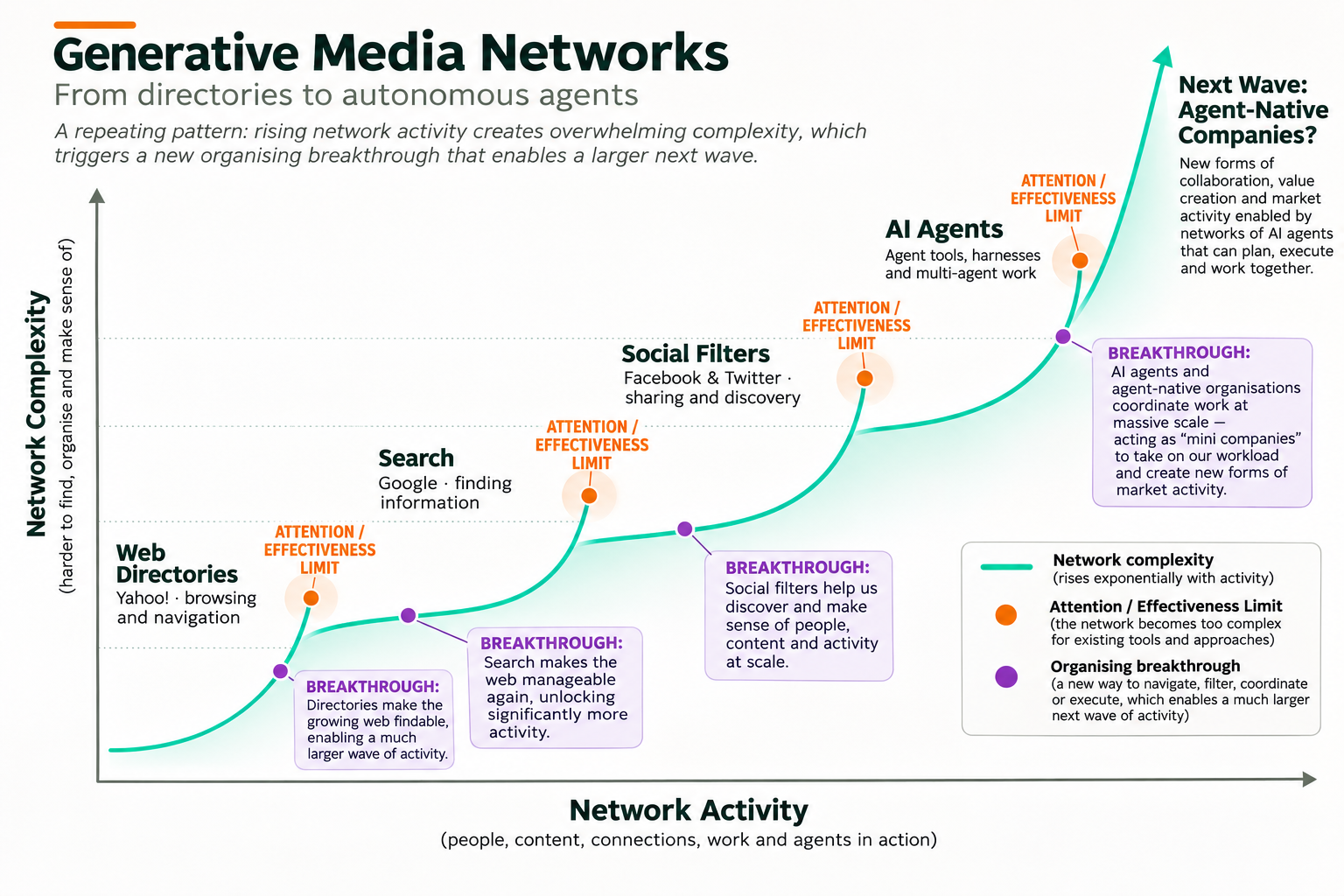
We saw a few different forms of Internet-native firms evolve in the past that may point to how AI-native orgs will arise. I argued in the past that breakthroughs happen when activity levels and complexity become unmanageable.
The same market trend may apply here, too.
We’re seeing a lot of specialist AI-native products and services built from a shared set of features, often packaged as a “harness”. A harness is the scaffolding around an AI model that turns it from something you chat with into something that does work. It gives the model tools it can use, memory and context about you and your business, instructions for how to behave, and a loop that lets it plan, act, check its results and try again. In these products, the harness is the engagement layer on top of a unique data set, tuned to reach some objective. In other words, they take on your workload and do it for you.
I suspect that means we’re all going to be doing a lot more work or rather triggering agents to do a lot more on our behalf. It’s Jevons paradox. When something gets cheaper to do, we do more of it, not less.

It’s not quite the same but one of my favorite lines in The Good Place was when Michael discovered frozen yogurt and said, “There’s something so human about taking something great and ruining it a little so you can have more of it.”
We’ll have more and more tools to send more and more agents out to do more and more stuff. That’s the wave we’re in right now. It’s good to be in the tools and agent management business as the market starts to flood. The current game is figuring out how to move from the one-agent call-and-response dynamic to full swarm deployment in a way that’s cost-effective and easy to manage.
That change will accelerate the activity across the network and, as a result, create a lot of complexity. It will be fun, but it will get messy, too. And that’s where the next opportunity will be.
Those who are able to make sense of the activity, to hone a position where the contexts, the workflows, and the outcomes are able to synthesize the activity into something actually valuable will be the winners.
What kind of company is going to be able to do that?
The “harness” is probably the right product bet. But how you operate matters just as much, and the operating model probably needs to mirror the product. As Marshall McLuhan famously observed, the medium is the message, and I’m suggesting that when agents are working on behalf of everyone in the organization that the organization is the message. A company selling agent-native work has to be agent-native itself. Otherwise the product will always feel like it was built by people who don’t use it.
In practice, that means the company has to have the same parts as the harness. It needs tools, including ways for teams to automate more of their own work, not to cut costs but because the automation gets better the more the system uses itself. It needs memory, a shared knowledge base that’s kept clean and current, because without it agents have to learn everything about everything before they even start a job. A tidy memory will get them up to speed instantly. It needs context, meaning the company’s own data must be easy to manage, update and share internally plus a clear line of input from customers flowing straight into the system, so the context reflects what the company knows and what customers want in real time. It needs instructions, a strategy written down clearly enough that people and agents can act on it without a meeting. And it needs the loop. A heartbeat of monitors watches the activity, notices when something changes, sends agents or people out to deal with it and checks whether it worked. Then it feeds what it learned back into the system, so everything operating within the company learns from everything else.
In other words, the company itself becomes a harness. There’s an old rule in software called Conway’s Law where organizations end up shipping their org chart. The agent-native version runs the other way. You design the org to look like the product you want to ship, and the companies that win the next wave will be the ones where the org chart and the product architecture are basically the same diagram.
There’s a nice symmetry in that. The agents start organizing themselves like little companies, and the companies start organizing themselves like the agents’ harness.
Which brings me back to Coase. Firms exist because going to the market for everything is expensive. Finding the right people, negotiating with them, coordinating the work and checking it all cost something, and a company is a way to pay those costs once instead of every time. Agents push those costs toward zero. When my agents can find, brief and coordinate with your agents in seconds, a lot of what used to need a company can happen out in the open market. Firm boundaries get blurry, and probably smaller.
So what’s left inside the boundary? Not the labor, which becomes abundant and rentable. Not the tools, since everyone has access to roughly the same models. What’s left is what the harness is made of: the memory, the context, the instructions and the loop. That’s the part nobody else’s agents can rent, because it only exists as a result of the work you’ve done and what you learned doing it. It may also be where Benkler’s commons-based peer production shows up this time, creating new interoperable entities: harnesses that choose to share their memory and loops across organizations the way Wikipedia and Linux pooled people’s contributions.
Agents won’t make the firm disappear. They’ll reshape it to form the structures that remember, learn and get better every time it runs. That part is the firm.
Leave a Reply